Contexte
"You also like memory. Micron you know earlier today Micron was 924 now starting to rally higher. Buyers are starting to buy this weakness here. Why do you like it?"
you think maybe there's potential here for momentum and networking to continue to rock and roll like this
Contexte
"You also like momentum you know I talked about this earlier uh in the show and the A block up like a thousand% in the last five years and still you think maybe there's potential here for momentum and networking to continue to rock and roll like this."
Transcription Complète
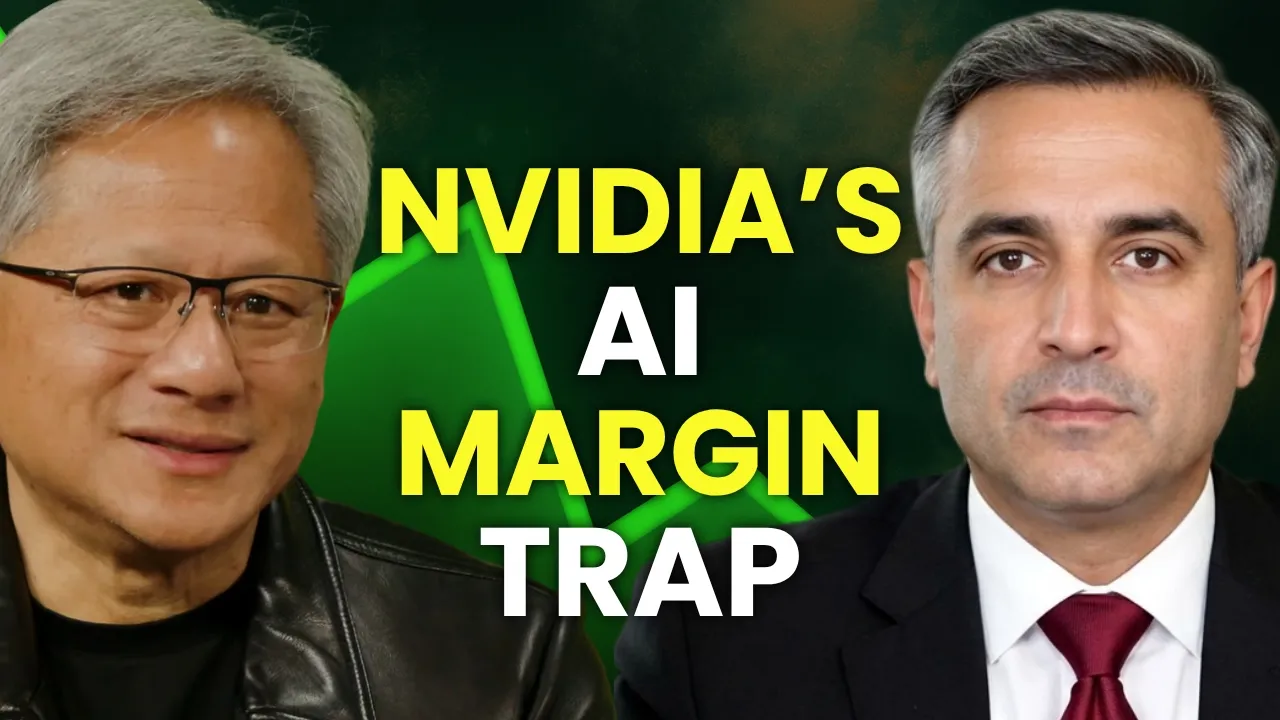
Nvidia's 1200% revenue surge over four years has made it the undisputed heavyweight of the artificial intelligence market. But a massive debate is brewing over whether its sky-high margins can survive rising supply chain costs. Recently on Fox Business, host Charles Payne sat down with Beth Kindig, CEO of the IO Fund, to unpack Nvidia's massive economic footprint just ahead of its highly anticipated earnings release. By the end of this video breakdown, you will know exactly why Nvidia is shifting from a simple hardware play into a complete sovereign economy and how competitors and key infrastructure providers are positioning themselves to capture the next wave of spending. >> Nvidia financials being released after the close. This is a juggernaut, an absolute revenue juggernaut. Revenues up more than,200% in the past four years alone. I want to bring in now IO fund CEO and lead tech analyst Beth Kind. Beth, uh, you know, nobody disputes Nvidia as a money-making machine, but obviously the big concern out there revolves around circular financing. Uh, Morgan Morgan Stanley says the company must qualify quantify rather, you know, these these liabilities, right? We in other words, we know they want to have control over their supply and the power and the models and demand, but is it worth the tradeoff? >> Hi, Charles. So good to see you. What I would say is that Nvidia is really an economy at this point. Uh you know it's contributing heavily to GDP. AI is at this point and then when you break down how much of AI funnels into Nvidia 2/3 of AI around twothirds of AI is going to Nvidia. So we're really looking at an economy here. We're not really looking at just a product and just a company. And I think everyone needs to reimagine what that means not only for the United States but for the overall AI industry uh when when one company is really supporting this economy. >> Well, you know, it does it kind of does hearkens back to the to to you know, you see these charts on how much we invested in canals and then how much we invested in rails, then how much we invested into the internet. And and there's no doubt humankind mankind did well, United States did well. But from an investor's perspective, uh, and someone who wants to say, okay, Nvidia, you know, was a great stock, has been a juggernaut for a long time. Can a stock itself still enjoy, you know, a potential upside, >> what I would look for in potential upside with Nvidia is look for manage management to outgineer constraints. So when it comes to constraints, for example, something like energy, um you have a fixed power envelope. Ways that Nvidia can continue to raise prices and continue to grow its stock is they will simply do more within that power envelope. They will help companies produce more tokens, more revenue with one gigawatt of power. Um there are many ways that Nvidia can outenineer the constraints that the AI industry faces and that is the way that Nvidia will continue to to to continue to climb as a stock. >> So over the weekend I was reading about them raising their prices. You know they're rolling out this ver Ruben uh and and I was reading your note that says more important necess than the revenue are these are their profit margins. Uh and I I think they're going to cut back a little bit maybe on memory. Is that all part of you know maintaining those hefty margins? Yes. So, the first thing the street will want to see is that Nvidia can maintain revenue. And I would say that Nvidia can maintain revenue. I can't think of another company that can raise prices while losing market share quite like Nvidia. Um, but at the same time, Charles, I'm sure you've covered so much on your show that memory prices are surging. Um, we have advanced packaging that is surging uh in terms of pricing and then content, networking content is also increasing. Um that means the bill of materials is just growing and where that will make the biggest impact is Nvidia's margins. We could be seeing peak gross margin for Nvidia, but we could give the company some credit. Their gross margins are pretty big right now. They could probably afford to lose a couple of points. >> All right. Hey, >> I did read though that you like right now you like AMD better than Nvidia. Why? >> I would say that AMD has not only one catalyst, but it's it actually has two catalysts. Um, so it's ramping a new generation of CPUs at the same time that they're ramping a new generation of GPUs. That is a powerful combination. Um, this is the first time that AMD can compete with Nvidia at the full rack level and that's important. >> Uh, I did read somewhere though that eventually Nvidia could be a CPU leader. >> Oh yes, absolutely. Nvidia will be a CPU leader. Um, it's really that AMD will drive down prices. uh they will try to undercut right >> Nvidia on pricing and and that's where they will go headtohead. >> Uh you know you mentioned uh uh we talked about memory a moment ago. I know you like memory. Micron you know earlier today Micron was 924 now starting to rally higher. Buyers are starting to buy this weakness here. Why do you like it? >> Yeah I mean I hear a lot about a cyclical top. Um I just have a really hard time imagining that memory is topping while inference is in such early stages. um those two are quite aligned and so inference would have to be much further into um its market and much further um into its roll out compared to memory topping now that it just doesn't make any sense. >> You also like momentum you know I talked about this earlier uh in the show and the A block up like a thousand% in the last five years and still you think maybe there's potential here for momentum and networking to continue to rock and roll like this. Yeah, I guess the way to put it, Charles, is that the way the AI cluster um the larger an AI cluster becomes, the harder it is to move the data. Um and that's why optics can actually grow faster than total GPU count. Um so for that reason, Lumenum is not a one product story. Um as optics move closer to GPUs um next year and Lummen will have multiple products, multiple ways to participate. I know you're also looking at the uh at this cyber security space as well. Uh going to invite you back. Uh one thing I'd love to do is to get your p perspective ahead of these numbers particularly Nvidia. Let's come back tomorrow after this number and talk about what they got right, what maybe they didn't get right. Beth Charles Payne wasted no time jumping into the most controversial financial cloud hanging over Nvidia, ticker symbol NVDA, asking about the looming spectre of circular financing. It is a complex term for a relatively simple yet risky practice. A giant tech company invests capital into a smaller artificial intelligence cloud provider and that provider immediately uses those funds to buy the giant's chips. This creates an immediate revenue boost on paper, but critics worry it creates an artificial demand loop. Charles pointed to reports from Morgan Stanley suggesting that Nvidia needs to clearly quantify these liabilities. He asked Beth Kindig point blank, "Is the massive control Nvidia gains over the supply chain and model demand actually worth this complex financial trade-off?" Beth's response shifted the entire frame of the debate, arguing that Nvidia has grown so large and so dominant that it is no longer just a company, but an economy unto itself. She pointed out that about 2/3 of all global investment in artificial intelligence currently funnels directly into Nvidia, making the company a massive contributor to overall gross domestic product. In her view, trying to analyze Nvidia through the lens of a traditional tech company misses the point entirely. Instead, she compared Nvidia to a sovereign state, an entity whose capital flows are so massive they dictate the health of the entire technology sector. When a single company commands that much of the global tech budget, its product roadmap ceases to be just corporate strategy and becomes macroeconomic policy. This sovereign status is precisely why Charles Payne pushed back on the sustainability of the current cycle. If Nvidia is indeed acting like an economy, it is an economy heavily dependent on a very small group of massive buyers. Charles pointed out that the capital expenditures of just four or five hyperscalers are keeping the entire AI thesis afloat. If those tech giants do not see a clear profitable return on their massive infrastructure investments, they will eventually have to scale back. And if they scale back, the entire Nvidia economy faces a dramatic demand shock. My take on this tension is that both perspectives carry deep truth, but they are operating on different timelines. In the immediate term, Beth is correct that the momentum is too powerful to ignore. The hyperscalers are caught in a classic prisoners dilemma. If Microsoft, ticker symbol MSFT, slows down its capital spending to protect short-term margins, it risks falling behind Alphabet, ticker symbol GGL, in the race to develop next generation foundational models. The cost of losing the AI race is existential for these firms, which means they will continue to buy Nvidia's chips even if the immediate return on investment remains speculative. But let's look at the actual numbers behind this sovereign economy. Last quarter, Nvidia's networking business alone generated more revenue than many legacy semiconductor companies make across their entire product portfolios. We are no longer just talking about graphics cards. We are talking about the entire fabric of the modern data center. This brings us to the software moat that Beth Kindig frequently highlights as Nvidia's ultimate insurance policy. When people look at Nvidia's 78% gross margins, they often assume a competitor like Advanced Micro Devices, ticker symbol AMD, can simply build a comparable chip for a lower price, and steal market share. But hardware is only half the battle. For nearly two decades, Nvidia has been quietly building and refining CUDA, its proprietary software platform that allows developers to program GPU and Appos S directly. If you've made it this far, you're my kind of viewer. So like the video and subscribe to the channel and stick with me. CUDA has become the industry standard for AI research and development. Every major machine learning framework, every library and every enterprise model is optimized to run on CUDA. If an enterprise wants to switch to a competitor's hardware, they cannot just swap out the chips. They have to rewrite millions of lines of proprietary code, retrain their engineering teams, and risk software instability. That is a massive friction point that keeps developers locked into the Nvidia ecosystem regardless of how cheap or fast Rival Silicon claims to be. But a structural shift is coming and it represents the first major open loop we need to track. The transition to Nvidia's new Blackwell architecture. Wall Street has been pricing in massive revenue gains from this new chip family. But the engineering complexity of Blackwell is introducing unprecedented supply chain pressures. To understand the Blackwell challenge, you have to look at how these advanced chips are actually manufactured. Nvidia does not own its own fabrication plants. It designs the silicon and hands those designs over to Taiwan semiconductor manufacturing company, ticker symbol TSM. Blackwell is not just a single chip. It is a massive system that packages two separate silicon dyes together, connecting them with an ultraast interface and packing them alongside high bandwidth memory. This design requires an incredibly complex manufacturing process known as chip on wafer on substrate or co-ws. The packaging capacity for co-was is the primary bottleneck in the entire AI hardware industry. TSMC is working around the clock to expand this capacity, but they hold immense pricing power in this relationship. Because Nvidia has no viable alternative for high-end foundry services, TSMC can raise its manufacturing prices to capture a larger share of the AI profit pool. This is where the margin compression debate becomes critical. As Blackwell begins to ship in volume, Nvidia's gross margins are widely expected to dip from their historic highs in the upper 70% range down to the mid 70% range. While some analysts view this as a temporary manufacturing yield issue, my take is that it exposes a long-term vulnerability. Nvidia may be the sovereign king of AI software and design, but TSMC is the gatekeeper of the actual physical hardware. Does this mean the Nvidia bull run is nearing its end? Not necessarily, especially when you consider a massive untapped demand driver that Beth raised during the broadcast, the rise of sovereign AI. Up to this point, the primary buyers of Nvidia GPU and APOS have been American technology giants and venture-backed startups in Silicon Valley. But nation states around the world are starting to realize that artificial intelligence is too critical to be outsourced entirely to US-based cloud platforms. Countries like Japan, France, Canada, Singapore, and India are actively funding their own localized AI infrastructure. They want models trained on their own cultural data, respecting their own local laws, and running on servers physically located within their borders. This sovereign AI movement completely changes the demand dynamic for Nvidia. These government-backed initiatives are not driven by the same short-term profit and loss metrics as a venture-funded startup. a sovereign nation building national defense models or localized public services will buy GPU and appos. It's because they view it as a national security imperative. This creates a highly diversified politically insulated customer base that can help absorb any potential slowdown in spending from US hyperscalers. Yet, even with sovereign buyers entering the market, the long-term competitive threat is shifting from traditional chip rivals to Nvidia's own largest customers. While Microsoft, Google, and Amazon continue to buy billions of dollars worth of NVIDIA hardware, they are simultaneously pouring massive resources into developing their own custom silicon. These custom chips, often referred to as applicationspecific integrated circuits, or AS6, are designed for highly specific workloads. Google's tensor processing units have been running their internal AI systems for years, and Amazon's tranium and inferentia chips are becoming increasingly popular choices for AWS customers looking to cut costs. Think about the economics of this transition. If you are a cloud provider spending tens of billions of dollars a year on third party silicon, the incentive to vertically integrate is overwhelming. Every dollar you spend on custom silicon is a dollar you do not have to pay in Nvidia's massive margin markup. Where I land on this threat is that the battleground is shifting from training to inference. Training a massive foundational model requires the absolute peak performance, raw scale, and software flexibility of NVIDIA's top tier GPU and AppOs. But once a model is trained, running it daytoday, a process called inference requires far less computing horsepower. Inference is all about energy efficiency, latency, and cost per query. This is where custom AS6 have a major advantage. They can be optimized to run specific models incredibly efficiently without the premium price tag of a generalpurpose NVIDIA GPU. As the AI market matures, the ratio of spending will inevitably shift from training new models to running existing ones. If Nvidia cannot dominate the inference market the way it has dominated training, its long-term revenue growth will face a severe headwind. To close our open loop on Blackwell's margins, the near-term dip we are likely to see in upcoming quarters is a classic manufacturing yield curve issue. As production matures and TSMC's packaging capacity increases, Nvidia will likely optimize its yields and stabilize its gross margins. But the broader structural pressure from rising foundry costs and custom big tech silicon will remain a persistent drag on profitability over the next three to five years. Ultimately, the discussion between Charles Payne and Beth Kindig highlights the dual reality of Nvidia's current market position. The company has successfully established itself as an indispensable utility for the next industrial revolution, commanding a software and hardware moat that is currently unmatched in corporate history. Yet, no sovereign economy is entirely immune to the laws of supply, demand, and competitive pressure. The next phase of the AI expansion will not just be about who can build the fastest chip, but who can deliver intelligence at a price the global economy can actually afford to sustain. This tension between short-term margin volatility and the long-term structural shift toward costefficient inference will determine whether Nvidia's valuation can maintain its current trajectory. As the industry moves from the initial gold rush of model development to the practical realities of enterprise deployment, the market will stop rewarding raw performance at any price and start demanding a clearer path to profitability. The question is no longer just about who owns the data center, but who can make it pay for itself. Thanks for sticking with me all the way through. Like the video and subscribe to the channel if you haven't yet.

Commentaires 0
Connectez-vous pour rejoindre la discussion.
Se connecterAucun commentaire pour l'instant. Soyez le premier à partager votre avis !