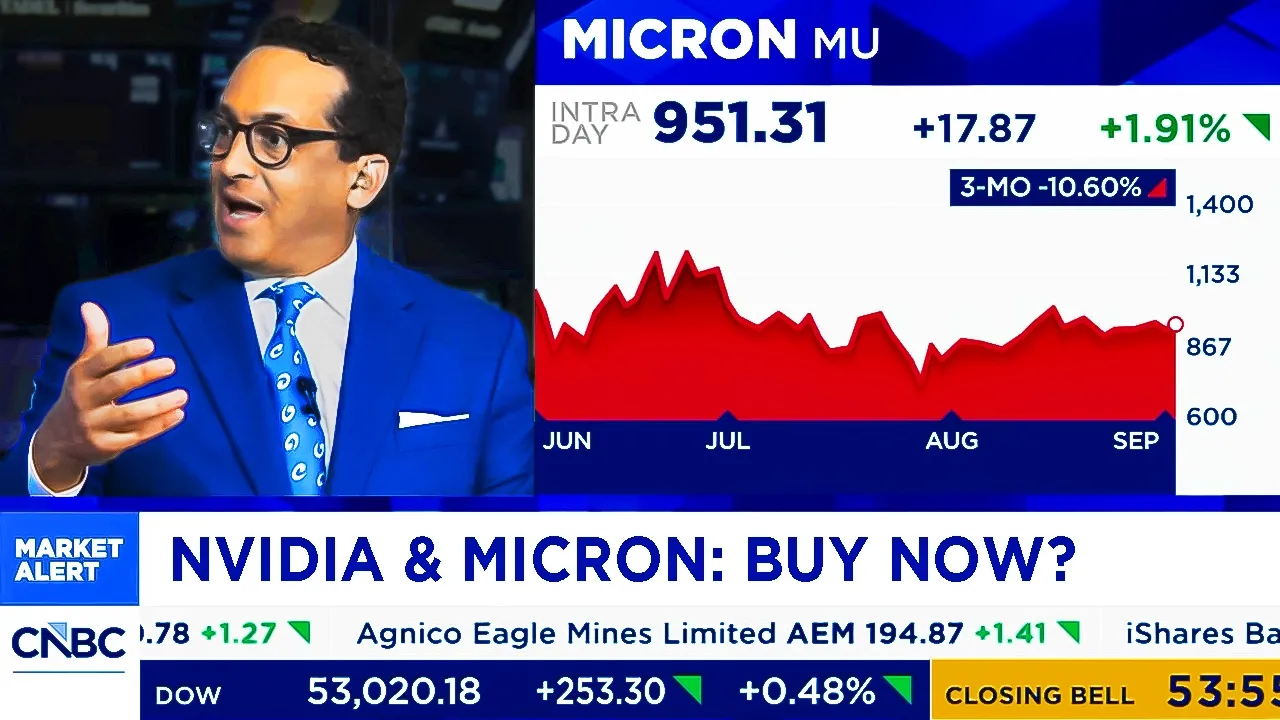
CNBC Today On NVIDIA Stock, Micron Stock, Anthropic, Broadcom Earnings - NVDA Update

- Rendement de la vidéo
- —
- Appels
- 2
- Achat / Vente
- 2 0
- Publié
Recommandations
L'entrée est le cours de clôture de l'actif à la date de publication. Le cours actuel est la dernière clôture enregistrée.
-
Entrée $224,41 02 sept 2026Actuel $226,20 03 sept 2026Résultat +$1,79vs. indice −0,2% SPY +1,0% sur la même période
I think Nvidia is the cheapest investment in the world.
-
Entrée $956,08 02 sept 2026Actuel $930,67 03 sept 2026Résultat −$25,41vs. indice −3,7% SPY +1,0% sur la même période
Nvidia, I would have said Micron, they don't have they don't want to buy back until after the government they have to finish the government relations, but that's the cheapest stock in the world and they should be buying that.
Transcription Complète
Jensen Wong is uh due to speak to a tech focused group at the G20 innovation summit today for more on Nvidia in the chip sector. Let's bring in Pierre Farrago global technology managing partner at New Street uh research and it is good to see you this morning. Uh Pierre, thank thanks for joining us. Um >> thanks for having me. C can you what do you do you get involved with trying to figure out exactly uh what's moving the the uh the chip sector or or should we just not even try to figure that out and just and just talk about fundamentals where where do we stand right now in the cycle in your view there there's not enough chips and that makes for firm pricing and I mean it's the it's it's the houseion days isn't it? Yeah, moving the stocks is like the most difficult part of the AI trade. Like it's it's very difficult if you look at the fundamentals. Uh what Jensen said, the CEO of Nvidia last week is that his supply constraints um and he's expecting to grow his business by at least 70% next year and he generated $50 billion in um uh in free cash flow in the in the quarter basically. So we are at a scale and and like across like the the supply chain the situations are very very similar. So we are in in a situation where AI usage uh is growing very fast. AI users are willing to pay for the token they consume. They see like um very clear value in them. Um and the actual debate today is are we short more like power supply like energy gigawatts or are you are we short more in terms of chips and it looks like in the near term uh we're going to struggle to have enough power to uh light up uh and turn on all the chips we are manufacturing. And in the medium term, like next two, three years, we we still don't have enough chips and we need to continue to ramp production. So, it's kind of I don't want to say we're early in the cycle, but there is no like top insights yet. And I I've given up on the law of of large numbers uh Pierre in terms of market cap in terms of uh revenue growth uh in terms of of u the buildout and the in the type of numbers that we talk about for the industry if I've given up does that mean it's finally going to uh come home to roost or is it just all systems go still? Well, I mean it it's sold all out and the thing is that AI created like this extremely universal uh dimension for technology that is fairly new. So you used to sell like very advanced software to fairly tiny group of people experts and that was your addressable market. Now what you see with products like u clothe code or even palenteer that very very advanced very expensive technology is being used by everybody and so AI is actually capturing like a very significant share of the GDP and the underlying technology be it like the frontier models developed by entropic and open AI or the chips designed by an Nvidia robotcom are extremely global uh and concentrated markets, hence the gigantic market caps we see uh today. One thing to note though, all these gigantic market cap are getting extremely cheap. Like if you look at Nvidia and if you trust what the CEO Yansen said, this stock is actually trading on singledigit earnings multiple uh on 2028 earnings. I and I've seen price targets uh at at 400 which would value the company you know closing in on 10 trillion or eventually and and do you expect to see that in in the next decade? I I'll even give you time. >> Yes. I I think like given the earnings power of the business in I would say even like 18 months from now, it's very likely that we see that kind of like $400 plus dollar uh stock price seems like um very at least to me very um very uh very likely. And the interesting parallel here is you know Apple in the early 2010s at some point that company was too big and at the time it was only approaching 8 trillion instead of 10 trillions. um that company was too too big to be true and the stock got cheaper and cheaper on earnings multiple uh in a very similar way. And then at some point the market swallowed the scale of Apple that was completely new and started looking again at the fundamentals and understood that Apple had pricing power. They could defend their margins and they had opportunities to diversify to increase pricing widen the product range and develop services and continue to grow earnings. and the stock had a wonderful run and and actually now Apple is a multi-trillion dollar market cap. So that's probably, you know, you were asking about the stocks as we started the conversation. That's that's probably what's going to eventually move the stock like getting getting the market to acknowledge uh that outlook for Nvidia. >> Jensen Wong is addressing the G20 this morning, Jim, and he says that countries shouldn't write rules for AI's quote theoretical harms. I mean, what Alman's talking about this isn't theoretical. >> No, I mean, look, I I always want to see the context because he spent all he spent so much time at Falcon yesterday talking about the need for cyber security that I don't want to put words in his mouth, but Oh, David, Nvidia's up. >> Nvidia is up. >> Nvidia's up. Call someone. >> And and and the key to this market that you were describing earlier, Dell is also up nicely. >> How much is up? >> Only up 7%. But you know um >> David Jensen I for I called for a half a trillion dollar buyback >> out of Nvidia. >> Yes it needs that indeed. >> We've been talking about this Luca like >> they got to go Apple. It's the first time I put a number on it. Half a trillion. >> So almost 10% of the of the market cap. >> Oh yeah they have to. I mean remember Apple bought back 44%. I'm just starting with this buyback. I think it's so much better than giving it to Nebius. mean giving him a what? A a back stop. >> Back stop. >> Yeah. >> Well, you can do them all. You can do them all. They're generating so much free cash flow that you can buy back a lot of stock and you can still offer. >> You get a back stop and you get a back stop and you get a back stop. >> If they start doing refining companies, it's going to get down to Brown Foreman. >> True refining. We have to get a half trillion dollar buyback. Period. >> Now, I think it was Barrens yesterday uh talking about this latest anthropic deal. an Nvidia backed AI developer renting computing from an Nvidia backed cloud provider using an Nvidia leased data center filled with Nvidia hardware. >> The one we were talking about yesterday with that >> prop if you did a half a trillion dollars it would move the stock up a lot more than that. No, of course they're not doing that to move the stock. I am saying that one of the things you do when you're a CEO is you try to assess where your capital should go. and that Tim Cook and Luka Meister whom I think regardless two of the greatest tanms I've ever seen, CEO and CFO said, "Our stocks the cheapest investment in the world." And I think Nvidia is the cheapest investment in the world. Nvidia, I would have said Micron, they don't have they don't want to buy back until after the government they have to finish the government relations, but that's the cheapest stock in the world and they should be buying that. They should not necessarily be giving a backs stop to what now is amounting to every Tom, Dick, and Harry when you listen to Secretary Vessel. I'd love to get your thoughts on Nvidia. We've had a lot of discussions today about whether or not they're going to get more aggressive on the buybacks, whether shares here are undervalued. Obviously, the guidance the other day was interesting. And now this hugging face sort of parlor game. Uh BFA today calls it a kind of a Trojan horse in that open source kind of enters the window as free software, but after that it drives all kinds of demands. Um what do you what do you make of Nvidia here? Yeah, and you know I think you I was just discussing with with one of my colleagues today you know a lot of parallels and you know quite timely given you know Tim Cooks just stepped down a new management at Apple you know I just think a lot of parallels to where Apple was you know three and a half years after the launch of the iPhone and here we are kind of you know similar timeline post the launch of chat GPT you know an area of phenomenal growth over the last few years then a massive dating of the stock you know Apple got down to 10 times PE back then and Nvidia's trading on about 10 times PE if you go out a couple of years and so you know what did Tim Cook do as soon as he kind of got the reigns, he he put in a massive shareholder program to say, you know, we're not just selling a a phone. We're not the next Nokia or Motorola. This is sustainable and we're going to prove it by giving you, you know, one of the the greatest shareholder return programs in the history of US corporate America. And it's the same with Nvidia. They're embarking on that journey as well. So, you know, that's going to be the only way that there's only limits to what they can do in terms of convincing people this is durable and this is going to last beyond next year, which is currently what the valuation is telling you the market doesn't believe. >> That's a really good point. As we await the the IPOs of Anthropic and OpenAI, both of which are filed confidentially, how do you think about the potential liquidations of of more liquid tech parts of the market in order to free up cash for that? I know that was a big discussion surrounding the SpaceX IPO and whether it happened in some of the levered ETFs that were unwound in order to free up some cash to invest. Do you expect the same kind of phenomenon with the the other big IPOs that are in the pike? Yeah, I think a little less about the IPO itself, but more about when the unlocks come. I mean, generally these companies are listing a very small portion of their free float and and as a result, you know, you've got a lot of unlocks and often early unlocks coming, which is a lot more supply that needs to buy digested. And you've also got to put that next to the fact that because the free cash flow of many of the mega casing, you know, big buybacks from from Nvidia, because the free cash flow's dried up from many of those companies, those buyback programs have gone away. So you've got more supply and you've got less buyback action in in some of the traditional um sort of companies have been doing that. So kind of the combination of the both does put a bit more pressure on those stocks. So you know we do need to navigate through the through some of those big IPOs into the end of the year and into early next year. >> I'm I'm glad Scott that you brought Nvidia in because that's where my head was. What Nvidia is saying is that the whole space is supply constraint. What what Broadcom has been saying Joe with your comment about last quarter they missed by a billion is that there's competition out there. Now, which one of those two is right? I happen to very strongly believe Nvidia. Um, you know, basically what they're saying is they could do more than 70% if supply constraints come out of the way, particularly on memory. I got that. But basically, the whole space, the whole semiconductor space is semic uh semiconductor supply constrained. And what that means is if there is competition, say from AMD versus Broadcom, particularly with the Alphabet partnership, then it really doesn't matter. the competition doesn't matter because there's enough of this pie and it's growing big enough to satisfy everyone. That's what Broadcom needs to say tonight is that the pie is big enough that don't worry about the competition. And frankly, Scott, that is what Nvidia was saying is the pie is big enough and it's growing faster than anybody can uh fully meet. I just have so much more growth before I have to worry about that that I don't want to sell uh into what's going to be very strong earnings. Even if I embed a lot of multiple contraction, um I still can make stocks work. I mean, Micron's a good example. They report later this month. I know you're focused on uh Broadcom here in the short term, but like >> you know, Jensen told you the numbers are too low at Micron. It's told you, >> right? So, if the biggest issue in the whole market right now, and Steph knows this well, is I just don't want to own stuff that misses because the penalties been so harsh if they miss. >> It's not just been earnings though, it's been revenues are growing double digits. It's margins also that are expanding. Talk about margins going higher, micron, those margins are going, you can't keep up with it in terms of the modeling of it. >> I like the AI food chain a lot here. I think this pause in the last few months isn't because we topped out and it's over. It's bec we're going to end up way higher before the end of the cycle. So, I think the risk's pretty pretty skewed to the positive um in in the medium to long term on on the whole AI food chain. the data center debate, Steph, we've talked about it, you know, every day because everybody's talking about it every day, too. From politicians to leaders within the AI space, it's probably led to some of the weakness that we've seen in the stocks of late. How do we deal with that right now? >> Well, I think that um the whole issue is overdone, overblown. I mean, I I think that we are going to see building out of data centers. I think the states that are actually allowing it are going to get more and more of the business. um the more push back that you get from other states. But I come back to the federal government is very supportive of AI and the whole food chain and and we talked about this the other day on halftime that Nvidia went from 45% revenue growth to 70% revenue growth forecasting guiding by 2028. They obviously see the demand and you can talk to any of the the the hyperscalers. You can talk to any of the industrial manufacturers. I mean, I went back and looked at all the back the backlogs of all the industrial companies that benefit from the food chain, and you're talking about 30, 40, 50% backlog growth. Sure, that could get cancelled, but some of these are take or pay um contracts. And so, that's to me the the long story. So, I think that the fact that we have this push back, it leads to a longer cycle. And I think this is a decade or two decades long theme. And I think that the push back only makes me more confident in that thinking. >> Do you think the push back has had an impact on these stocks? >> I think I think I agree exactly what Steph said. I think the push back has had an impact. I just think it's mostly stupid and baseless. I mean, Google it. Uh you use about the same amount of water for a data center as two golf courses. Are we going to cancel all the golf courses to save data centers? Do you think it's political? Do you think it's informed? No. Uh and that's by the way bipartisan. That's a that's happening in I'm I'm equally critical of both parties when I say that noise abatement. It's pretty easy to get like if you look at the criticisms from the 23 or whatever states it is there don't make any sense. Do you want revenue and jobs and tax? Yeah, you should. So this is just I think a a temporary kind of misunderstanding um that will sort itself out as as a you know important people communicate what what's really at at stake here. I think ultimately the bull case is that I don't think people even understand what's going to happen with physical AI yet and all the all the uh you know humanoids that are going to be out there all the robots we're all going to use and have all the silicon that's going to go in there. I think there's a couple certainties that you can point to. We're short compute and we're short power and there and the associated stocks over the next 5 years have come nowhere near peaking. Sure there'll be growth scare. Sure there'll be policy could screw it up in in a three-month trade. But like we're we're headed way higher in terms of the overall growth rates for those industries. And if you're managing a diversified book, you just have to have exposure to compete and power in order to outperform. >> Broadcom earnings are out. Christina Parts Neville has the numbers. >> Yeah. So it's a beat on the top and bottom line. $3.32 EPS earnings per share on $29.6 billion. Uh for the actual quarter semiconductor revenue did come in a touch higher than what the street anticipated. uh the infrastructure revenue which encompasses VMware that was a little light at 8.75 billion and then the big number a lot of people were looking for was AI semiis revenue so AI chip revenue that came in at 16.7 billion up 54% uh sequentially quarter over quarter they're guiding that AI revenue to hit 21.7 billion which also clears the street estimates but overall the revenue guide for the fourth quarter coming in a touch light 34.8 8 billion. So you have uh the fact that they maybe came in light on the revenue guide, the fact that they didn't provide the fiscal 2027 uh total AI revenue, which needs to be well north of hundred billion in this report, may be released on the call, uh could be contributing to the 5% sell-off in the stock. And then lastly, Q4 non-GAAP operating margins came in at 66%. Street was looking for 66.5%. So it's just tiny misses, but enough for the stock to drop about 5%. also one of the uh I guess dare I say worst performing chip names this year up what is it 67% versus the socks up 66% so this is a name that is still not benefiting from that uh Mike >> yeah this uh aftermarket decline takes it not far from the flatline for the year we'll see where it goes during the call Christina thank you moving lower after posting third quarter results revenue guide coming in a bit light but semiconductor revenue and infrastructure revenue were both higher than estimates in the latest quarter joining me now is Stacy Rascott from Bernstein. Uh Stacy, good to see you. >> Good to be here. >> Uh thanks for coming by. So I mean sort of a beat on some of the relevant numbers modestly. Uh maybe a disappointed reaction. What's your read on? >> Yeah, you know, so the quarter was actually very very good. So I it was it was good. Like it was it was a beat overall. A semis beat a little bit. The infrastructure software was a slight miss, but I mean it it's it bounces around. It's fine. Gross margins look pretty solid. They're about 75%. That was a point higher than the street. >> Um and the AI number in the quarter was was quite strong. Um the guidance is kind of in lineish. The operating margin guidance just a hair light at 50 bips. It's probably memory pricing. We've we've seen that. We'll see what they say on on the call. The AI guide looks looks okay. Um in the Q4, it's a little higher than the street, but they had already sort of given a 26 number for that. Anyways, most of what we want to hear and we're interested in is not in the press release. Like it's going to be on the call. Okay. >> We're going to want to know what what do they say about 2027. They'd already given a 100red billion plus number. People are widely expecting them to take that up and and hopefully they they will. And where does it go? And I'm also hoping that they can help us maybe frame out some of what 2028 looks like. They had talked a little bit before. They have something called um uh they basically have some financing work that they're doing with Apollo and Blackstone >> that can deploy a potentially a tremendous amount of um data center capacity into 28. And >> if you think about that, it actually points to material upside, but last quarter they just sort of let it hang there. They didn't really help us frame it. Yeah. >> So, anything they can give us on that I think would be helpful as well. >> You mentioned the hundred billion dollars. That's sort of their previous uh guides. That's for AI semis. >> For AI, I'm sorry, for AI semis. That's correct. >> Okay. Um so we we'll listen for that. Um in terms of how the stock has kind of struggled on a relative basis, I mean, there was at least a perception that maybe they didn't any longer have the inside track on some of the custom chip business and where does that all stand? >> I mean, yeah, so there are other players in custom chips and like Google is working with guys like MediaTek and and and others. And so there's always a narrative around share losses and this is semiconductors. You always worry about that. My view has been a a little more blas is the the wrong word. I understand how it moves the stocks, but my general view has been, you know, is is it big or is it not? If it's big, I think there's actually room for everybody. If it's not, we're all in in big trouble anyways. And I mean, given the numbers that that Broadcom is already put out there, I'm not I'm not even convinced that like the percentage market shares are necessarily even changing very much. Everybody's like growing like crazy. Broadcom and >> MediaTek and and Nvidia and AMD and I mean even guys like Qualcomm are all are all seeing upside in a world when everybody needs more and you have to build the capacity and diversify if you can. >> So that that's what we've been seeing right. So I haven't been terribly worried but I understand how the narratives can can move the stocks and it's it's been a narrative headwind if if not necessarily like a a fundamental headwind at this point. >> So how does it boil into a case for the stock? I mean it's pretty modest valuation at this point after this run. >> Yeah, I mean it it's gotten cheaper. or so have a lot of the other names in the space, but it's gotten cheaper. Again, I I think the answer to that question, we'll know in a little bit when they when they talk on the call, that's actually going to give us a lot of of visibility in terms of where this can go and whether or not people want to buy into the story or not. >> And how was Broadcom the expectations shaped by Nvidia or even in general people thinking about where it fits? >> Yeah. You know, before the NVIDIA print, I I feel like expectations for Broadcom had been coming down. I think post Nvidia, you know, the pressure is is is on, right? I mean, yeah. And you know, Jensen sort of went a little bit shock and awe and >> Exactly. >> You know, we we'll we'll see how Hawk responds. Yeah. >> Yeah. No, it'll be fun to listen to. Uh Stacy, thanks very much. >> Oh, you bet. You bet. >> Get on that call. >> All right. I hope you're all doing well today and staying calm in this market. Today was overall a positive day in a market at the index level, but slightly mixed beneath the surface as the situation in the Middle East continues. Tuesday night, Bloomberg reported that Nvidia is in advanced talks to acquire Hugging Face for $ 122.9 billion plus a $1 billion retention package for Hugging Face employees, bringing the total to roughly $14 billion. According to Bloomberg, a final agreement has not been reached, and the timing or details could still change. If this deal were to happen, it would have interesting implications for Nvidia. We know that Nvidia wants to be the leader in open source. If this deal happens, Nvidia will be moving further up the stack and control what is arguably the primary platform developers use to discover, build, fine-tune, and deploy AI models, especially open source and openweight models. It would help strengthen Nvidia's CUDA mode as it would make deploying open- source models on Nvidia's infrastructure even more seamless and further cement NVIDIA as being the default platform for open models. From strategic perspective, I find this very interesting considering that major hyperscalers are trying to diversify their chip supply away from Nvidia by developing their own custom accelerators. And by acquiring hugging face, Nvidia would be vertically integrating in the opposite direction, moving up the stack into models and developer tooling and strengthening their mode there. I guess one potential risk to this acquisition is that it might encourage the development of alternatives. Hugging face has been viewed as relatively neutral and open. Some developers and especially Nvidia's competitors might become slightly concerned if Nvidia were to own the platform. It's also possible that this deal could draw some regulatory scrutiny which would not be ideal for Nvidia. Overall, I think this deal could make a lot of sense for Nvidia from strategic perspective. At the time of making this video, we do not yet have confirmation of a deal. In other news, JP Morgan analyst Harllinser met with Nvidius, vice president of investor relations and strategic finance to discuss Nvidia's outlook. Nvidia said they provided their fiscal 2028 outlook of 70% revenue growth due to stronger visibility into next year and a meaningful gap between street expectations and internal projections. As a reminder, Nvidia's fiscal 2028 is mostly in calendar 2027. It begins in late January. I've heard some people incorrectly assume that Nvidia guided to 70% revenue growth in calendar 2028, but it's fiscal 2028, not calendar 2028. Anyway, Nvidia said training versus inference revenues was roughly 50/50 around 18 months ago, but Nvidia expressed confidence that inference is now larger and continuing to grow as a percentage of the business. That's important because more inference ultimately means that Nvidia's customers are monetizing AI more than they were previously. Also, I'm sure many of you remember the many incorrect takes last year claiming that Nvidia was losing ground in inference. As I said repeatedly on this channel, Nvidia systems are actually the best on the market for inference with the lowest total cost of ownership. It's also important to remember that Nvidia's platform is fungeible. So while companies will use the leading edge accelerators for training new models, those same accelerators can later be transitioned to inference workloads, meaning they're useful for longer and have a longer useful life. That's positive for Nvidia's customers. Importantly, and this may be a big reason why Nvidia traded higher on Wednesday. Nvidia indicated to JP Morgan that without supply constraints, Nvidia's business could potentially more than double year-over-year. That indicates that demand is even stronger than what Jensen and Colette implied on the earnings call last week. Another reason why Nvidia traded higher on Wednesday is likely Dell earnings. As I mentioned in last night's video, Dell reported another very strong quarter. I'm not going to go over all the details, but revenue was up 58% year-over-year. Adjusted EPS was up 203% year-over-year, and Dell indicated that their backlog is growing much faster than their revenue, meaning there is plenty of runway ahead, and we are not at peak spending. That's positive for Nvidia. Dell also spoke about being supply constrained, and they indicated that memory is the main bottleneck. Also on Wednesday, Jensen Huang spoke at the G20 Innovation Ministerial and urged world leaders to build their own AI infrastructure so that they don't get left behind. On Nvidia's recent earnings call, CFO Colet Crest said that Nvidia's sovereign AI business primarily through the regional clouds grew 35% sequentially and more than tripled year-over-year in Q2. Sovereign AI revenue is included in Nvidia's non-hyperscaler, ACIE customer segment. That customer segment is growing very strong with revenue up 138% year-over-year in Q2. In other news, it's being reported that Nvidia is investing in Mstral's €3 billion euro funding round. We don't know how much Nvidia will invest. We also got Broadcom earnings Wednesday after market close. I'll just briefly cover some of the main points. Broadcom slightly beat consensus on both the top and bottom lines. Revenue was up 86% year-over-year. AI semiconductor revenue came in at 16.7 billion, which is up 221% year-over-year. And Broadcom expects Q4 AI semiconductor revenue to accelerate to 21.7 billion, which will be a 236% year-over-year increase. Broadcom guided Q4 total revenue at $34.8 billion, which is slightly less than consensus. Now, what really helped Broadcom and after hours were CEO Hawkan's comments on the earnings call when he said that Broadcom has secured the supply for AI semiconductor revenue in fiscal 2027 to be approximately $115 billion. That will be a double from this year. He said Broadcom's demand exceeds this outlook. Hawk then said that Broadcom expects the trajectory of growth to continue in 2028 and they have line of sight for fiscal 2028 AI semiconductor revenue of $230 billion. So they expect AI semiconductor revenue to double in fiscal 2027 and then to double again in fiscal 2028. That outlook and the fact that Broadcom expects their growth trajectory to continue in 2028. That is the key detail from Broadcom's earnings in my opinion. Broadcom's outlook and Dell earnings both reaffirm the thesis that there is still plenty of runway ahead and we are not a peak spending. As I've said so many times on this channel, this is not zero sum. The world is already compute constrained, which means there's already enough room for multiple chip makers to succeed. In a total addressable market is growing at an extraordinarily strong clip. On top of that, as long as the world is compute constrained, almost all viable compute that is produced will be sold. This is not zero sum and now is not the time for Nvidia investors to worry about market share. Now, let's cover a couple pieces of memory news. SK Group's chairman raised the possibility of building a new memory plant in Japan between SKH Heinix and Kioa. He also said that data center memory supply is currently 20 to 30% sure demand and that SK's existing expansion in South Korea is not enough to meet that demand. In other news, Micron discussed a new architecture at Seicon Taiwan that it says could provide more than 10 times current HBM bandwidth while consuming substantially less energy per bit. This appears to be more exploratory rather than a near-term commercial product. Micron is also reportedly exploring near GPU NAND. The concept would place high endurance NAND extremely close to the accelerator, potentially on the package or board, creating a new memory tier that sits between HBM/D RAM and conventional SSD storage. The idea is aimed primarily at large model inference. This comes as SanDisk and SKH have been pursuing a related high bandwidth flash concept. This could potentially be important longer term as a new highv value use case for NAND. Looking ahead, Jensen is scheduled to speak at the Goldman Sachs Communicopia and Technology Conference on September 10th. Then we have Micron earnings on September 30th. And then Jensen is scheduled to speak again at GTC Berlin on October 21st. Now, in case you're new to the channel, I want to make sure that you have at least a basic understanding of the underlying long-term thesis. So, let's cover that. Now, I don't know what's going to happen in the short term, but from a long-term perspective, I am very confident that Nvidia will be worth much more in future years than it is today. When Jensen was on the Lex Freedman podcast not that long ago, he was very seriously raising the possibility of Nvidia becoming a $3 trillion revenue company in the near future. If that happens in the coming years, then it is very plausible that Nvidia could one day be worth tens of trillions of dollars in market cap. That might sound crazy, but that's what Jensen is implying when he raises the possibility of Nvidia becoming a $3 trillion revenue company. I guess the question at that point is what multiple the street will be willing to give Nvidia. I don't know the answer to that question, but I truly do think that Nvidia will be worth much more in future years than it is today based purely on the fundamental growth of the business. Based on everything I'm seeing, the world is still computed, and I expect that to continue at least through the first half of calendar 2028. In a computed environment, developers will use whatever viable compute they can get their hands on. Today, there are no GPUs that are sitting dark due to a lack of demand, like there was fiber sitting dark due to a lack of demand at the height of the dotcom bubble. Back then, companies were laying fiber in the hopes that use cases and demand would eventually show up. Today, we are seeing the complete opposite. As I've said many times, when market participants compare this AI revolution to the com bubble, they ignore the fact that the internet is already here this time. This means that mass adoption of the technology and new use case development at scale are immediately possible. We don't have to wait years for it to show up. It's already here. The world is compute constrained, which means there is not enough supply to satisfy demand. New capacity is utilized as soon as it comes online. The hyperscalers are monetizing capacity as soon as it comes online. Each of the hyperscalers spoke about being supply constrained on their most recent earnings calls. Additionally, many of the clouds are building out into contracted demand. They're not blindly building in the hopes that demand will eventually show up. No, they're building out because they have signed contracts and in some cases significant prepayments from their paying customers. This AI revolution is fundamentally different from the dotcom bubble and 2026 will be a pivotal year for the AI industry thanks to the rapid adoption of agentic AI and the proliferation of agentic systems in the world's leading enterprises. The leading AI labs revenues are surging right now. Agentic coding and the implementation of agentic systems in large enterprises are new use cases that are increasing inference demand significantly that subsequently is increasing compute demand. The rapid adoption of Agentic AI is why we're seeing an inflection in inference demand. It's why we're seeing the leading AI labs revenues surge. I wish both Anthropic and Open AI were public so the public could see the ramp in their revenues. I think the leading labs surging revenues may be the initial proof point that grabs market participants attention and causes them to realize that there will be a clear ROI on AI infrastructure. I think the leading labs surging revenues will also help assure investors of the longevity of Nvidia's growth since these labs revenues are directly tied to compute. If they had more compute, they would have greater revenues. It really is that simple. Demand is not the problem. The problem is a lack of supply to meet the demand. As I've said previously, I expect the world to be compute constrained at least through the first half of 2028, possibly longer. And so, regardless of what happens in the short term, it's important for long-term investors to remain focused on the fundamentals, maintain a long-term perspective, and remember that we are only in the early stages of aic systems being adopted at scale. This will increase compute demand significantly, and after that, the next surge in compute demand will likely be fueled by physical AI. We're no longer talking about digital agents performing digital tasks. With physical AI, we're talking about physical AI agents performing physical tasks in the real world. NVIDIA CFO has called physical AI quote, a multi-trillion dollar opportunity and the next leg of growth for Nvidia. This industry will fundamentally transform society and Nvidia has positioned themselves to benefit massively. Nvidia sells the hardware for the data centers where the models are trained. They offer omniverse where the models are taught and tested. And Nvidia also sells the hardware that allows ondevice real-time inference through Nvidia AGX, allowing robots to have intelligent interactions with the real world, even when they are not connected to a data center. Notice that Nvidia is taking a holistic platform approach to physical AI, and they're embedding themselves as the underlying foundation supporting all of it. Over 3 million developers are already building on the Nvidia robotic stack, and this is not getting enough attention. As for production ramps, Blackwell Ultra has ramped and remains in high demand. Vera Rubin is rolling out to customers. Nvidia Gro 3 LPX is in full production. Later on, we're expecting the launch of Reuben Ultra in 2027 and Fineman after that in 2028. We have a clear data center product roadmap stretching into 2028. And Jensen believes that AI infrastructure spinning will reach 3 to4 trillion annually by the end of the decade. That means Jensen is expecting growing AI demand and an expanding total addressable market underpinning all of this. I don't think we are anywhere near any type of bubble bursting type of event. With all of this in mind, I seriously think that Nvidia still has plenty of runway ahead of it. And I think this company will be worth substantially more in future years than it is today. At least that's my view of the situation. A quick note before I wrap up. All of the compilations on this channel are edited by Finn Vid with original structure and commentary. Occasionally the same edits appear elsewhere on YouTube. If you're looking for the original version, it's always here on this channel. Thanks for watching Finn Vid. I appreciate your support. Remember to stay calm in this market. Remember to maintain a long-term perspective and do not make any hasty or irrational decisions. With all of that being said, I hope you all have a great rest of the day. And I'm curious to hear your thoughts about Nvidia in the comments below. Please leave a like on this video so more people will see it. And while you're down there, please consider subscribing. It's free and you can always change your mind. Thanks for watching and hopefully I'll see you in the next
Commentaires 0
Connectez-vous pour rejoindre la discussion.
Se connecterAucun commentaire pour l'instant. Soyez le premier à partager votre avis !