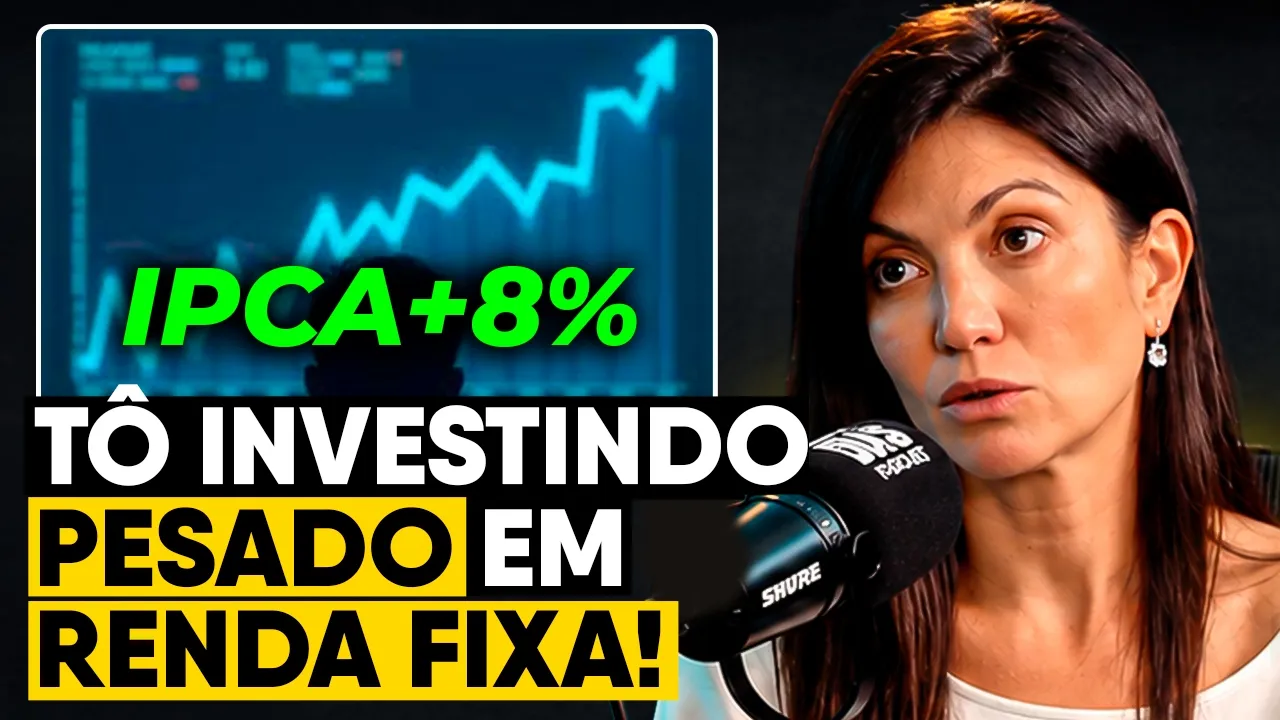
"NÃO TEM NADA PAGANDO MAIS QUE RENDA FIXA AGORA!" - MARILIA FONTES

- Rendement de la vidéo
- —
- Appels
- 1
- Achat / Vente
- 1 0
- Publié
Recommandations
L'entrée est le cours de clôture de l'actif à la date de publication. Le cours actuel est la dernière clôture enregistrée.
-
Entrée — 07 sept 2026Actuel $78 606,00 09 sept 2026Résultat —vs. indice — BTC est l'indice de référence — il n'y a pas d'excédent à mesurer
a little bit of Bitcoin I like a lot at the current moment, uh, as a diversification of global reserves, since the United States is losing a little value as the world's reserve, but a small position, right?
Contexte extrait par IA "a little bit of Bitcoin I like a lot at the current moment, uh, as a diversification of global reserves"
Transcription Complète
What does your portfolio look like today, Maril, in terms of percentage? Do you have a lot, a lot in fixed income, because you know a lot about fixed income, but is it well distributed, do you have stocks? I have a lot in fixed income, not because I know a lot about fixed income , but because I think the moment is favorable right now, you know? We have, uh, a very dual scenario ahead, so I prefer to invest with a little more when everything is a bit more decided; I don't like to invest when investing is like flipping a coin, man, heads I win, tails I lose, right? I like to invest in symmetry, when I can perceive a little more of the scenario that will unfold. So I'm in a bit more fixed income, I'm quite liquid. Uh, now we entered into a slightly more opportunistic stock market trade. I think that due to the improvement in the electoral polls, the market, uh, will appreciate a little until the elections, but it's just opportunistic until the elections, then we take it out and stay more liquid, and that's it for opportunities. So now I'm heavily in fixed income, I also have my 20% outside of Brazil, I think that's important. If the scenario worsens here , I think the dollar, uh, will rise significantly. Our debt is very high, so I think it's a relevant risk. You can't have nothing abroad. So, I have my 20%abroad, I'm, I'm really in a lot of fixed income, a little bit of Bitcoin I like a lot at the current moment, uh, as a diversification of global reserves, since the United States is losing a little value as the world's reserve, but a small position, right? I'm there with my 5%. Uh, and that's it, I'm, I'm really, really, uh, heavy on fixed income right now. Hey, Marila, you know what caught my attention? You talking about mark-to-market, because in the past many investors who had, of course, more knowledge, they used this practice to earn even more within fixed income, mainly using Treasury Direct. Uh-huh. That move can't be done anymore. It can't be done, because we depend on a major downward cycle, but with a debt-to-GDP ratio heading to 100%of GDP , and inflation 4.5%above the target ceiling, you won't be able to do mark-to-market. If you could even explain what that is, because many people watching us might not understand what that means, right? How did people make money with mark-to-market? Uh, seeing how it works? Explain it, you know, in your expert way. Yes. And anyway, which unfortunately is harder now, right? Yeah, mark-to-market makes you value your bonds at their current price. So, what basically happens is that for a fixed-rate bond, you mark it at the value you'd get if you bought it now. So, let's suppose you bought a bond with a 15%rate. It was worth 1000 down the road; you bring it to present value , it's worth, I don't know, 900. If the rate drops to five, that 900 will become 950. And then you'll have a big mark-to-market gain, because you have to reach 1000 in the end. The lower the rate, the closer the current value will be to that 1000. So that's the process, and with that, you can get returns of 30%a year, 40%a year, 50%a year, if you have a large downward cycle. Like we had in 2016, 2018, 2019, this 4-year period gave a 160%gain for a bond with a duration of 10, 15 years. No, I thought I bought a lot of Tesouro Direto, especially since Maril has seen it here a few times and in those years I’ve been doing some operations like that. But I thought that now, by getting these Tesouro Direto IPCA plus 8 and a bit, I said: "Well, okay, I'm set here, right?""Because in two, three years this interest rate can't be sustained, it has to fall and later on I'll get out." So, it's, it's harder for that to happen. No, I think, it's what you said, it has to fall because this isn't sustainable. Brazil can't live with an interest rate of IPCA plus 8, you can't pay the public debt. So, something has to be done. My fear is that for something to be done, it has to get worse before it gets better, you know? Uh-huh. So that's what usually happens. In Brazil it's kind of. No. And also, if it doesn't improve, IPCA plus 8... You're doing very well, you're good either way, right? Exactly. That's it. I think nowadays fixed income is for holding. Only if things go completely sideways, if we start seeing inflation skyrocket, if we start seeing IPCA plus 10, the most that will happen is you'll earn less than you could have. But even so, an IPCA plus 8, looking historically, I think it's an excellent rate, right, Mar? If you hold to maturity, yes, it's an excellent rate. And now, still on fixed income, Marília, Banco Master taught us all a very big lesson. I myself had Banco Master too, but within the FGC limits, all good. But I was very lucky because I had Voitter and Master, and adding the two together exceeded 250,000. And so, Voitter left the conglomerate before Master went broke. Voitter left earlier , so I got lucky. But what is the lesson for us fixed-income investors? Because people say they think fixed income has no risk, right? That the FGC is sovereign and will protect them forever. I want you to say: "Look, Master taught you this, stay sharp, okay? Because risk does exist in fixed income, right?" I think this shows how much the individual investor was manipulated, right? Because you, Banco Master, anyone in the market knew it was a very challenging case, let's put it that way , and didn't invest in Banco Master. No institutional investor invested in Banco Master, except for BRB. So, it was really an investment nobody touched , and that's why they pushed it to retail investors with the FGC stamp. So , it was a big scheme, let's put it that way. But I think what remains is this issue of naivety, of not trusting a bank just because it has FGC, of doing a credit analysis, of looking to see if the issuer is safe or not. All of this ends up influencing things a lot. If the rate is too high, you have to be suspicious, because the risk is very high too. But now, are the market or the regulatory bodies taking steps to minimize this type of problem? Or do we have to stay sharp from now on because another Banco Master could happen? What do you think? I think they are minimizing, but not solving it. What would be necessary to solve it, they are not doing. Minimize, I think so. They changed the rule. If you are going to invest in riskier assets with the raised funds, you have to put more resources into the Central Bank. So I think that reduces the chance of a new Banco Master a bit, but it doesn't solve it. Cool. Let me take a quick look at the chat here, guys. And look there at Sidney Capa Rosa, we're live, he said: "Congratulations, André, these ladies are amazing, they've only come to add more knowledge." Congratulations to them, right? So, congratulations to them. Oh, Vai Pelos Fundos is also here , an influencer, sending us a hug. A big hug to you as well. There are people here saying that with the SELIC rate high, the interest rate high, it's complicated for variable income and making money right now. I even want to understand from you if you agree. You know what I think? I think you can make money, yes. You can, because in real estate funds you will have at least 85%of your return coming from dividends, from earnings. So, if everything is beaten down, your earnings are much higher, right? What we were talking about, these shares that are from good funds, but that are way down. Uh, imagine the IFIX is delivering an average of earnings of 12 %per year. That's very high, isn't it? It's tax-exempt. Uh, with brick-and-mortar funds at 10, 10 and a little bit per year, which is also bizarre, right? Brick-and-mortar and paper funds are around 14. So, I mean, you've already won there. Of course, you're not going to buy just anything, right? You're not going to buy funds that have no fundamentals, but I mean, there is a way to win, there is a way to win by understanding what your intention is, for example, with a real estate fund to have earnings. So then you are winning. Uh-huh. Because in reality, it's not a finished product. You can even buy low and end up selling. In 2019, MXRF11 was there, imagine Tegar at a hundred and something, 150. Today, how much is it? I don't even know. Wow, Tegar dropped a lot. Tegar must be around 50 something. Yeah. Yeah. So, there is a potential for appreciation if interest rates fall and so on, but anyway, we have to understand what the product provides you, if you want dividends, then I think it's a great moment. Meet Investidor 10, the only platform an investor needs to take care of their investments. Manage your assets, have access to company data and balance sheets, receive price alerts and dividend receipts. And stay informed with everything happening in the market in real time. Want to see your investments simplified? Access Investidor 10 now.
Commentaires 0
Connectez-vous pour rejoindre la discussion.
Se connecterAucun commentaire pour l'instant. Soyez le premier à partager votre avis !