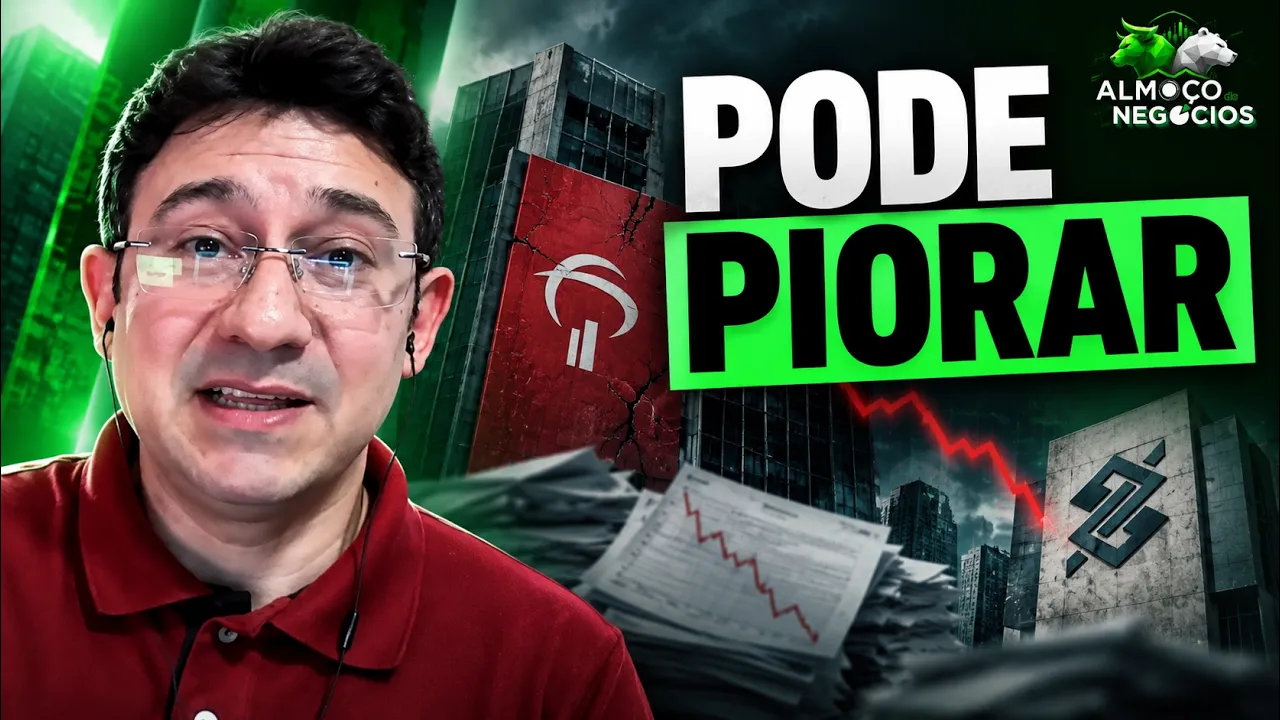
O risco que ainda pode pesar nos bancos com a onda de recuperações judiciais

- Rendement de la vidéo
- —
- Appels
- 1
- Achat / Vente
- 1 0
- Publié
Recommandations
L'entrée est le cours de clôture de l'actif à la date de publication. Le cours actuel est la dernière clôture enregistrée.
-
Entrée R$18,22 08 sept 2026Actuel R$18,22 08 sept 2026Résultat +R$0,00vs. indice +0,0% BOVA11 +0,0% sur la même période
Of course, there is the risk-return trade-off; you have to buy at the lows. ... In two years, it might be, it could be a good investment for the medium term
Contexte extrait par IA “Of course, there is the risk-return trade-off; you have to buy at the lows. ... If your medium term is one year, it might not be enough. In two years, it might be, it could be a good investment for the medium term”
Transcription Complète
Professor, you don't know—well, I know a little about your routine, I know it's very busy. I imagine you aren't able to watch MRT News every day . So, I don't know how much you've followed in recent weeks, how your name has been mentioned in our chat. A bunch of people talking, did they speak well or poorly? Very well, professor. Ah, that's a relief, man. No, always well. People asking us to schedule an interview with you to understand your view on this series of companies filing for bankruptcy protection and the impact of this on the financial sector. So, the day has finally arrived. This is the first topic we are going to cover. And I joked here, professor, I exaggerated regarding interest rates. I said that the last time we spoke, interest rates were at 2%, isn't that right? They were already at a much higher level than that. But it’s no exaggeration to say , professor, that this is the time we've spoken, since we've known each other, that we have the most requests for bankruptcy protection, out-of-court restructuring, and bankruptcy decrees. A lot of companies are throwing in the towel. How do you see this, considering the impact on the financial sector, professor? Hi, good afternoon. Once again, Vind and team. Okay, let's do a general summary. We have a record of bankruptcy and restructuring filings. Year after year, this record is being broken. Probably this year we will break another record as well. What is the point? Interest rates have been at high levels for a long time. We hit 15% interest. I think 15%interest hadn't been seen since one of Lula's first terms, when he took the rate at approximately 26%. I don't recall off the top of my head now, but companies got used to a scenario of interest rates lower than double digits. They need third-party capital for the working capital of their operations and several other points. Other additional points, which companies are filing for bankruptcy protection? These are some that have had their operations quite worn down recently: automation, migration to the digital market, many retail companies above all, and consumption, since household consumption and household debt are way up. So, families don't have money to consume. When they do, they spend it either on essential goods or even betting sites, which are part of many family budgets. So, it also puts pressure on how people will consume in retail, for example, in non-cyclical consumption. This hurts companies ' sales; although some don't show a drop in sales, they don't show growth either . They need increasingly larger teams, they need machinery, they need to reinvest in their operations, and they need to take on more debt. Some took a gamble and went into debt thinking that interest rates would fall to a single digit. That didn't happen. In fact, it wasn't just companies. When the Lula administration began, everyone thought interest rates would hit a single digit , partly because that was the expectation based on the Central Bank's interest rate curve. That we were going to have a big drop in interest rates, which is not what happened. Now we continue with quite high, double-digit interest rates, with only a small expectation that they will decrease. So , it put a lot of pressure on the budgets of companies and people who weren't prepared for such a high increase in interest rates. With bankruptcy protection filings, we see a drop in consumption once again, and it is a reflection of the interest rates. Let's say interest rates went up to a level to curb inflation and curb consumption. When it starts to come down, it's because the Central Bank has already seen a slowdown in the economy. A slowdown. That's it, companies going bankrupt and people not consuming. So the expectation is that inflation will drop because of that. And when interest rates are falling, it's because the Central Bank has already seen this effect, and it will likely get worse until rates drop even further. But this isn't just about today's interest rates . This is years and years of high, double-digit interest rates that are having continuous effects on the operations and consumption of all companies and families in Brazil. Professor, is there any bank that suffers more from this trend of various companies failing to honor their financial commitments? A Bradesco shareholder, for example, is historically worried when seeing this succession of headlines. Is there a reason for this concern or not? Yes, because every time a large company files for bankruptcy, when you look at the largest creditors, Bradesco is always there among the first in line. What happens? Above all, large banks need to lend money to companies to maintain commercial relationships and sell other services. You have the company's account for treasury, something like that, you provide services, investment banking services, whatever that higher value-added service might be, and what does the company do? It takes advantage of this good relationship and asks for credit, and the bank can't deny it, otherwise it will also lose those other provided services. But of course, you don’t need to be in first place for every bankruptcy filing that appears in Brazil. We don't see Itaú with such significant volumes for companies that went bankrupt, nor BTG, even though BTG’s credit portfolio is much smaller than these other banks. So there needs to be greater selectivity when granting credit to these companies . The last time I saw the list of creditors for Casas Bahia, it was at the top, along with Bradesco and Banco do Brasil. Of course, all the big banks will be on the creditor list, because they all have to lend money to maintain commercial relations with these companies. But as you present high values for risky companies, when a collapse inevitably occurs, it will be listed among the first, and it will have to recognize everything on the balance sheet with at least a 50% provision, perhaps a 100%provision of that value, and it all goes to losses for the fiscal year. Professor, do you understand that the financial market has already priced in, for these companies, especially Bradesco, but for companies in the financial sector, all this trouble related to a series of companies filing for judicial recovery, extrajudicial recovery, and declaring bankruptcy? Or has this pricing not yet fully occurred, and could we see the sector suffering a bit more? Oh, it could suffer more, yes, because the big surprise comes from the large companies that file for bankruptcy. Some mid-sized companies that don't make as much news when filing for bankruptcy and saying they won't pay, or going bust, they don't have such a big impact because they borrow so little from these banks, just a few million. When a large company declares bankruptcy, it owes billions to each bank. Between millions and billions, right? There is a huge difference in magnitude on the banks' balance sheets. That’s what we are talking about, especially for large companies in difficulty like Raízen, Braskem, Casas Bahia; the impact is very large on the banks that lend to them, because they will have to recognize practically the entire loan balance as a loss, which amounts to billions. And this significantly impacts those profits. But often, it is a matter of surprise. The company is in a difficult situation, and out of nowhere, it files for bankruptcy, right ? Who are the main creditors? Some we can see in the explanatory notes, in others we cannot, especially those private companies that go bankrupt. These are harder for us to verify who the biggest creditors are to try to anticipate some stress scenario. Professor, to our audience, I'd like to thank those sending us messages and greetings; people missed you, Fabinho Silva is here and J is greeting you. Anderson said: now we can really talk about banks with someone who understands the subject. Folks, I miss our conversations here. Professor, me too. It's great that we can resume them from time to time. People want to know your opinion on the "blusinha" tax, the US President's tariffs, and how much these domestic and international tariff measures have impacted companies with loans and financial commitments to banks that won't be able to honor them. Can these tariffs also be held responsible, or is the issue much broader than that? It's about management and high interest rates; you can't just dump all this responsibility on tariffs. Professor, look, I think the tariff issue is more marginal. Oh, removing the "blusinha" taxes will make Brazilian retail less competitive. It will, but like, it already has so many problems that one more won't be the main cause for these companies going bankrupt. And regarding Trump's tariffs, I think it's all already kind of on the margins. It started with higher tariffs, then decreased; it's a back-and-forth, and these negotiations might also depend on the next president. The bigger issue is Brazil, it's Brazil's interest rates and the domestic environment. The international aspect with these points is more of a minor reflection, not something that will define everything. Of course, some companies will have strong impacts on their operations regarding import taxes to the United States. But, at least on the stock exchange, the main ones impacted, I think, are Gerdau, steel companies, and businesses in the basic materials sector, but they are solid companies; they won't go bankrupt because of this, especially since many of them also have operations abroad. It's more large to medium-sized companies that aren't listed, and although there is a reflection on bank balance sheets, it's marginal. The real major reflection is in the individual consumer portfolio, which is generalized here with record-high debt, and large companies declaring bankruptcy that have very large loans with one or another bank, especially those that have appeared so far, Bradesco and Banco do Brasil, which lead these large exposures, right? We will talk specifically about these two banks, professor. Sandrinha is preparing a question about Banco do Brasil. But just so we can finish with more questions from our audience and talk about Bradesco as well. First, Luciano Oliveira, a member of our channel, said: "Vine, I live in Arapongas, Paraná, one of the biggest furniture hubs in Brazil. Casas Bahia owes a total of 70 million to the companies here in the city. To the company I work for, Casas Bahia owes 5 million." That’s what our Luciano Oliveira replies here. Thank you, Luciano, for sharing the situation with us. Deplorable. Truly regrettable. The question is, when will they receive it, right? Nobody knows. Rodrigo Bonat asks you, professor, what is the financial situation of smaller banks looking at small caps, for example, BMG? Professor , have you also been following the situation of these smaller banks? Are they also offering credit, suffering from this default scenario, thinking about companies, about businesses? What can you answer, professor, to Rodrigo Bonatti, our viewer? Look, regarding smaller banks, if we were to talk about non-listed ones, we are also seeing many financial firms going bankrupt, many that are unable to stay afloat with this interest rate level. Everyone says high interest rates are good for bankers. Yes, but they also raise funds based on interest rates, especially the smaller ones. Smaller banks have a higher cost of funding. If you buy a CDB from Itaú and one from BMG, you will ask for a higher spread to buy the BMG one. Usually, smaller banks also operate with riskier portfolios, don't they? BMG, in this case, focuses more on retirees and pensioners, so it is more exposed to regulatory changes. Let's say the Minister of Social Security says: "Ah, now interest for retirees is 1.5%per month," and they have a funding cost of 1.2%per month. So, the spread kind of doesn't add up. These are more niche-concentrated effects on these small banks. Who is the small bank that is under a lot of pressure? Those who operate heavily with credit cards, especially FinTechs, which have a high cost of funding; they raise CDs at quite high rates, lend at high interest, but also face a default rate of almost 50%. Those involved in payroll-deducted loans have a bit more resilience because it’s somewhat guaranteed money, especially when it’s payroll loans for civil servants and INSS retirees and pensioners. As for the banks listed on the stock exchange, I think that among the small ones on the exchange, many are not as affected because their portfolios are more resilient. We have Banco Pine, we have Banco Mercantil, and another one listed on the US stock exchange, AGIBank, which focus on private and public payroll loans, so they have a guarantee, even if it's starting to get a bit weaker. The big point is banks that are not listed on the stock exchange and have a portfolio with higher default rates. Regarding other portfolios, I mentioned credit cards, and people might immediately think of Inter and Nubank. Of course, the default rate for them, professor, of course, the default rate for them will increase significantly, but what is the point? They already have a more mature portfolio. Inter and Nubank clients have been with them for years, and they are diversifying their operations. So they already have a good credit history for these clients, and a good database to study how credit was granted to these customers and how they react. So, despite the increase in defaults, these are more resilient portfolios. They won't have a 50%loss in their credit portfolio like other banks that operate with credit cards. They will be much more resilient, and with high interest rates, they can also maintain higher collection amounts from customers. In addition to float revenue , for example. It's harder today, but there are people who pay their credit card bills in advance. Where does that money go? Until the bank makes the payment to the merchants where you made your purchases, it stays in the bank's float. So that money is likely invested in government bonds, generating a spread for the bank in that sense as well. Very well, thank you, professor. Given all this context, would you hold Bradesco at this moment thinking about a medium-term investment? Is it a discounted asset, or is it a discounted asset? But the current scenario does not favor the Bradesco thesis. It depends on what you mean by medium term. For example, Bradesco's results were so bad that it is now showing growth every quarter, but it is growth because the previous average was quite poor. Bradesco's ROE—let me just check, as I had this number handy—its ROE, which is return on equity, was practically identical to Itaú's. What happened? It declined to alarming levels. Bradesco used to have an ROE above 20%, today it is at 16, 16.2. The investor paid a very high price for Bradesco's recovery, which is premature , before it actually showed a recovery. Of course, there is the risk-return trade-off; you have to buy at the lows. But it's as if the market has priced in a faster recovery for Bradesco, which I don't think is what it will deliver. Even though it is showing high growth, growing 4, 5%in quarterly results, 10% in annual results, it is still far from how Bradesco was priced in the past. Even at this current valuation, above book value, with the 16%return it is generating. It will improve its results . There may again be some stumbles regarding the issue of large companies that might go bankrupt and have loans with Bradesco. The question is, well, it's about how long until interest rates fall to a level that normalizes this record of bankruptcies and reorganizations of large companies we're seeing? And also normalize household debt so we can have a healthier credit environment. If your medium term is one year, it might not be enough. In two years, it might be, it could be a good investment for the medium term, but it has a worse credit portfolio than Itaú, so it may suffer more in this scenario where its recovery is expected. Imagine investing in a company you think is discounted because it will recover, but the recovery takes too long. So the market starts hitting this company a bit and repricing it, even though it could be a good asymmetry, yes, but for how long? Short-term investor until the end of the year. By the end of the year, it might not have recovered that much. In 2 years, it might have. Will the investor have the patience to hold for 2 years while seeing news of companies going bankrupt and releasing creditor lists? It will always depend on the investor's risk perception and risk tolerance. Professor, now let's change the subject to talk a little more about Banco do Brasil. We know there is a very strong issue here, which is agribusiness default, but we are in an election year , the elections are right around the corner, and we also know that this is one of the assets that becomes quite volatile. I wanted to ask you a bit more about the election trade. We saw Banco do Brasil soaring with the tightening race between Lula and Bolsonaro. I want to hear from you if there is still room for a rise in Banco do Brasil, professor. There is room, yes, but as you said, it's an election trade; it won't be based on results for now. No matter who wins, the next two, three, or four earnings reports from Banco do Brasil will either be poor or show very slow recovery. Rural credit, individual loans, corporate loans—practically all credit is a more macro-level phenomenon. Uh, but what is the expectation for the election trade? Okay. If, uh, I think the bank's issue isn't so much a political problem, it is, but it's a sector it's exposed to, which is 30%of its portfolio, that has hurt results significantly, and there's no way to avoid that. There is the question, ah, will it reduce credit to agribusiness? No, because it is the largest agribusiness operator in Brazil , that's where it has a competitive advantage. It may be a bit more selective in granting credit, but maybe the portfolio will fall regarding that. Uh, the issue is more, ah, eh, will the bank be able to cut expenses to try to balance things out? When you look at the number of employees at Banco do Brasil, Itaú, and Bradesco, the one with the most employees per revenue level is Banco do Brasil. More employees, or more branches; sure, there are branches open in small towns, many that don't show economic results, but due to political reasons, they aren't closed. So it's as if it had many, many expenses to reduce, but they won't be reduced. I think that's true regardless of who wins the next election. But of course, investors will see it as an improvement in the bank's future long-term profitability if Lula doesn't win, and they will start buying . Professor, I wanted to talk a little bit about this in the final stretch of our conversation, because in fact, a good portion of market agents, of investors, understand that a management different from the Workers 'Party administration will bring more professionalism, more profitability, and better margins for Banco do Brasil. And then I was thinking, and from memory, I couldn't remember who was the president of Banco do Brasil during Jair Bolsonaro's administration. Do you remember, professor? Does our audience here remember? Daniela Marx? No. Daniela Marx, who now tends to be the economy minister, finance minister for Flávio Bolsonaro, she was president of Caixa Econômica Federal. She was not president of Banco do Brasil. Banco do Brasil had three presidents during the Jair Bolsonaro administration. The first of them, Ruben de Freitas Novais, held the position from January 2019 to September 2020. He resigned. Then came André Guilherme Brandão. He took office in September 2020, stayed until March 2021, and resigned due to friction with the government. Then came Fausto de Andrade Ribeiro, appointed in March 2021. He remained as president until the end of the Bolsonaro administration, in December 2022. So, I want to hear your thoughts on this, professor, whether this belief is actually real, or if we are forgetting that in the previous administration we had some turbulence at Banco do Brasil that could repeat itself now, considering a possible change in power. What is your assessment of this? Ah, the point is really that Banco do Brasil will always have government interference. Every government will use the bank to conduct policy in some way, so it won't have that optimal result as if it were a private bank. That's why it is public and is priced as a public bank. What's the point? Every president of Banco do Brasil will be under pressure to release more credit, grant more credit at lower interest rates, and all of that. The question is how much of this will affect the bottom line. Let's say moving from one government to the next, the ROI increases by two percentage points. That is what the market will price in. Or, I think the possibility is remote, but privatization could get on the investor's radar, even if only as a thought and a remote possibility. So these are the main triggers. Ah, if this very populist government comes in, eh, the bank's ROI falls by two percentage points. Of course, there was an extreme which was Dilma, who expanded credit to individuals and companies in every way she could, without clear credit granting criteria, and the bank almost imploded. But I think a scenario like that is very unlikely to happen again.
Commentaires 0
Connectez-vous pour rejoindre la discussion.
Se connecterAucun commentaire pour l'instant. Soyez le premier à partager votre avis !