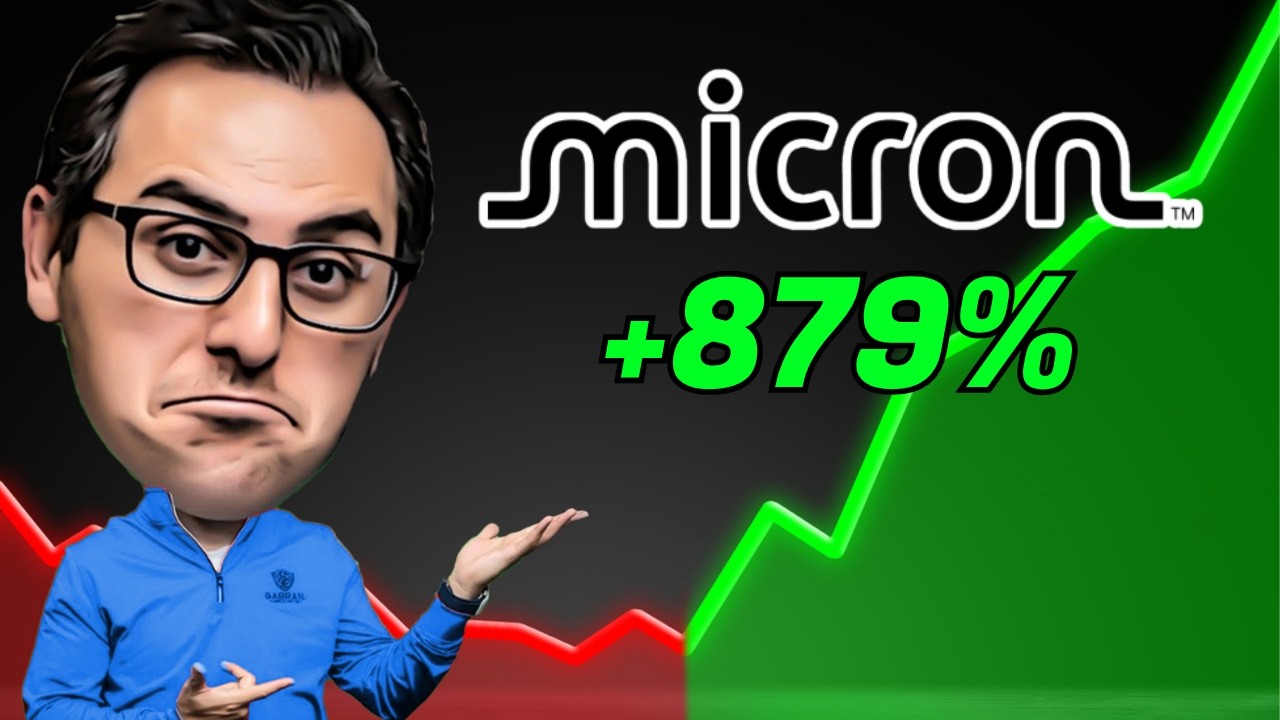
If You're a Micron Stock Shareholder... Get Ready! $MU

- Rendement de la vidéo
- —
- Appels
- 0
- Achat / Vente
- 0 0
- Publié
Recommandations
Aucune recommandation d'achat/vente trouvée dans cette vidéo.
Transcription Complète
Micron shareholders are currently on one of the wildest rides in the entire stock market. The stock is up 280% in the last six months and almost 900% in the last one year, 25% in just the last week and it just hit the $1 trillion market cap club. Wall Street is calling it the new AI supertock. UBS just slapped a $1625 price target on it, and the CEO is out there saying AI demand is breaking records that have never been broken before. Bulls are telling you the boom and bust cycle that's crushed Micron shareholders for years is finally dead. But something is happening that Micron shareholders need to pay very close attention to right now. And today, I'm going to lay out both sides completely, the bull case and the bare case. and then we're going to run the numbers and find out what Micron is actually worth based on my own personal assumptions. Before we get into that guys, let's make sure we all understand what Micron actually does because a lot of people are buying the stock right now and they have no idea what they own. And this is a very common theme amongst a lot of people with a lot of companies they own. Micron is an American company based in Boise, Idaho. They've been around since 1978. And get this, they started in the basement of a dental office with four guys and some money from a local potato farmer. That is 100% a true story. Today, they are one of the three biggest memory chip makers in the entire world. Guys, back in the late 90s when I loved computers and I was a little computer nerd, my very first supercomput was a Micron. They made these workstations. They made all these great computers. But in 2008, they stopped making computers and focused fully on memory chips. So next question is what is a memory chip? Well, here's an easy way to think about it. Every computer, every phone, every car with a screen, every eye server in every data center, they all need memory to work. Memory is where your computer holds information so it can grab it fast. Now, don't confuse it with your hard drive. This is temporary memory. This is the memory the computer uses to store things that they're currently in the process of using. Without memory, nothing works. The more memory you have, the more things you can run at the same time. And Micron is one of only three companies on the planet that makes the kind of memory the entire tech world runs on. And here is why everyone else is talking about Micron right now. AI is exploding. And AI needs a special kind of super fast memory called HBM. Micron makes this stuff. And right now, they're sold out all the way through the end of this year. And that is why this stock has gone absolutely crazy. And as I mentioned earlier, UBS came out and said Micron is worth $1625 a share. Then Barclays said $1,175 a share. And Wall Street is telling you something very specific. They're telling you essentially that this time is different. They're saying that Micron has signed new long-term contracts that lock in high prices. So the company will never crash again like it has in the past. That is a very, very large claim. So, let's go into the bull case a little bit further and I want to give you the best version of it because if you're going to own the stock, you need to understand exactly what the people that are buying it are seeing. There are three big reasons Wall Street's going absolutely crazy for Micron right now. Old case number one, the memory business has changed forever. This is the biggest one. For 40 years, the memory chip business has been one of the worst businesses on the planet. Prices go up, prices crash, companies make a fortune, then they lose a fortune over and over and over again. But the bulls are telling you that it's over now. They're saying AI has changed everything because now Micron is signing these long-term contracts with the big AI companies at locked in prices. It's no longer a company that has to pray that the market is good this quarter and next quarter and for the years to come. They're trying to make it more like a subscription business. UBS analyst Timothy Aurori came out and said the market's going to start putting a much higher multiple on the stock because of these structural changes. Bull case number two, the world is running out of memory right now. AI data centers cannot get enough memory. They're begging for it. Micron is already sold out all the way through the end of this year. And according to UBS, the shortage is not going away anytime soon. They think DRAM memory will be under supplied until at least 2028. Now, ND memory would be the short until late 2027. When you're sold out and the world is begging you for your product, you have something called pricing power. You can basically charge whatever you want. And that's exactly what's happening to Micron right now. Bullcase number three, the profits are going through the roof. When you have a product everybody wants and you can charge whatever you want, guess what's going to happen? You're going to make a fuckload of money. Micron's last earnings report nearly tripled their revenue. Their profit margins on ammery are exploding and the bulls are telling you this is not a one-time thing. They're saying we're at the very beginning of a multi-year run where Micron's earnings could blow past anything this company has ever done before. And one more thing the bulls will point to, some of the biggest super investors on the planet are in the stock right now. Dave Tupper, the billionaire hedge fund manager who runs Apple loa management, owns about 1.7 million shares of Micron. That's almost 10% of his entire portfolio. Ken Griffin, who runs Citadel, one of the most successful hedge funds in history. He's holding over 4.6 million shares that are worth over $4 billion. And he just made his position even larger. Now, I want to share something because this is exactly why being in our community matters. Back on December 27th, 2024, our in-house analyst, Dalton, made an exclusive video on Micron for our community. He looked at the numbers and he said, "There's a lot of value here." That's when the stock was under $90 a share. That was before the trillion dollar headlines. That was before UBS slapped a $1,600 $25 price target on it. And since Daltton made that call, the stock is up 934%. Now guys, I'm not saying that Daltton is some savant that sees everything. But this is an example of something that he said, "Hey, there's some pricing power here." Now, I haven't personally talked to Dalton about Micron in a while, but we're going to look at the numbers here, and my guess is that when a company 10xes over one year, the price versus value is going to be a lot different than it was a year ago. But that is the power about being in a community. On our main YouTube channel and on our Plus channel combined, we analyze over 50 stocks per month. That's a lot. But inside the community, members analyze over almost 4500 stocks just this year alone. That's the difference. That is what you get when you're in the room with us every single day. So, if you want to see what stocks Daltton and other community members are analyzing right now before they show up in the news, click the link in the description and check it out. Because remember, UBS only increased their price target because of price movement, not because of fundamentals. Dalton was analyzing the company at $90 a share based on fundamentals and said there is and he actually has said which I give him credit for there are mispricings in the chip memory world business. He's been saying that for a long time. So I give him credit that these are actually playing out as we speak. Now can he control that a stock goes up a 10x over one year? Absolutely not. But the point I'm trying to make is these are the conversations to have in the community. Now to the bare cases because just like Daltton spotted value right now there are some serious warning signs hiding underneath this rally that almost nobody on Wall Street and definitely nobody on YouTube is talking about bear case number one. The memory cycle is not dead. It is sleeping. Remember how the bulls told you that AI has changed memory forever? That boom and bust cycles are over. The bears are saying that's exactly what people said the last time the boom and bust happened and the time before that and the time before that. Here's the problem. When prices go up and demand is crazy like it is right now, what are other companies going to do? They build more factories. Micron is building, Samsung is building, SK Hinix is building, everyone is building. And in two or three years when all those new factories come online, you're going to get something called over supply. Too much memory chasing too little demand. What happens then? Prices crash. William Kerwin is an analyst, a senior analyst at Morning Star, and he said it perfectly. He said, "Memory is a commodity. There are multiple companies making chips that are basically the same. When that happens, you cannot keep prices high forever." Bare case number two, the stock might be in a bubble. Let me show you what's happened to the stock. This is a six-month chart on Micron. And I may sit there and say, "Well, Paul, it's, you know, it's going up." But guys, this is $200 and some dollars a share. In six months, it's almost $1,000 a share in the last one year. Same thing. You might look at it going, "What the heck is going on here?" This 96 $95 a share up 10x in one year. Guys, the bears are looking at that chart and they're saying that's not normal. That's a bubble. Thomas Hayes runs Great Hill Capital and he came out and warned that memory chips and semiconductors have absolutely run away from reality. Guys, I'm not going to lie to you. If I owned this company, I thought it was worth $1,500 a share automatically. This would worry me. I'd be like, "This is too much growth too quickly. Even from a fundamentals perspective, it made sense. From a technical perspective, having people go up so high so quickly, you gota expect a breather at some point." Now, Tom Hayes, he said they've gone parabolic in the last four to eight weeks. And here's what that means for you. When a stock goes parabolic, it's not pricing in what the company's worth today. It is pricing in an absolutely perfect future where everything goes right. In fact, everything goes better than what's expected for the next 10 years. Now, that might not be the intention of a stock purchaser, but that is what the numbers will show when you understand what the future has to be in order to justify today's price. And if anything, and I truly mean anything, goes wrong. If suddenly AI spending starts to slow down even a little, if one big customer cuts back, the stock doesn't just dip, it will crash. Bear case number three, the people who run Micron are selling it. Now, this one's a big red flag for bears because if the future is so bright for Micron, if the stock really is worth $625 a share, you'd expect the CEO and executives running this company to be buying more shares, right? They are not. They're doing the opposite. 247 Wall Street looked at insider transactions from February through May of this year. They found 63 trades. The people who know this company better than anyone else in the planet are dumping their shares while Wall Street is telling you to buy. That should make you stop and think. With that said, the counterargument to that is people sell for a million reasons. I don't care what the reasons are. If you think the company is worth $1,000 a share, you might sit there and say, "You know what? I just 10xed my net worth in last year. let me take some money off the table and put it towards trust for my kids or buy a house, something like that. So, I do want to make sure I keep that in mind here. But when you don't see that much buying, it is an indication because people only buy for one reason, that's to make money. So, that's all the bare cases that I'm the top three bare cases I can think of. Memory is still a commodity and the crash is coming. The stock is in a bubble that could pop at any moment and insiders who know the most are selling. If the bears are right, the people buying Micron today at $1 trillion are going to get crushed. So, who is right? The bulls or the bears? Guys, keep in mind both can be right and the stock can still go up. And both can be right and the stock still goes down. I always bring the example of Cisco. Cisco is the company that in 1999 went up parabolic and didn't see a new all-time high until last August. That's 25 years of no growth. Yet, the business got better. Profit went up 10x. revenue went up three or 4x. So, the bulls were right, the business got better, and the bears were right that it was overvalued. Both can be right and the stock can go down. Both can be right and the stock goes up because three bull and three bear cases doesn't mean they're equally weighted either. One could drive more than the other. Now, from my perspective, what wins in the long run? Fundamentals. Price versus value. If you overpay for a great story, even if the great story comes out to be true, you're still not going to do very well. So let's go do my own personal analysis on Micron. So it just joined the $1 trillion club. Now guys, price to sales ratio is one way to look at a company immediately and compared to others. Microsoft and Google sell between 8 and 12 times sales. This is 19 time sales. That's expensive. The market overall is at like three times sales, which is by the way already an expensive market and it's three times sales. But this business has a higher gross profit margin. And look at this guys. This is where I get concerned. Now you may sit there and say, "Well, Paul, the numbers got better." But they got too much better, if that's even possible. Their 10-year profit margin average is 23%. Their 5year is 22%. Last year they did 41 a.5%. That doesn't happen very easily to go on forever. This seems like it's probably not going to be sustainable, especially as people see these gross margins getting higher and higher and higher, more people will enter the fold. Now, one thing I love is they haven't made many acquisitions. Only actually, by the way, they've only made like not even a billion dollars in acquisitions. And look at this revenue growth. 15% a year for the last 10 years, 20% a year for the last five, 36% a year for the last three adorable dividend. And look at this. Well, I don't like free cash flow versus net income. Very different. But my guess is they're probably spending a lot on capital expenditures over the last uh couple years. Let's go check that out. Let's see if their capital expenditures have really changed because that's the difference between free cash flow and net income. Their capital expenditures. Oh yeah. Um actually not a ton. Not as much as I would have thought. 10 12 7.7 8 1/2 16 and 15. It's up but it's not up a ton. That doesn't make up for the the difference of $9 billion in free cash flow. Hm. That's interesting. That's very interesting. All right. So, even though it's selling for 150 5-year PE and 44 times one year, and by the way, for a company like this, it's kind of hard. You look at the five-year number or the one-year number because the five-year number, they've had a lot of growth, but then the five-year number is probably more about the average. This is a very tough situation to understand. This is very tough. And people in our community have this rated as a hold, but probably before, this is the last six months they've been talking about this before a 300% runup. Something to consider here. Let's check out the eight pillars. Oh boy. Expensive, expensive, low returns on capital. Shares outstanding up aren't up much. So, I'm not worried about that. Although, if I were this company right now, I'd be printing every share I possibly could. I'd be issuing so many shares, unbelievable. I would be like I'd literally be like, "Okay, how do I issue let's say $1,000 a share?" If I wanted to raise a bill, $10 billion in cash, what is that? 10 million shares. I go issue 10 million shares tomorrow. I be like, "Let's do 10 million shares. Get that 10 billion in our pocket." That's what companies should do when the stock is massively overpriced and people want it like they want crack. All right. Low debt. That's great. Let's see what analysts think. Oh, wow. Look at analyst projections for earnings per share, guys. Analysts predict project that their earnings per share are going to decline over the next five years. And I wonder if it's because the analysts haven't updated their assumptions over the last year, but look at revenue. Basically the same four years from now than today. Wowza. Keep in mind, I don't think the analysts have updated all their numbers quite yet. Now, guys, I threw a lot of data at you. And if it feels overwhelming, you're not alone. It was overwhelming for everybody in the history of the world at some point, no matter what the topic was. Warren Buffett was overwhelmed at some point. We're here to keep this as simple as possible. I want to compare companies to your own personal financials because they're essentially the same thing. I look at this the way I look at potentially shipping costs after co you guys remember after CO it was hard to get products and shipping companies were overwhelmed. We used to ship a container from China for $4,200. During after CO it was $25,000. We kept saying that's not going to stay around forever. And sure enough, prices came down. Short-term demand. Now, you might be thinking, well, Paul, this is different than shipping. Maybe it is. It's different in the sense of one's chips and one's shipping. But at the end of the day, business people are business people. They want to maximize their profit. It's a healthy balance of how do you put too much of the inventory out there? It it's it's very difficult to do. But we're here to break this down as simple as possible for you. So, what I want you to do is I want you to download our free key metrics PDF. It goes over all the key metrics of the company, the ones on this main page right here. It'll explain all of these, the numbers behind them, how you calculate them, and their explanation. Keep it with you. That way, you and I are speaking the same language. If you're sick of being confused by all these financial metrics, this is your way of getting over the confusion. If you do a little bit at a time, you'd be amazed at how good you'll be one month, 3 months, 6 months, a year from now. you'll be a brand new person. And this is exactly why I teach on YouTube. This stuff isn't overly complicated. People just like to complicate it to make themselves feel smart and everything. I actually feel bad when somebody says, "Paul, I don't get what you're saying." I say, "Oh my god, I failed at what I was saying here." I want to teach it to you as simple as possible. And in a couple minutes, I'm going to go over the price that I want to pay for the stock. So, how do we do that? Well, guys, this is why I created our stock analyzer tool. This allows me to make assumptions about the future. I'm going to go on a 10-year assumption for Micron. Now, guys, the last time I did this was probably before all this market surged. I'm going to do two different stock analyzers with you. So, please do me a favor and stick around with me after the first one because the second one's going to be what needs to happen to justify $1625 a share. But for this, I did 10year revenue growth of 10, 13, and 16%. I did profit and free cash flow of 20, 24, and 28. You might sit there and say, "Well, Paul, that's so much lower." It's actually not much lower today on the free cash flow number. Look at the free cash flow. Guys, this concerns me. Big- time difference between free cash flow and profit margin. What PE do I sign to this company 10 years from now? Their returns on capital are getting worse. They make a good product 15, 18, 21, and my 9% no margin of safety return. So, what I'm going to do here is the numbers going to pop up aren't the numbers I'm going to pay for Micron. It means this is what I think Micron would be worth in the market. But of course, I'm an investor. I want to buy it for less than it's worth. So, I hit the analyze button. Again, remember, stay with me for one more analysis. Guys, look at this. I have a low price of 260, high price of 735, a middle price of 447. Do you now see why at $90 a share, Dalton was sitting there saying there's a lot of value here? That's why even on these low numbers. So, what has to happen in the next 10 years for this company to be worth $1,625 a share? Well, I'm going to sit there and do 20, 25, and 30% revenue growth. I'm going to do 25, 32.5, and 37.5 profit margin. Let's see what that does. Keeping everything else the same. Still not there. So, 25% revenue goes the next 10 years. Profit margins at 33%. We're still not at 1625. Remember, that's what it's worth, not what it actually should sell, what it actually should be bought for. That's the difference. So guys, this is what we do here with Stock Analyzer. It's garbage in, garbage out. If you put bad assumptions in, you're going to get bad results out of it. It's not about putting in what you want it to say. Put in something realistic. If you told me to invest in companies based on these kind of assumptions, that'd be hard for me to do. these revenue growth assumptions and profit growth assumptions when the company hasn't done that for a long time makes me go I'm betting on perfection. I don't that's not investing in me. That's gambling. So guys, my personal opinion is when it comes to hype, I stay the f away. Now guys, there is one more stock that you need to see. It's one that I think could be a bigger opportunity in the market right now. Click this video right here to watch it. Thank you so much for your time.
Commentaires 0
Connectez-vous pour rejoindre la discussion.
Se connecterAucun commentaire pour l'instant. Soyez le premier à partager votre avis !