… a lot of these names have been drawn into. But you make the point that today's capex burden could be tomorrow's infrastructure mode. What if that's the case? Which of these names do you like the most considering an infrastructure mode? >> Yeah. So if I think about that framework and apply it, I would say Google's probably the most interesting to me because it really captures a lot of the ownership benefits of having the AI infrastructure coupled with their cloud business and you know they're able to monetize that through a lot of their legacy assets and it's through a complete stack. Um, so I would say because they have the infrastructure control, the data centers, the TPUs and multiple ways to monetize th…
Yeah. So if I think about that framework and apply it, I would say Google's probably the most interesting to me because it really captures a lot of the ownership benefits of having the AI infrastructure coupled with their cloud business
Contexte extrait par IA
Yeah. So if I think about that framework and apply it, I would say Google's probably the most interesting to me because it really captures a lot of the ownership benefits of having the AI infrastructure coupled with their cloud business...
Transcription Complète
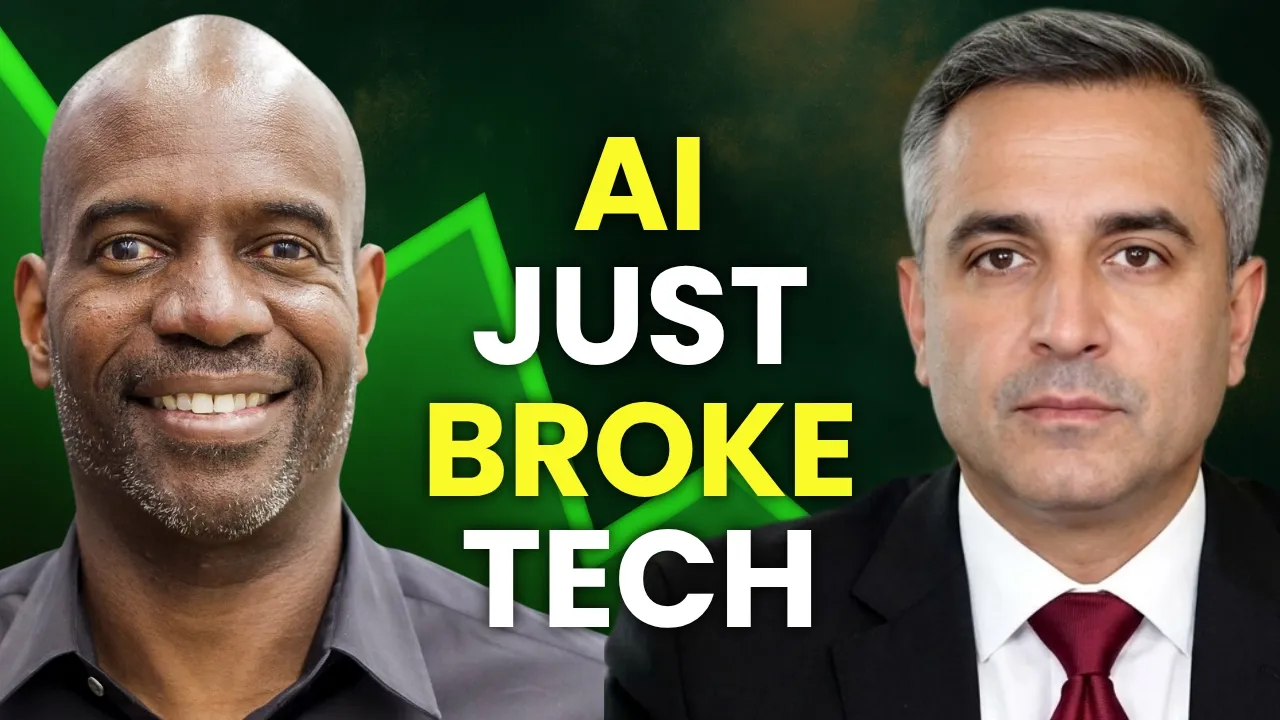
The magnificent seven tech giants are starting to slip relative to the broader market, triggering an intense debate over whether these dominant players are actually cheap or fundamentally diverging. Founding partner of Plexo Capital, Lo Tony, sat down with host Becky Quick on CNBC recently to unpack why artificial intelligence is actively breaking up this elite cluster. By the end of this video breakdown, you will know how to separate the winners from the losers using his simple 2x two framework. But which of these giants has quietly built an impenetrable moat that makes its current valuation a massive bargain? >> Many of the magnificent seven stocks underperforming the S&P 500 this year. But last week, Jim Kramer called for investors not to sleep on the tech giants. >> The market pull ahead of the Mag 7. We got sick of them, right? I mean, the group's about to reap the profits finally and spending all that money and we now decided that we're so close to we're so close to 2027 and we're not giving them any credit. THAT'S WRONG. THE STOCKS ARE CHEAP. I THINK IT IS TIME BY BUY TO BUY. >> Joining us now is Plexo Capitals founding managing partner and CNBC contributor Lo Tony. Lo, what do you think of that call? >> You look I think what we should probably think about is that AI is being the lens to view everything right now. But I would think a mistake is assuming that means the MAG 7 is becoming one trade again. In fact, AI is breaking up the Mag 7. Google, Microsoft, Amazon, they're building these massive AI factories and they have to prove the return on all that infrastructure. Meta and Apple are using AI to make their distribution franchises more valuable. Tesla is turning AI into real world physical assets and services with a completely different set of deployment, regulatory, and unit economic pressure and questions. And then there's Nvidia. Nvidia sitting back and getting paid while everyone else proves the economics. >> Did you mention Apple in that or did I miss out on that? >> I did mention Apple. Apple is very valuable because they are of the point of origination for a lot of the AI uh queries. So I think you know Apple's able to leverage their fantastic distribution, great hardware and then also the fact that I keep coming back to a point I made last year which is you know Apple didn't make these massive investments um but now they're reaping some of the rewards because of that. So basically, you think the MAG 7 label is a pretty useful one, but not all boats within that Mag 7 label are necessarily will float equally. >> Yeah, exactly, Becky. I think the way to view it is, or at least the way I do, is to think about maybe a 2x two or just two important questions. First question, how much control does the company have over AI infrastructure? And second, how strong is the ability to monetize the intelligence that infrastructure produces? And then you can almost start to bucket these, right? There's the hyperscalers and these are the companies that are building the AI factories around and inside their massive cloud businesses. They've got the capital, the infrastructure, the customer base and they have to answer the question of is all that spending going to provide an attractive return on the capital. And then you have the aggregators. So Meta and Apple, they don't necessarily need AI to become a standalone business, but they have enormous pools of demand and distribution. So you know, Meta can use the AI to monetize ads better and make Apple's ecosystem. AI can make Apple's ecosystem more valuable. You've got the physical in Tesla and then again, you've got Nvidia. And while everyone else is trying to figure things out, Nvidia is monetizing their ecosystem, hardware, software, um the open model layer through their acquisition of hugging face. So again, while everyone else is trying to prove AI economics, Nvidia is getting paid and strengthening their ecosystem around the buildout. Look, the big concern has been the capex spending that a lot of these names have been drawn into. But you make the point that today's capex burden could be tomorrow's infrastructure mode. What if that's the case? Which of these names do you like the most considering an infrastructure mode? >> Yeah. So if I think about that framework and apply it, I would say Google's probably the most interesting to me because it really captures a lot of the ownership benefits of having the AI infrastructure coupled with their cloud business and you know they're able to monetize that through a lot of their legacy assets and it's through a complete stack. Um, so I would say because they have the infrastructure control, the data centers, the TPUs and multiple ways to monetize that intelligence through search, YouTube cloud, and increasingly even Whimo. So, you know, Google's one where I don't have to make a bet about where the AI economics ultimately acrew because they participate across the entire stack. And you know, you look at the stock so far this year, it's up about 8% or so, but the analyst consensus implies maybe a 25% upside. >> Becky Quick kicked off the exchange by pointing to a highly publicized call from Jim Kramer, who urged investors not to sleep on these mega caps because the market's recent rotation away from them was a mistake. Kramer's core argument was that Wall Street has grown impatient, refusing to give these companies credit for the massive capital expenditures they are pouring into artificial intelligence. When Becky asked Lo Tony for his take on this aggressive buy call, Tony offered a much more nuanced perspective that challenges the traditional index investing mindset. He agreed that AI is the essential lens for the market right now. But he strongly cautioned against treating the Magnificent 7 as a single uniform trade. In Tony's view, the era of these seven stocks moving in lock step is over because the deployment of artificial intelligence is actively breaking up the group. Where I land on this opening exchange is that Tony is highlighting an essential transition that passive investors are totally unprepared for. For years, the Magnificent 7 acted as a monolithic block where a rising tide lifted every boat, allowing investors to simply buy an index and enjoy massive market beating returns. But Tony's core thesis is that this passive one-sizefits-all approach is officially dead because the introduction of generative technology has forced these companies to take wildly different paths. If you treat them as a single trade today, you are taking on massive concentrated risk without realizing that some of these companies are spending billions on infrastructure that may never yield a clear return, while others are quietly capturing pure profit. This fundamental split led Becky to ask how investors should actually categorize these diverging giants, prompting Tony to introduce his analytical framework. To make sense of this split, Tony outlined his 2x two framework, which evaluates how much control a company has over its physical AI infrastructure and how strong its ability is to monetize the intelligence that infrastructure produces. He pointed first to the hyperscalers Microsoft, Amazon, and Google who are building massive artificial intelligence factories inside their existing cloud businesses. When Becky pressed him on the massive capital expenditure burden these companies carry, she highlighted the primary anxiety holding these stocks back. Wall Street is terrified of this capital expenditure cycle because it eats into free cash flow today while promising revenues that are still years away. Tony responded by pointing out that the real question for these hyperscalers is whether all this spending will ultimately provide an attractive return on capital, warning that if compute becomes a commodity, the margins on these massive investments could collapse. What I make of this is that the market is acting with its usual short-term bias. If you look closely at the hyperscalers, this spending isn't just an expense. It is a defensive necessity. Because if Microsoft or Amazon stop spending on data centers, they risk losing their core cloud customers to competitors who can offer faster compute speeds. Yet, Tony's point about compute commoditization is the real wild card here. It is one thing to build a massive compute factory. It is another thing entirely to sell that compute at a premium when capacity across the industry is expanding rapidly. This is why we are seeing a split even among the hyperscalers themselves as some are far better positioned to monetize their infrastructure than others. That infrastructure worry naturally led Becky to ask about the companies avoiding this capital expenditure trap altogether which brought the conversation to the aggregators. Quick pause here, like the video, subscribe to the channel, and then let's pick this back up. This second bucket in Tony's framework is dominated by Apple and Meta companies that do not need to build multi-billion dollar factories from scratch because they already possess massive lockedin distribution networks. When Becky asked how these companies can win without heavy infrastructure spend, Tony pointed out that Apple did not make the same massive speculative infrastructure investments that Microsoft or Google did. Yet today, they are reaping some of the greatest rewards. He explained that Apple controls the point of origination for consumer queries, acting as the gatekeeper at the glass. Tony then highlighted how Meta is executing a similar playbook by open- sourcing its llama models, which effectively forces the hyperscalers to compete on raw compute pricing, while Meta uses the technology to make its core advertising business more profitable. My take is that Apple's strategy is a masterclass in capital efficiency. They let their competitors spend hundreds of billions of dollars building the back-end infrastructure and training the foundation models while they simply position themselves as the interface, integrating these models into their ecosystem to charge a premium to consumers without taking on the massive capital expenditure risk. Meta is pulling off an equally brilliant defensive maneuver by using open-source software to commoditize the underlying tech, turning their distribution franchise into an impenetrable moat. But what happens when we move beyond the digital screen? That is when Becky steered the conversation toward the physical world, asking how Tesla fits into this framework. When Becky raised the question of Tesla, Tony categorized the company as the physical representation of artificial intelligence. He explained that unlike Meta or Apple, which operate in the digital realm of ads and consumer software, Tesla is attempting to translate intelligence into realworld physical assets and services. Tony noted that this physical deployment introduces unique regulatory hurdles, deployment pressures, and unit economic questions that do not apply to software companies. If Google wants to update its search engine, it can deploy software globally in seconds. But if Tesla wants to deploy a fleet of autonomous robo taxis, it has to deal with local municipal laws, physical manufacturing constraints, liability insurance, and the messy unpredictability of city streets. Nobody wants to manually turn this massive annual report into a presentation. So watch this. I'm going to transform it into a professional presentation outline in under 5 minutes. I upload the report to Naratorra. Narrator analyzes the source and recommends the appropriate workflow. I select presentation outline, choose my settings, and generate. And there it is, a slide by slide presentation with talking points and suggested visuals built from the original report. No complicated prompting, just a few clicks. This is Naratorra, generative content automation. Turn your sources into finished content at narrator.com. Where I land on this is that this physical bottleneck is precisely why Tesla remains the most polarizing stock in the entire group. Many retail investors value Tesla as a pure technology play, assuming its autonomous driving network will scale with the high margin economics of a software company. But the reality of physical manufacturing and regulatory compliance means that Tesla's path to monetization is much longer, noisier, and capital inensive than its digital peers. It is a high- risk, highreward bet on the physical future of robotics, making it completely distinct from the rest of the Magnificent 7. from physical hurdles. The conversation naturally pivoted to the one company that profits regardless of who wins the digital or physical race, Nvidia. When Becky asked where Nvidia fits in this fractured landscape, Tony highlighted that while the hyperscalers, aggregators, and physical players are fighting to prove their economics, Nvidia is simply sitting back and getting paid as the ultimate arms dealer. He pointed out an overlooked aspect of Nvidia's dominance that goes beyond their hardware, explaining that Nvidia is actively strengthening its ecosystem by combining hardware, proprietary software like CUDA, and acquisitions in the open-source model layer, such as their investment in HuggingFace. My take on Nvidia's strategy is that they are building a vertical lockin. By acquiring or partnering with key players in the open- source community, they ensure that the next generation of artificial intelligence models is optimized to run on NVIDIA hardware. They are monetizing the entire buildout phase and they do not have to worry about whether the enduser applications are profitable today because the infrastructure demand is still far outstripping supply. However, the risk for Nvidia is that this buildout phase eventually slows down once the initial factories are completed. This brought Becky to the ultimate question of the segment. Where should investors actually allocate capital within this fractured landscape? When Becky asked Tony which specific name he likes the most, Tony did not hesitate to name Alphabet, the parent company of Google, he explained that Google is the most compelling because it successfully bridges multiple categories in his framework. They are a massive hyperscaler with deep control over their own infrastructure, including their proprietary tensor processing units. Yet, they also possess some of the most dominant consumer distribution channels in the world. I went back through Google's recent financial performance, and Tony's reasoning is incredibly sound. Google has spent years building a fully integrated vertical stack, designing its own silicon, and owning the data centers and fiber optic networks. Most importantly, they have multiple highly diversified ways to monetize the intelligence they produce, spanning search, YouTube, cloud enterprise tools, and even autonomous driving through Whimo. While the rest of the market panics about the eyewatering capital expenditure of these tech giants, Google is proving that today's massive investment is building tomorrow's unbreakable moat. At the time of this discussion, the stock was only up about 8% on the year, but Wall Street's consensus was pointing to a massive 25% upside, making Tony's top pick look even stronger. The era of buying the Magnificent 7 as a single uniform basket is officially over. Moving forward, the real winners will be the ones who can turn expensive silicon into repeatable high margin revenue. The question is no longer whether AI is a bubble, but which of these giants will be the first to truly scale its intelligence. For investors, the key isn't just watching the total spending, but tracking how efficiently each platform converts that raw compute power into actual user engagement. If Google can keep growing their advertising and cloud margins while the rest of the sector struggles with diminishing returns, this current valuation will look like a significant bargain in hindsight. Keep an eye on the next earnings print. That is where the narrative shifts from capital expenditure to real world profitability. If you made it this far, you're the reason I make these. Like the video and subscribe to the channel and I'll see you in the next

Commentaires 0
Connectez-vous pour rejoindre la discussion.
Se connecterAucun commentaire pour l'instant. Soyez le premier à partager votre avis !