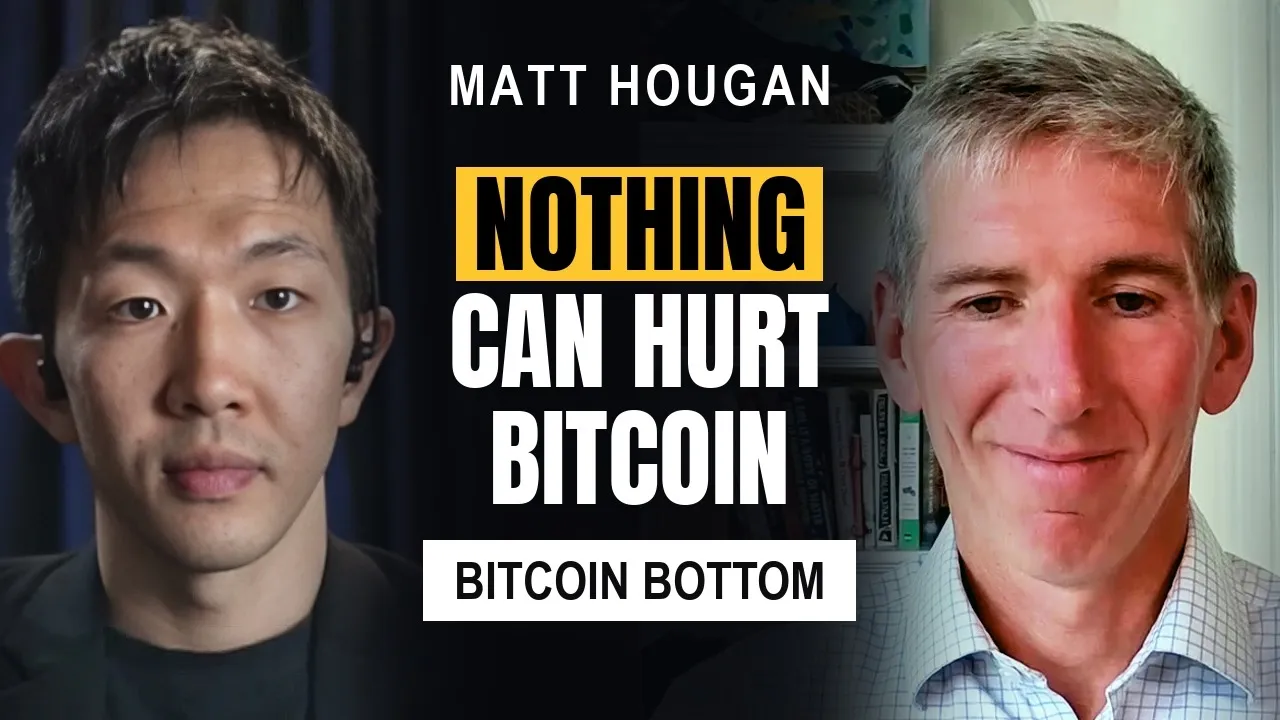
How to Tell the Bitcoin Bottom Is In | Matt Hougan Interview

- Rendement de la vidéo
- —
- Appels
- 3
- Achat / Vente
- 3 0
- Publié
Recommandations
L'entrée est le cours de clôture de l'actif à la date de publication. Le cours actuel est la dernière clôture enregistrée.
-
Entrée — 09 sept 2026Actuel $78 135,00 10 sept 2026Résultat —vs. indice — BTC est l'indice de référence — il n'y a pas d'excédent à mesurer
Citer cette recommandation Voir la vidéo source * †
Contexte de la transcription source
…'s the point we've been trying to make. It's hard to exactly time the bottom. But if you think the top is substantially higher because those wealth management platforms are going to add hundreds of billions of dollars into this asset, then you're better off just allocating, getting in, and being confident we'll be higher 6 months, 12 months from now. That's how I do it in my own personal portfolio and we think that's how a lot of clients can be well served. >> [snorts] >> I totally agree with that point and I I [clears throat] usually say this on live stream as a different way. Um so j…
you're better off just allocating, getting in, and being confident we'll be higher 6 months, 12 months from now.
-
Entrée — 09 sept 2026Actuel $78 135,00 10 sept 2026Résultat —vs. indice — BTC est l'indice de référence — il n'y a pas d'excédent à mesurer
Citer cette recommandation Voir la vidéo source * †
Contexte de la transcription source
…. And the point we've been trying to get across to people is it's less important whether we bottomed and more important whether we've topped. If you don't think the top is in, if you think we're going back above 125k and I think, you know, our base case at at Bitwise is we're going to 1.3 million dollars by 2035. We can talk about how we get there if you're interested. But if you think you're going there, does it really matter whether you bottom ticket at 59 or 55? Of course it would be nice. But to maybe make just to close the point, you know, Bit…
our base case at at Bitwise is we're going to 1.3 million dollars by 2035.
-
Entrée — 09 sept 2026Actuel $83,31 10 sept 2026Résultat —vs. indice — Aucun indice de référence enregistré pour cette reco
Citer cette recommandation Voir la vidéo source * †
Contexte de la transcription source
…t really allowed in the first place at least not clearly. So is clarity act going to be a necessity for these, you know, DeFi fee switches to fully work and and just be available everywhere? >> Yeah, and I should say just on my last point. I'm actually hugely bullish on hyperliquid. So I'm not unbullish there. I just also think these are misallowed. Yeah, you're exactly right. The reason they didn't have fee switches, the reason they had these sort of goofy governance tokens was that under the previous SEC, if you gen…
I'm actually hugely bullish on hyperliquid.
Transcription Complète
Welcome back everyone. Today, I am joined by Matt Hougan, the Chief Investment Officer at Bitwise, which is one of the largest crypto asset managers in the US. I wanted to talk to Matt just on a very simple reason and a simple conversation today, which is most of us are staring at the charts while Matt is one of the most vocal and one of the most generous in giving us his take on where the institutional money is actually going in crypto. And he has been one of the clearest voices in breaking down individual topics not only by sectors in crypto, but also by cycles um month over month instead of just giving a vague, very general view. And particularly with the four-year cycle, he has a very strong strong theory that the four-year cycle might be dying. So, we will definitely be discussing that today. And um Matt, thank you so much for taking the time and joining us today. Happy to have you on. >> Well, thank you so much for inviting me. I'm really looking forward to our conversation. >> Awesome. Uh well, let's start off with a very brief introduction for those of us that are just watching from uh their computer as a retail investor. Could you explain to us um what is Bitwise the institution and what is your day-to-day job at Bitwise and what do you guys do? >> Sure. Bitwise is a global crypto asset manager. Crypto is all that we do. We've been in the market since 2017. So, we've been around for a couple of these different cycles. We manage about $10 billion of assets globally. That's across US ETFs, Bitcoin ETFs, Ethereum ETFs, Solana ETFs, Hyper Liquid ETFs. We have a similar franchise in Europe in the ETF market. And then we do have an on-chain solutions business where a large provider of staking services, vault services, and on-chain portfolios. We aim to be uh uh, the the the key asset manager that helps institutions access the crypto market. So, one way we differ from many crypto asset managers is we're oriented towards serving financial advisors, family offices, and institutions. That's what we do every day. My role as chief investment officer is to look after our index-based and single asset strategies to help uh drive new product development. And then also to do education. Really what I do all day is I meet with those institutions. We do 15,000 meetings a year with institutional investors, and I talk to them about Bitcoin, about crypto, about regulation, about DeFi, about what's happening underneath the surface. Uh, and it's a really fun seat. For what it's worth, as a little bit of background, uh before I joined Bitwise 8 years ago, I was the CEO of ETF.com and spent a decade building in the ETF industry. So, the intersection of ETFs and crypto is sort of the intersection of my bio, and uh I get to live that every day, which is fun. >> Awesome. [snorts] And through our research prep as well, I I was very fascinated the fact that um ETF.com and apparently uh the biggest ETF conference in the world uh was basically run by you, and um obviously, you know, you having such uh vast experience in the ETF world is going to bring a lot of value to us. Um so, let's get straight into it then. Um ever since last December, around the beginning stages of the bear market, um everyone has been speaking about you guys' thesis on uh the 10 points, and one of the uh the number one point is that um prediction number one, Bitcoin will break the 4-year cycle and set new all-time highs this year. Um but obviously, this is a prediction from last year. Now, I'm not here to count scores for anyone, but I believe that the four-year cycle will eventually break regardless. Whether you look at, you know, the diminishing importance of mining or the institutional adoption, it just doesn't really make sense why it would continue to be so exact. But, in your words, how do you see the death of the four-year cycle and what does that mean exactly? >> Yeah, I think there are sort of two markets in crypto right now. There is the OG crypto market dominated by retail investors who were the first people to allocate to Bitcoin. And I think in that world the four-year cycle is still very live. I think one of the reasons we've had a pullback this year is you saw in Q1 and Q2, a lot of, uh, older crypto investors rotating out of the market in anticipation of that four-year cycle. So, there is still this retail market for whom the four-year cycle is still a big deal. But, there is this other market in crypto, which is the the fastest growing part of the crypto market, which is institutional nature. And for those people, I do think the crypto the four-year cycle is dead. Those people move on 10-year timeframes. They're just starting to allocate to the market. And, uh, they have a thesis that stretches far beyond what's going on in the mining sector, far beyond what's historically driven this four-year cycle. So, I think as we move forward into the future, you're going to see institutions become a larger and larger player in this market. And they just move on a different timeframe than retail investors. Again, they move on multi-year timeframes. I think as they start to rotate in, you're going to see a different Bitcoin in the future, one that's probably a little bit lower volatility, one where the cycles take longer to play out than they did in the past. We're not repealing the four-year cycle entirely, but I do think it's going to change and I don't think we should count on, you know, four years repeating forever into the future. >> Yeah, well said. And I to the point of um the diminishing return of of uh and diminishing importance of mining, I think eventually um I totally agree with this point. ETFs should um very soon start to purchase more than the newly minted supply of Bitcoin because uh on one hand it's the um demand side from ETF, but on the other hand less and less new inflation is coming out due to the halving. So, by definition, after each halving event, technically the the effects of it from the supply side should diminish. Um so it just naturally makes a lot of sense. Then, I would love to dive into that. So, uh I've after reading your CEO memos, you have actually been totally bullish on Bitcoin um in the majority of this bear market, which I think is the right approach. I have been so as well, at least since February. Um and especially in this choppy period, it's it's much more important to just educate people on the different factors that are not moving Bitcoin so much, so people don't panic. Um but yeah, I've read back in February that um crypto winter starting, but um you were one of the first to call out that um Bitcoin could be bottoming soon. And then in June, um calling Bitcoin a contrarian bet across uh the broader asset market. So, what makes you have such strong belief in um the future of Bitcoin uh and especially calling it so in this bear market year when it's very tough to do so, in a quiet room? >> Yeah, it it it is a little bit. Um it's really those 15,000 conversations that I have with institutional investors. Right, if those people allocate into Bitcoin, it's going to be enough capital to lift that price significantly higher. Right, not just back to new all-time highs, but indeed above that. To put that in framework, let's take just the four largest wealth management platforms in the US. They're Morgan Stanley, Merrill Lynch, Wells Fargo, and UBS. Collectively, that group controls about 20 trillion dollars of wealth. Which until recently had a 0% allocation into the Bitcoin market. But what we're seeing at those platforms is that they started evaluating Bitcoin when the ETFs were approved back in January of 2024. They've gone through a process of evaluating it. They're now approving access, that happened last year. They allowed their clients to allocate to Bitcoin for the first time. And this year, we're starting to see firms like Wells Fargo put Bitcoin into their models, which is what most of their advisors allocate to, whatever is in the home office model. If you think about 20 trillion dollars of wealth, if you get 1 to 3 5% of that allocating into the Bitcoin market, that's hundreds of billions of dollars of flows. Right, to go back to your point, that's vastly more than the amount that a halving takes out of the market. That's why this is the bigger deal. If you get that 20 trillion, or you expand beyond that to other platforms, 30, 40, 50 trillion dollars, starting to make 2% Bitcoin the norm, again, hundreds of billions of dollars of flows, that's going to lift us back out of the market. The reason we've been so bullish on Bitcoin, there's so much focus in the Bitcoin community about whether we have bottomed, whether we're going to bottom. Right now, the conversation is was 59,000 the bottom, or could we go down to 55 or maybe 50 or 49. And the point we've been trying to get across to people is it's less important whether we bottomed and more important whether we've topped. If you don't think the top is in, if you think we're going back above 125k and I think, you know, our base case at at Bitwise is we're going to 1.3 million dollars by 2035. We can talk about how we get there if you're interested. But if you think you're going there, does it really matter whether you bottom ticket at 59 or 55? Of course it would be nice. But to maybe make just to close the point, you know, Bitwise was around during the 2018-2019 bear market. And if you remember that bear market, Bitcoin fell to from about 17k to 5k. It treaded water and it eventually did fall down to about 35-3300. Now, if you were able to bottom ticket at 3300, that's great. Right? You've had spectacular returns. We're at 63k, it's gone up significantly. But if you bought at 5k, are you sad? You're not sad because you're still up 12x, right? From that 5k allocation. And that's the point we've been trying to make. It's hard to exactly time the bottom. But if you think the top is substantially higher because those wealth management platforms are going to add hundreds of billions of dollars into this asset, then you're better off just allocating, getting in, and being confident we'll be higher 6 months, 12 months from now. That's how I do it in my own personal portfolio and we think that's how a lot of clients can be well served. >> [snorts] >> I totally agree with that point and I I [clears throat] usually say this on live stream as a different way. Um so just based on pure probabilities, I give it at least 90% probability that in my head that Bitcoin will eventually have a new bull run and that new bull run means a new all-time high. So, that um that is a much easier thing to uh play as the goalpost instead of the probability of uh 63k being a goodbye or 59k being the bottom or 50k being the bottom. It's always a toss up around there and the the returns are marginal compared to the upside potential that has a much higher certainty. So, um I really like the way that you have uh spun it as a simple quote, just think about has Bitcoin bottomed has Bitcoin topped in the next macro cycle? Clearly not. So, this [clears throat] local bottom, wherever it is, as long as you get cheap enough and um comparatively speaking um in that, you know, 50% plus drawdown, um compared to last uh the past few bear markets, it's good enough, right? You're not going to get the returns that are worthwhile to speculate on between 65 and 55. So, I totally agree with that. >> Absolutely. >> And um on the the second point there that um I was very curious about, which was um obviously your your guys' um eventual long-term price prediction, that's very interesting. We'd love to dive into the math on that. Um but one quick point that I always hear people discuss around ETFs is the um uh Morgan Stanley ETF that's their spot Bitcoin ETF represents something very different from uh the BlackRock spot ETF, for example, because they are a um wealth manager first bank instead of a um I I'm not even sure what the exact term of that will be. So, for a retail investor, it kind of is the same to um except for the arbitrage fees, but for what these institutions serve differently, that's a huge difference in what kind of wealth will actually come in. Could you explain that a little bit? >> A massive difference. I'm really glad you raised that. So so BlackRock is an asset manager, right? Their business is to launch products that other people buy. And they're a great firm. I have huge respect for them. We love that they're in the market, but you can think of them launching a product as somewhat mercenary, right? They think there's demand, and so they'll launch a product because that's how they generate revenue. Uh Morgan Stanley and these other large asset managers are of course, as you said, wealth managers first. You know, the biggest Morgan Stanley is a fantastic business, but the biggest business is uh helping uh individuals who help other individuals invest in the market, right? Financial advisors and wealth managers who might have 100 clients, each of whom has wealth that they want to invest, and Morgan Stanley will help them do that, help them manage taxes, etc. etc. That's the core of their of their business. Um yeah, the fact that they're launching ETFs in crypto with their name on it is a really important signal that they think these assets have a place to play in this wealth management context, which remember controls uh tens of trillions of dollars of assets. So it's a really important signal to the market. The other signal, which I think is also important, is they continue to launch products, right? I think they've rolled out Ethereum and Solana into a bear market, and that's also to me really notable, right? They are not launching those out of FOMO. You don't launch a product when the market is down 50%. Uh you know, because there's there's momentum. You're launching a product because you I I would assume, because you think there is a long-term story here. So, it is a really important signal, and I think it tells you that look, Bitcoin is going to be part of people's asset mix in the future at a fundamental level across most investors, I think they're going to have an allocation to Bitcoin. And if that happens, this the scale of money that comes in One One last point I'll make uh I don't think retail investors uh usually realize just how much capital is controlled by these large institutions. It's the majority of the money in the world is controlled by these large institutions. It's tens and hundreds of trillions of dollars. So, if they begin to allocate to Bitcoin, it really [clears throat] is a significant change. It's a lot of capital that can come into the market over a sustained period of time. And I think that's what we're going to see in this next cycle. >> Ultimately, it it's the difference in in scale of uh of the math. So, um depending on, you know, which uh who you ask, the total wealth of the world is somewhere around, you know, 4 to 500 trillion is give or take is what I've read. And over the next, you know, few decades, if it grows in the same trajectory that we've seen in the last couple decades, it could be 600 to 700 trillion. So, then the story of Bitcoin becoming 1 million uh is just a simple math of how much portfolio allocation uh that takes up in the actual wealth pie of the world, which is, you know, the other 95% outside of anything that we ever touch or or at least I ever touch. And um so, the I really like the Morgan Stanley and the Wells Fargo's examples. If they say that the average portfolio um in their wealth managers' uh recommendation should be a few percentage point, then that is a direct signal to to tell you to make those calculations. and ultimately that's how I see um Bitcoin could eventually get to 1 million. So, speaking on that point, I would love to hear kind of you guys' take on the 1.35 million target and that um time frame. So, how exactly do you get there? >> Yeah, it actually ties in exactly to you what you were just saying. So, the way many people look at Bitcoin is it's a digital version of gold. It's competing in that store of value market. And so, people make their price predictions by looking at the size of the gold market, which is roughly $30 trillion and saying how much of that market can Bitcoin get, right? It can it get uh 10% of that market, then Bitcoin would be a $3 trillion asset. So, maybe it's got 50% upside. Could it get 20%, then it'd be a $6 trillion asset and so on. That's how people arrive at their price targets. But, the mistake that that makes is that people think the gold market is static. Actually, if we go back 20 plus years to when the first gold ETF launched, the first gold ETF launched in the US in the US in 2004, the size of the gold market back then was only $2.5 trillion. That was the entire gold market. It was actually in the exact situation that Bitcoin is in. Before there was gold ETF, very few people had gold in their portfolio. So, the asset was relatively small. It was $2.5 trillion. What's happened over the last 20 years is gold has been normalized as a portfolio allocation for many investors and the gold market has gone from $2.5 trillion to $30 trillion. So, what we do when we predict the price of Bitcoin in the future is we ask how big the gold market's going to be in 2035. And if you take its historical growth rate over the last 20 years, the way it's been growing, and you continue that for another 10 years, then the gold market is not $30 trillion, it's $90 trillion. Importantly, that's not saying the size of this store of value market will accelerate because debt is accelerating, right? The US is going to cross $40 trillion in debt this year, and it'll be at $50 trillion before the next presidential administration. There's a good case to be made that this store of value market will accelerate in growth. We're not saying that. We're just saying it will continue to grow. And then we ask ourselves, by 2035, how much of the market could Bitcoin represent? And I think it's reasonable to say it could be a quarter of the market. It won't be as big as gold. Gold's been around for 5,000 years. It's well trusted. But in 10 more years, could it be 25% of the market instead of 4 or 5% of the market today? Seems totally reasonable. If it's 25% of the market and the gold market continues to grow the way it has for the last 10 years, then every Bitcoin's worth $1.3 million. And that to me doesn't seem far-fetched. Right? If you go back 10 years from now to 2015, 2016, Bitcoin was a blip compared to gold. Maybe it was 10 basis points of the gold market. No one had heard of it. Now you do 10 years where there's a Bitcoin ETF, and you have Morgan Stanley and Wells Fargo and UBS and Merrill Lynch and BlackRock and Bitwise and Fidelity and others educating people about what Bitcoin is, could it be 25% of that market? I think it could. So, I know $1.3 million sounds like a very lofty price target. But actually, it's built on very simple math. Gold continues to grow as it has. Bitcoin continues to take share. It takes a quarter of the market, not more. You have $1.3 million Bitcoin. I think it's I think it's pretty easy to imagine us getting there. Maybe we get bigger. Maybe we get a little bit smaller, but it's hard to imagine where it's $60,000 Bitcoin given those sorts of characteristics. >> Well said. And and I think so much of it actually plays into the unit bias when you hear about one main unit of an asset reaching $1 million when right now it's 60,000. People just discount that as, you know, something that you kind of just made up. And because that unit bias is is so large at this point, it it's way more so than you know, saying something is currently $10, maybe it goes to a thousand. We have seen that happen before, but for an asset like this that can still do another, you know, 16x from current price. It's It's hard to imagine, but then when you look at the market cap, makes total sense. It's like saying, you know, if we did not measure gold by Troy ounces instead we measure by, you know, much bigger unit price, then obviously it would be the same. So, I think eventually people have to get this this stigma out of their head to stop giving so much weight on the lofty goals and just looking at the the real numbers and um thinking about more so percentage, right? How big of a wealth mark wealth percentage will the average allocator put into Bitcoin? It's honestly not even 1%. I've read somewhere like 0.5% at the moment. When you think of it like that, can it grow to 1, 2, 2.5%? It's not a big difference, and it's natural for it to eventually get there. >> I I love that so much. I love the unit bias thing. It's so sharp. You know, the other metric that we talk about in gold worlds is metric tons. And a metric ton of gold is about $141 million. What if we were talking about gold being priced at $141 million, right? People would be like, "That's crazy." But you're totally right because we have troy ounces, which are you know, $4 to $5,000 now, it seems reasonable. I think that's exactly right on Bitcoin. Look, the math is the math. It doesn't It It just gets to these numbers if we continue to see the kind of growth we've seen for the last 10 years continue for the next 10. And I think we will. >> I want to shift gears on this cycle then and for the rest of this year for something that um everyone can take away as um how to navigate the rest of this year. So, I've read that um from your analysis as well, there have been a ton of headwinds technically speaking from clarity, from um the cold card situation, from uh ETF flows in the first half of the year, but none of these seem to be able to bring Bitcoin lower and barely lower than the February low. So, uh how do you treat this? Do you think most of the leverage and most of the negative sentiment has basically bottomed out? And um how are you navigating, let's say, the rest of this year? I know a lot of people are saying um you know, the bear market has to end this year. So, in terms of a time frame, do you have an an estimate? >> Yeah, I I love that example. Uh it's my favorite signal that a bear market is at its end is when the asset stops reacting to bad news. It's like that moment in the Matrix where uh the bullets are flying at Neo and then he just like decides they should fall to the ground and they do. That's what's been happening in in Bitcoin. As you mentioned, uh the the cold storage hack, Bitcoin didn't care. The Clarity Act getting postponed, Bitcoin didn't care. Michael Saylor selling Bitcoin, Bitcoin didn't care. It to to to maybe make this hit home, uh imagine it was November of last year. We had just gone through the 1010 collapse. The sort of community was in panic. Imagine if Michael Saylor had sold 2,000 Bitcoin then. The bottom would have fell out. People would have exploded. They would have said it's over. The largest buyer is out of the market. We're like but we're in a different market. We're in a market where bad news has stopped hurting us. And that is to me the strongest signal that we're near the bottom of a bear market. It's I like it better than all the technical signals that people look at. It's this sort of qualitative signal. When bad news doesn't doesn't hurt, um that's a really good sign. Uh you know, where do we go from here is somewhat path dependent. I think if we have reasonable uh economic activity and a reasonable return on risk assets, then I do think the bottom is probably in and Bitcoin ends the year higher. The thing that could derail us is if we get a massive risk off move in the market. If we get an AI bubble bursting in a dramatic fashion, if we get the Fed hiking interest rates by a percent cuz there's runaway inflation or something. If we get one of those big macro shocks, I think that could uh sort of delay us. But absent that, I think the conditions are in place for a a pretty good recovery into the end of the year. I will note that bear markets don't usually end in a V. They usually end in like a U. You sort of have to round out of the bear market and you get the upside once you start to get that positive momentum. So, I don't think we're going to like zig uh back really fast. But I do see a lot of signs that we're in this bottoming process and I do see some optimism building Uh uh and I think you could get higher prices that we get reasonable macro activity into the fall. >> Yeah, I agree. I think it's way more uh I I think majority a larger portion at least of the bear market should have been behind us. I think we are definitely past that 50% point in terms of time and definitely in terms of drawdown at least from my the number that I want have in my head. I don't want to say oh we Yeah, even by previous cycle metrics the worst is behind us. I think that's the the general take that people should have. >> Yeah. >> Now on that what do you think about all coins? Uh the bottoming of Bitcoin in the different past different scenarios if Bitcoin has bottomed or if Bitcoin still has a bit of downturn due to some headwinds from equities. Where does that put all coins? Are there individual all coins that could make a strong recovery earlier than Bitcoin such as you know some of the revenue driven coins like hyperliquid has been the biggest example biggest story of this entire year. What do you think about you know how how that's playing out? Are all coins able to stand out in this part of the cycle? >> Yeah, select all coins. I think are already standing out which which I'll I'll get to some of them that I'm most excited about but it's worth noting that it's select. As opposed to previous all coin cycles, you know in previous cycles you would see Bitcoin rally and then ETH rally and then kind of everything rally, right? You could buy any ticker on coinmarketcap or coin gecko it probably was going up the riskier the better. I don't think we're going to have that kind of all coin market. I think we're going to have high quality projects that are capturing revenue and delivering it to token holders, rally substantially, maybe even ahead of the majors, maybe faster than Bitcoin, ETH, Solana, etc. So, you called out Hyperliquid, it's already been doing fantastic. And assets that do really well during bear markets can really accelerate if sentiment shifts. So, when I look at Hyperliquid and look at both how the project is executing, including moving into real-world assets and expanding into prediction markets and those sorts of things, and then how the token is performing, I think there is a lot of upside. I think that's true of other revenue-producing projects that are delivering value to token holders. So, we're seeing improving tokenomics on many DeFi apps, whether that's Uniswap turning the fee switch and doing burns, Aave with Aavenomics 3.0, uh you could think about Aerodrome, you could think about uh Morpho is earlier in that process, but moving in that direction. Uh you know, on the far end of the spectrum, you could look at something like pump.fun even, which is doing real revenue. You could look at Meteora. I think those sorts of assets that are positioned in the DeFi space and that are now turning on fee capture and returning revenue to token holders, I think they're probably mostly underpriced and I think they could do well. In fact, they've been leading this market. They they've actually rallied over the last handful of months, they've been doing well. I think that accelerates if we get into a better overall crypto sentiment. >> I really love that list, actually, because there there are some on there that I well, most of that list has to do with DeFi and revenue generation, swapping platforms, DEXes, exchanges, or lending-borrowing markets. And you can clearly track everything that happens on chain. Their whole tokenomic structure is on chain, which is what part of what makes it powerful. Um but I do see kind of a difference in how they have performed so far in this bear market. For example, when you take out um you know, plug out hyperliquid versus Uniswap, for example. Um how do you see this dichotomy? Like uh I know some people will say, "Oh, the the coin that has already performed a lot has proven itself, such as hyperliquid, and thus I want to allocate to hyperliquid." But then the other part of me um that you know, comes from three cycles of bear market is uh saying that no coins are really different in a Bitcoin bear market, and uh anything that rallies too early probably will come back down, whereas the things that are still quiet might have better risk-to-reward. Um so, how do you see that? And for example, the hyperliquid um performance in the first half of this year, do you think that will be like necessarily sustained um even if Bitcoin hasn't bottomed? >> It's a great question. I'm optimistic on hyperliquid. I think it ex- it's executing very well, but it was the one asset that crypto was willing to buy, right? So, if you went and talked to uh hedge funds or VC funds or even just crypto OGs, they were all allocated to hyperliquid because it was the one thing that was working. And therefore, you do have an element of, you know, some degree it's already had part of its run. Conversely, if you look at something like Uniswap, I think um because people were so scarred for so many years by these DeFi assets that just had governance tokens that had no tie to what was going on, they're uh I think slow to re-underwrite the changes that are taking place on an asset like Uniswap. Like, they're a little bit skeptical of the fee switch. They wonder if liquidity providers will leave or customers will leave. They wonder how sustained that is. It's not a loved asset. Um you know, generally if you're looking for high upside, you want to find a investment that's both right and non-consensus. So to drive to your point, hyperliquid has been very right but has been at least within crypto and crypto Twitter has been consensus. I'm still optimistic on its growth, but if you look at something like Uniswap or Ave or even Morfo, they have been in my view increasingly right but still non-consensus. And so there is, you know, maybe some alpha in watching the market catch up to those emerging as consensus. So I think there's a lot of upside in some of those DeFi apps. >> And just a you know, small extension point on that like why do you think this is the case? I know Uniswap has had for the longest time people just wanted this fee switch and it didn't seem like it was only them that could decide it. Although there is, you know, governance trouble for the longest time but ultimately it's it wasn't really allowed in the first place at least not clearly. So is clarity act going to be a necessity for these, you know, DeFi fee switches to fully work and and just be available everywhere? >> Yeah, and I should say just on my last point. I'm actually hugely bullish on hyperliquid. So I'm not unbullish there. I just also think these are misallowed. Yeah, you're exactly right. The reason they didn't have fee switches, the reason they had these sort of goofy governance tokens was that under the previous SEC, if you generated revenue and returned it to token holders, you were likely to be labeled an illegal securities offering and that's really bad for what it's worth. As a founder of a project, if you're labeled a a legal securities offering and you made that offering in in willful manner, you have unlimited personal liability and you can have criminal liability. So, the founders of these projects were really reluctant to have any associated tie with revenue. And that's why we got these from my view goofy governance tokens, right? That had no link. Um under the new administration actually whether we get clarity or not, you have much more scope to generate revenue. Clarity would be great in that it would anchor that ability in legislation that's unlikely to reverse in a future administration. But we're going to have the current SEC for 2 and 1/2 years. And they're pushing forward uh regulation uh that and and taking actions in court that make revenue easier for these projects. It doesn't make it as as fullsome as it would be under clarity. Clarity would still be a catalyst, but even without clarity, we have the right regulatory framework right now for these projects to turn on these fee switches. I think that's one of the reasons you're seeing it, right? They feel comfortable now in a way that they didn't feel comfortable 3 years ago cuz if they had done it then, they might have ended up, you know, being prosecuted for it. And that's just a no-go. So, that's why this shift has happened. Again, clarity would help, but even without clarity, I think you're going to continue to see these DeFi projects um turn on fee switches and take more and more revenue over time. >> Yeah, and that's super refreshing to see. Um I think that's scar tissue we have to get past. Um if you believe in Hyperliquid for every investor who actually believes in Hyperliquid from doing the math and seeing how they can share over 90% of their revenue with their holders, uh then that same capture loop could be easily calculated on other projects. And there's no reason to only be in Hyperliquid in just in my view and uh we should instead ask for all of the infra providers who are generating solid revenue in crypto and have a token to go towards this route. It's no longer an excuse to say oh we cannot do it. Um you know if if you could value a token like an equity structure without getting legal issues then that should be the way that um all token holders should have the you know privilege in in in sharing cuz that's ultimately like capitalism 101. So I I I like that approach a lot um from projects embracing this. So um just to cap off then um I've read you know the 10 predictions from you guys from the last year on crypto. Uh and you and Ryan uh who are honestly some of the most outspoken people in in the space who come from institutional background. So um what are the things that we are not seeing across crypto Twitter and retail that we haven't covered. Are there any thing that stands out that is really worth watching while everything is quiet. I'll give you the entire floor if you have anything um that's a true signal for us. >> Absolutely. Um I'll think of of of two things that really stand out to me where I think people are missing it. Um one is it's really hard if you're only on crypto Twitter to understand um how much these large wealth management platforms are reorienting around crypto. I haven't found a way to convey this to people because I live this every day but these are like ocean tankers. And um they are turning towards crypto and then they're going to move into it for multiple years. I think the example we gave earlier of them uh launching new products into a market that's down 50% really indicates to you sort of what you should take from. These are These are not short-term speedboats. They're like making a decision that this is part of our future, and they're orienting toward that, and they're going to accelerate at scale. Um and that's going to be very bullish for crypto for many years to come, and we haven't really begun to feel the weight of that in the market. So, that's one thing I would say. The other thing I would note is the scale of stablecoins and tokenization is so much larger than everyone uh talks about. People talk about tokenization, and they're excited about tokenization, they're excited about what it means for DeFi protocols, they're excited about what it means for layer ones, they're excited about what it means for oracles, but I think people are missing the scale. There's There's, you know, outside of stablecoins, 30 40 billion dollars on chain. Uh as we talked about, there's 500 trillion dollars of wealth. Um that's like a really big gap. Uh you could see tokenized assets 100x, and it would still be early. And as a result, the scale of activity on L1s, the scale of revenue available to oracles, the scale of assets that could be interacting with DeFi protocols, is not like 2x bigger, it's it's like 10 or 100x bigger over the next handful of years. And um I think that's why you're starting to see institutions like Standard Chartered put out price targets for these assets that are like 25x. There's no guarantee that we'll get there, but if you look at the scale of assets that are coming on chain, there's a lot of potential here. So, I think this is a really exciting moment right at the bottom of the bear market, I believe, and there's a lot of reason to think the next cycle is going to be pretty significant. >> That's amazing, and and I love whenever I can formulate the math in my head and and just think about how big the different pies are. And even if we're not talking about pure spec uh speculative coins that can grow a certain market cap compared to the growth of Bitcoin's cap, because those two pies are are kind of similar, and if the Bitcoin pie doesn't grow too big, then what's going to drive this pie? And that's because there's a much bigger pie that can feed into this revenue that comes from TradFi. And that bridge is tokenization. So, um that's very easy to visualize. So, I really love that point. Um thank you. And and honestly, Matt, thank you so much for having this great conversation with us today. I truly appreciate you taking the time, and um especially giving these metaphors and visualization, they they make things so much clearer for my head, and hopefully for our audience uh watching and listening as well. Um so, before we close off, is there anything else that um you think are worth mentioning to our audience that they can uh use as a takeaway? >> No, I think this has been a really great conversation. Um you know, bear markets are challenging, but it's great in this bear market that we can see the next bull market coming. Um and so, uh keep your eyes on that, and uh and think about that appropriately. And then I would just say, if you if you want to hear more from me, you know, you you referenced some of my memos, those are available for free. Uh I write one a week. I try to keep it pretty short, cuz everyone's busy. So, uh people want to hear that, they can they can sign up for those at at bitwiseinvestments.com. >> Amazing. Definitely, I have signed up, and uh it's a very clear, easy read. And it's no jargon from institutions, it's from a real investor uh spoken like a a real person, but with the lens into the institutional world of crypto, and I appreciate that a lot. So, uh thank you for providing it the amazing content and again, thank you for joining us today and we look forward to having you back on the channel in the future. >> Amazing. I can't wait for it.
Commentaires 0
Connectez-vous pour rejoindre la discussion.
Se connecterAucun commentaire pour l'instant. Soyez le premier à partager votre avis !