…inty, but I don't see it as a risk-free bargain. The stock, in my opinion, is cheap if Jensen stays and execution holds. It's close to fair value under my without Jensen stress test, and it could trade much lower during a confidence shock. My approach would to be buy slowly, keep the position controlled, and demand a larger margin of safety before becoming aggressive. This is a moment for discipline, not blind conviction. and let me know your thoughts in the comments below. Is Nvidia a buy today or maybe one just to stay on the sidelines? If you enjoyed the episode, smash the like button, hit the subscr…
My approach would to be buy slowly, keep the position controlled, and demand a larger margin of safety before becoming aggressive.
Contexte extrait par IA
The stock, in my opinion, is cheap if Jensen stays and execution holds. It's close to fair value under my without Jensen stress test, and it could trade much lower during a confidence shock. My approach would to be buy slowly, keep the position controlled, and demand a larger margin of safety before becoming aggressive. This is a moment for discipline, not blind conviction.
…raordinary profitability. The unresolved question is whether Nvidia can preserve that advantage without the founder who created its culture and has directed the company for more than three decades. So, is this dip an opportunity or a trap? At $169, I see a cautious buy for investors comfortable with the uncertainty, but I don't see it as a risk-free bargain. The stock, in my opinion, is cheap if Jensen stays and execution holds. It's close to fair value under my without Jensen stress test, and it could trade much lower during a confidence shock. My approach would to be buy slowly, keep the pos…
At $169, I see a cautious buy for investors comfortable with the uncertainty, but I don't see it as a risk-free bargain.
Contexte extrait par IA
So, is this dip an opportunity or a trap? At $169, I see a cautious buy for investors comfortable with the uncertainty, but I don't see it as a risk-free bargain. The stock, in my opinion, is cheap if Jensen stays and execution holds. It's close to fair value under my without Jensen stress test, and it could trade much lower during a confidence shock.
Transcription Complète
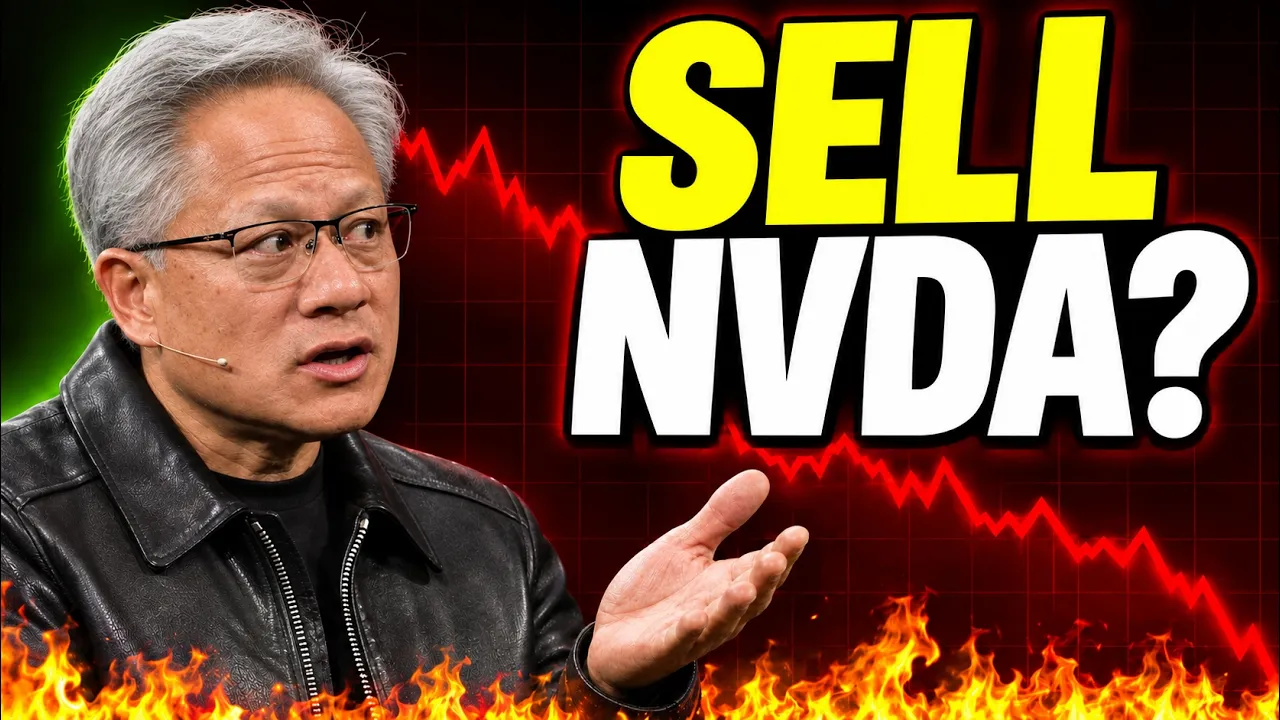
Nvidia is surging more than 5% in the morning session with AMD, Micron, and Brocom also rebounding sharply. Now, after the brutal sell-off that we've just witnessed, investors, they're clearly attempting to buy the dip. But look, one green morning session, it doesn't suddenly remove the risk. Nvidia still lost hundreds of billions of dollars in market value, and it remains within touching distance of its 52- week low. And by one widely followed measure, full P, Nvidia is now trading at its cheapest valuation since 2011. It makes today's rebound look extremely tempting, but it doesn't necessarily make the stock safe. Because we've got Dan Ies, he believes that Nvidia could immediately be worth 25 to 30% less without Jensen Wang from the current price. The warning points to a potential value close to $118. I've therefore built a bare case, a base case, and a bull case for Nvidia. Under my normal assumptions, the shares they appear to be worth around $255. But they've also rebuilt the entire model without Jensen, cutting Nvidia's future cash flow path by 30%. It produces a dramatically different answer, and it tells us whether today's rebound is a genuine opportunity or simply just another trap. Now, we also have Nvidia's earnings report just days away on November the 17th. So, the company is heading into one of its most important weeks with both expectations and uncertainty extremely high. Let's begin with what has actually happened because the difference between an allegation, an investigation, and a proven finding, they matter enormously when we try to value the risk. Now, we've recently heard from President Trump telling us the FBI is looking into Jensen Wang following reports alleging that he had an affair with a woman described as an alleged Chinese intelligence asset. Now, Trump has also said that Jensen's denied knowing the woman was a spy and that he believes Jensen will ultimately be in good shape. At this stage, this is just the president's assessment. And the Nvidia board, they've opened an independent investigation. Now, their statement says a committee of independent directors assisted by outside council will examine all of the available information. And still within this, it says the board currently has no reason to believe that national security or Nvidia secrets were compromised. It also says that Jensen himself is cooperating fully. Now, the board they've also hired WTel Lipson with former, as we can see here, acting US attorney leading the inquiry. It tells us that Nvidia they understand how serious both the legal and the political risk has become. And on top of that, Congress has separately requested that Jensen appear for a closed dooror briefing on November the 18th to discuss Nvidia security protocols and his reported interactions with Alice Wang. Now lawmakers, in fact, they're also looking more broadly at Nvidia's chip ties and the company's influence over US policy governing the sale of advanced chips into China. We got a report from the New York Times. They're saying that a commerce department inquiry into mega speed was transferred to the Justice Department after a senior Nvidia executive contacted commerce officials where separate reporting alleges that Jensen's long relationship with Alice Wang helped enable Nvidia chip sales into China. Now obviously these are very serious claims but as of recording they remain claims under investigation. The risk it therefore extends beyond the personal relationship. Investors must consider whether the reporting leads to questions about export controls, internal compliance, or how Nvidia communicated with US officials. Now, none of those outcomes, they've been established, but Congress, the FBI, the board, and outside council, they're all now examining overlapping parts of the story that honestly it makes a quick resolution less likely. And before we look at Nvidia's response, we're going to listen to the most aggressive bear case that I could find. This is Dimmitri, a Crowd Strike co-founder and former chief technology officer. This is his opinion, not a legal finding. >> Where do you think these lines of inquiry will lead with regard to Jensen Wong and his his role with Nvidia? >> It's great to be with you, Mike. Look, I see no way in which Jensen can survive this as CEO of Nvidia. Look, he he is an amazing founder, an amazing CEO of this company. In many ways, he is Nvidia. But look, any other CEO that has an affair with an alleged Chinese intelligence officer, they'd be out in a heartbeat. Now, that is the extreme outcome investors are now being asked to price. Nvidia's board currently takes the opposite position, and they've explicitly said they retain confidence in Jensen and his leadership team. And Jensen, well, he's returned to work and held his regular meeting with senior executives. CNBC reported that he was trying to project business as usual, although some employees described the internal mood as sad. We've also got the board themselves. They're facing scrutiny. Governor's experts have questioned whether Nvidia's directors became too differential as Jensen transformed the company into a global giant. Now, obviously, this matters because an investigation it can clear the underlining allegations and still expose a governance weakness. Investors want to know who challenges Jensen and who could replace him if at all required. And Bloomberg, they put the issue very plainly. Nvidia's bull case may now depend on Jensen surviving this investigation. This is an extraordinary dependency for a company that's worth more than $4 trillion. Now, Jensen, he founded Nvidia in 1993. He shaped its culture, product strategy, and relationships for more than three decades. investors they don't have an obvious successor standing beside him in public and if we look at the long track record very important Jensen survived several product cycles committed Nvidia to accelerate computing before the market understood the opportunity and positioned the company for generative AI so replacing a successful chief executive is difficult replacing a founder whose judgment has become part of the investment thesis it creates a much larger risk because investors also have to repric future decisions Now the company's unusual structure is always been part of the Jensen advantage. It can move quickly because important decisions flow through a founder who understands both the technology and the market. The same structure becomes a vulnerability when that founder is under pressure. A board investigation it cannot credibly be independent if the board appears unwilling to challenge the person who's actually being investigated. And Dan Ies estimates that losing Jensen would remove roughly 25 to 30% from Nvidia stock value. That's the figure I'll eventually translate into the DCF when we look at that from the perspective of Jensen no longer being CEO. Here's the discussion that frames the key valuation question. Listen to how quickly the conversation moves from Jensen's personal importance to the amount investors may need to remove from the stock. >> Change my mind, but right now I think he'll he'll make it through. It's going to be disgusting and ugly, but I'm a shareholder here and I and I want to see a positive resolution at some point in the future. >> Rob Barren today says unless Nvidia removes Jensen Wong, the stock is worth holding. Jim Kramer saying last evening investors have to consider owning shares in a Jensen less Nvidia. I mean, you have to consider it. Dan Ives says if he's removed, Nvidia is worth a lot less, 25 to 30% less uh as a stock. How are you thinking about it? I mean, if you ask the question, is Nvidia worth less without Jensen? The answer has to be probably. He's one of the most important figures in the industry? He's been at the helm of this ship since its founding. He's been more right more times than just about anybody. That 30% figure is a proposed valuation haircut. Ives hasn't specifically predicted that Nvidia's free cash flow is going to fall by 30%. So my model later on it needs to be understood as a severe execution stress test. And there's also a reason to avoid assuming the company collapses without one executive. Nvidia's return more than 7,000% over 10 years by building technology software and customer relationships that still remain inside the business. Also CUDA does not leave the building if Jensen leaves. Nvidia's engineers intellectual property installed base and ecosystem remain. The question is how quickly rivals could exploit weak leadership or slower execution. And that competitive question becomes especially important as AI moves from training towards inference. The forecast here expects GPUs to face much greater competition from custom chips in the inference market by 2030. Now Nvidia, they may retain a dominant position in training, but inference could reward cheaper or more specialized hardware. a leadership disruption. It would arrive as the competitive battlefield is already beginning to change. Now, Core Weeb, they reported their earnings yesterday and they said they see no reason for its Nvidia partnership to change. Their chief executive called Nvidia an unbelievably important technology company after reporting their quarterly results. And Core Weave stock, it also jumped after they raised their outlook. It supports the argument that AI infrastructure demand remains strong even while Nvidia faces a company specific governance discount. And you can see the operating numbers. They explain why investors are reluctant to abandon the stock. Nvidia's trailing revenue that is sitting around 303 billion trailing net income that's approaching 193 billion where their profits have risen from just over 4 billion in Jan 23 to almost 200 billion on a training basis. I mean, we've got estimates pointing to another enormous expansion through 2029. The latest operating margin that sits at 65% free cash flow margin that's around 38. Return on equity that's 117% while return on invested capital issues around 58. The figures here they show how efficiently Nvidia converts its capital and their competitive advantage into profit. Now the balance sheet it adds another layer of protection. Net debt to Ebitarm, net debt to capital, they're both zero. So Nvidia's not entering this uncertainty with a leverage problem. And we've got the profitability breakdown. It's showing gross margin sitting near 75%. EBIT margin at the 65% level and net income above 63%. Very very few companies of this size produce economics anywhere close to these. And the margins they also give Nvidia options. the company can absorb pricing pressure, increase research spending or support customers without immediately destroying the economics of the business. This is why I would not treat the departure of one person as equivalent to the disappearance of Nvidia's moat. The financial capacity and technology platform, they would still both be formidable. We've also got forward revenue growth estimated 74% forward ebitar sitting above 76. This business is not priced around ordinary semiconductor growth. Now there is one yellow flag here in the table and as we can see here that's their free cash flow growth over the most recent period is negative reminding us that cash conversion will not move in a perfectly straight line and we've also got longerterm estimates it still shows free cash flow rising sharply that cash generation rather than latest headline is what ultimately has to support Nvidia's multi-t trillion valuation now as we said at the beginning of the episode they are due to report the earnings on the 17th just days away after the market close. Wall Street well their expectation is EPS of $247 with quarterly revenue coming in just above 109 billion. And we can see on the left side latest quarter they delivered $222. They beat by 13 revenue reached 96.22 billion and that also exceeded consensus by more than 4 billion. And across the last eight quarters, Nvidia's beaten earnings estimates eight times and miss zero revenue that speed in seven times with just one miss. And then when we look at revisions, analysts, they've been raising their numbers aggressively. Over the last 3 months, there have been 45 upward earning revisions against one reduction and 49 revenue upgrades against one reduction. We've also got the quarterly chart is showing the same pattern. actual earnings. They've repeatedly cleared consensus while analysts continue projecting exceptionally strong year-over-year growth into the next fiscal year. And consensus revenue rises from roughly 412 billion for January 2027 to 692 billion in January 28 and then 94 billion by January 2029. These are extraordinary expectations. I mean even for Nvidia now I would stop relying on any of these expectations past 2029. Main reason for this analyst coverage it does fall sharply beyond the point. So the trillion dollar forecast here they do become much less useful as a consensus signal. The other thing to note is the range of estimates is already wide before the coverage falls for January 2028. Forecast stretch from roughly 506 billion to almost 779 billion. It just shows how uncertain the future demand path remains. And that uncertainty is important because a stock can look optically cheap when investors divide today's price by earnings that have not yet arrived. The earnings forecast still have to become real cash flow. I mean, we've got consensus earnings sitting at 932 for January 2027. Then we can see here 1593 for 2028, 2141 for 2029 at $169. These figures imply rapidly falling forward valuations. I mean the stock trades based here 18 times 27 estimate roughly 10.6 times the 28 estimate and below eight times the 2029 assuming these forecasts end up proving to be accurate. And Wall Street their view in fact is the average target price is $325. That represents more than 90% upside today. The lowest target though bear in mind does 180 or the highest at 515. Now at the same time analysts they're not completely ignoring the new risk. Bank of America removed Nvidia from its US1 list even while retaining a positive long-term recommendation on the shares. Now that's why the price target it does need context. Most analysts have not yet rebuilt their long-term models around the Jensen departure. So, the average target may lack the new governance risk. And the most dramatic valuation chart is showing Nvidia at its lowest next 12-month earnings multiple since 2011. The markets compress the multiple even while analysts continue increasing earnings estimate. And Nvidia's long-term forward price to earnings history. It tells a similar story. The current multiple is far below the level investors have typically paid during the AI expansion. Now, Simly Safe didn't show a forward earnings multiple around 14 compared with a 5year around 35. The yield is also far above its historical norm although it still remains tiny. And if we look at the blue tunnel, we're highlighting intrinsic fair price. This is showing such a massive disconnect. This therefore translates to a potential severe severe undervaluation signal. I mean it's closer to zero than it is the bottom end that is quite a massive disconnect. Not something you typically see. Yes, it has been undervalued for quite some time, but this disconnect probably from all the stocks that we've covered on this channel, never seen something so dramatic. Now, if we look at the broader valuation table, it is more balanced. Forward earnings and PG ratios look attractive, but the price to sales, enterprise value sales and price to cash flow, they still remain expensive, especially against the technology sector. Now what I will say is on forward earnings heat map here and video we can see sits around 11 times cheaper than several major tech companies different platforms they use different fiscal periods which does explain why the precise multiples as we've gone through it today do vary slightly and if we look at the PG price to earnings growth is showing Nvidia at just.17 it looks extraordinarily cheap because the calculation assumes the company can deliver the enormous growth which is currently embedded in analyst forecast. If we then switch to a price to free cash flow, it gives us a more cautious picture. Nvidia is shown here around 33 34 times cash flow, meaning the stock is cheap on future earnings, but not obviously cheap on trading cash generation. Now, this is the valuation contradiction. Nvidia can be historically cheap against its own past and still trade above the sector on sales and cash flow. Both statements, they can be true at the same time. The low earnings multiple, it tells us expectations have fallen. It doesn't guarantee that earnings estimates have stopped falling, especially if the investigation changes customer behavior, regulation, or leadership. And the shares, they're now down roughly 27% below their 52- week high. It's already a meaningful draw down even before we know whether the investigation produces any additional findings. Now, also consider it is Nvidia's fourth decline of at least 20% since the beginning of 2024. the previous drop, they remind us that even the strongest AI winner, they can experience repeated violent repricing. And if we look year to date, Nvidia's down roughly 9% while the S&P and NASDAQ, they're both up around 10%. The stock has given back its entire relative advantage. And in just the last week, Nvidia's fallen around 11% even as some semiconductor peers have risen. It supports the view that this particular sell-off is heavily connected to Nvidia's own risk. And the one-mon heat map is much weaker across technology. So Nvidia is not operating in complete isolation. Semiconductors and several major AI names, they've all experienced substantial pressure. We've also got the semiconductor index is recently traded almost 20% below its 50-day average. Nvidia therefore faces a company specific investigation during an already fragile period for the wider AI trade. We've also got the NASDAQ 100 forward multiple that's fallen towards 18 times. It's the lowest level since the worst phase of the pandemic. The wider market is offering investors a much lower entry valuation. And before moving into my valuations, Tom Lee makes the case that the market may already have absorbed the bad news. It doesn't remove Nvidia's company specific risk, but it matters for the wider backdrop. >> And here we are with this huge run today. What's it mean to you in the big picture? Um I think there were two encouraging data points today. Um the first is we had a a flurry of bad news over the weekend. One involving Nvidia and and some about Texas going after Elon Musk companies and yet the markets are at those stocks are rallying today. I think that's a good sign that markets are rallying on bad news. But the second is the VIX. Uh the VIX term structure which is the fourmonth VIX versus the one-mon that inverted last week. It's now normalized today. That's usually a sign of a bottom. So I I think that this is more proof that last week was the low. >> Tom may be right about the market bottom. Nvidia can still underperform though if the investigation worsens because lower index valuations. They don't eliminate the discount attached to one company's governance. And the positive interpretation is that demand remains intact. Coreweave is reaffirming the relationship and the market's already removed a substantial amount of optimism from Nvidia's price. The negative interpretation though is that investors still cannot quantify the probability of losing the executive most closely associated with Nvidia's culture, strategy, and extraordinary execution. Now, we can value the business. All three normal scenarios, they use a 9% discount rate and 3% perpetual growth rate. The DCF is deliberately driven by free cash flow rather than a target earnings multiple. It asks how much the future cash stream is worth today under several different growth paths and obviously figures here they're estimates not promises large portion of Nvidia's value sits in cash flows in fact as we can see many many years into the future so small change in growth of the discount rate they can move the fair value substantially bare case begins with free cash flow 158 billion in 2027 moving all the way to 211 billion by 2030 this gives us an intrinsic price of $27 $17. Now that indicates 28% upside with a margin of safety of around 22% with the same model using a lower growth rate of 10%. It gives us a value of $176. Stronger 20% comes to $268. Moving to the base case, we start with 150 billion of free cash flow rising to 250 billion by 2030. The base case therefore assumes Nvidia can convert the next phase of AI spending into cash while margins remain exceptionally strong. is optimistic although it is still below several published analyst forecast. Now this gives us a value of $255 implying 51% upside a margin of safety of 34%. Using the sensitivity 10% $26 20% 315. This is the scenario that makes Nvidia look like an obvious bargain. The market price is roughly 1/3 below my estimated base case value. and then the bullc case assuming free cash flow of 200 billion hitting 300 billion by 2030. These assumptions require Nvidia to retain its leadership, preserve extraordinary margins and continue capturing a very large share of global AI infrastructure spending. This gives a result of $36 81% upside with a margin of safety coming to 45%. The sensitivity ranges from 248 lowend up to 378. Obviously, this upper outcome, it requires execution to remain exceptional for another decade. Interestingly, the 306 bull valuation, it remains slightly below Wall Street's average analyst of $325. It shows you how much optimism is still present in analyst forecast despite the selloff. Now, we reach the test that matters most for this episode. I've used Dan IV's 30% valuation warning to construct a severe without Jensen cash flow scenario. I've reduced the base case cash flow path by 30%. Free cash flow as we can see it falls from 150 billion to 105 billion in 2027 then from 180 billion to 126 billion in 2028. The reductions continue to 2030 where free cash flow falls from 250 to 175 billion. From there the reduced cash flow base it grows like the other ones at 15% annually. So keeping everything else constant, we get a value of $179. That indicates 6% upside with a margin of safety, yes, but very small sitting at 5%. Now I have kept the discount rate unchanged to avoid counting the same risk wise. The 30% reduction, it already assumes that weak leadership damages execution and future cash generation. If I was to reduce the cash flows and raise the discount rate as well, the model would be assuming both weaker operating results and a permanently higher risk premium. That would be a harsher fifth scenario. Now, if I reduce business growth to only 10%, fair value falls to $145. That represents 14% downside at 20% roughly rises to $220, indicating 30% upside. The current market price, it implies 14% growth under this reduced cash flow starting point is achievable, but it leaves investors far less room for another disappointment. Now, there is also another separate short-term scenario. If the market immediately applies Iive's full 30% haircut to the $169 share price, Nvidia could temporary fall towards $118. This could create a draw down of more than 50% from the 52- week high. It sounds extreme, but Nvidia has experienced much larger collapses during previous cycles. The distinction is crucial. $118 represents a possible sentiment shock. $179 is my estimated long-term value under the without Jensen cash flow stress test. With Jensen staying and the business delivering my base assumptions, Nvidia looks materially undervalued at $169. My estimated fair value that's $255. If execution remains exceptional, the bull case reaches $36. That would make the current decline one of the most attractive entry points that Nvidia has offered in many, many years. Even the normal bare case produces a value of $217. On the operating numbers alone, I can understand why long-term investors, they're willing to buy the weakness. But without Jensen, that in fact drops to $179. It means today's price, especially with what we're seeing in the morning session, it offers almost no protection if the investigation results in a leadership change and execution weakens materially. My conclusion therefore depends on position size. For an existing shelder with a sensible allocation, I would hold while the independent investigation and earnings provide more information. For a new investor, I would personally treat anything below $175 as a starter position zone rather than really a price for immediately building a full allocation. That means accepting that the first purchase it may fall further. Buying in stages matter because the next headline it could move the stock before investors have time to reassess the underlining facts. I would consider using roughly one quarter of the intended position near the current range, keeping the majority available for either greater clarity or a much larger margin of safety. At around $145, the lower without Jensen value, it begins to offer a more meaningful margin of safety near 118. The market would be pricing in an extremely severe leadership shock. Now, I would also keep cash available for the November 17 earnings report. Strong results could confirm that customers remain focused on supply and performance rather than the investigation and the earnings call. It may matter even more than the headline numbers. Investors will listen for changes in demand, customer commitments, export exposure, and how management address continuity inside the company. The November 18 congressional briefing and any update from the board, it can matter just as much as earnings. The stock now has financial, legal, and political catalyst all arriving together. The evidence today though is says Nvidia's demand engine remains intact. Coreweave is standing by the partnership. Estimates arising and the company continues producing extraordinary profitability. The unresolved question is whether Nvidia can preserve that advantage without the founder who created its culture and has directed the company for more than three decades. So, is this dip an opportunity or a trap? At $169, I see a cautious buy for investors comfortable with the uncertainty, but I don't see it as a risk-free bargain. The stock, in my opinion, is cheap if Jensen stays and execution holds. It's close to fair value under my without Jensen stress test, and it could trade much lower during a confidence shock. My approach would to be buy slowly, keep the position controlled, and demand a larger margin of safety before becoming aggressive. This is a moment for discipline, not blind conviction. and let me know your thoughts in the comments below. Is Nvidia a buy today or maybe one just to stay on the sidelines? If you enjoyed the episode, smash the like button, hit the subscribe and bell so you're aware of future releases, and don't forget to click on the pin comment where you can sign up and read our weekly articles. Every single week, we uncover severely undervalued stocks as well as what's going on in the market. More importantly though, have a great day. I'll see you all on the next one.

Commentaires 0
Connectez-vous pour rejoindre la discussion.
Se connecterAucun commentaire pour l'instant. Soyez le premier à partager votre avis !