…nd we recently just broke out here. And what's interesting is we broke as we broke out here, implied volatility on the options are incredibly cheap. We're under the 5% range in terms of how inexpensive options have been over the past year. So I think this is an opportunity to actually buy some upside using a call spread. And I'm going out to the December expiration. I'm looking at buying the 235270 call spread earlier today. You can pay about $12.40 40 for that debit spread. And what that's buying you is the upside potential into our upside uh 270 target, which is essentially a measured move of the trading range that it's been in over the last few months proje…
So I think this is an opportunity to actually buy some upside using a call spread. And I'm going out to the December expiration. I'm looking at buying the 235270 call spread earlier today.
Contexte extrait par IA
Yeah so Nvidia recently broke out above you know that 230 level which has been an important resistance level for for many months now. It's been trading between 210 and call it 235. And we recently just broke out here. And what's interesting is we broke as we broke out here, implied volatility on the options are incredibly cheap. We're under the 5% range in terms of how inexpensive options have been over the past year. So I think this is an opportunity to actually buy some upside using a call spread. And I'm going out to the December expiration. I'm looking at buying the 235270 call spread earlier today. You can pay about $12.40 40 for that debit spread.
Transcription Complète
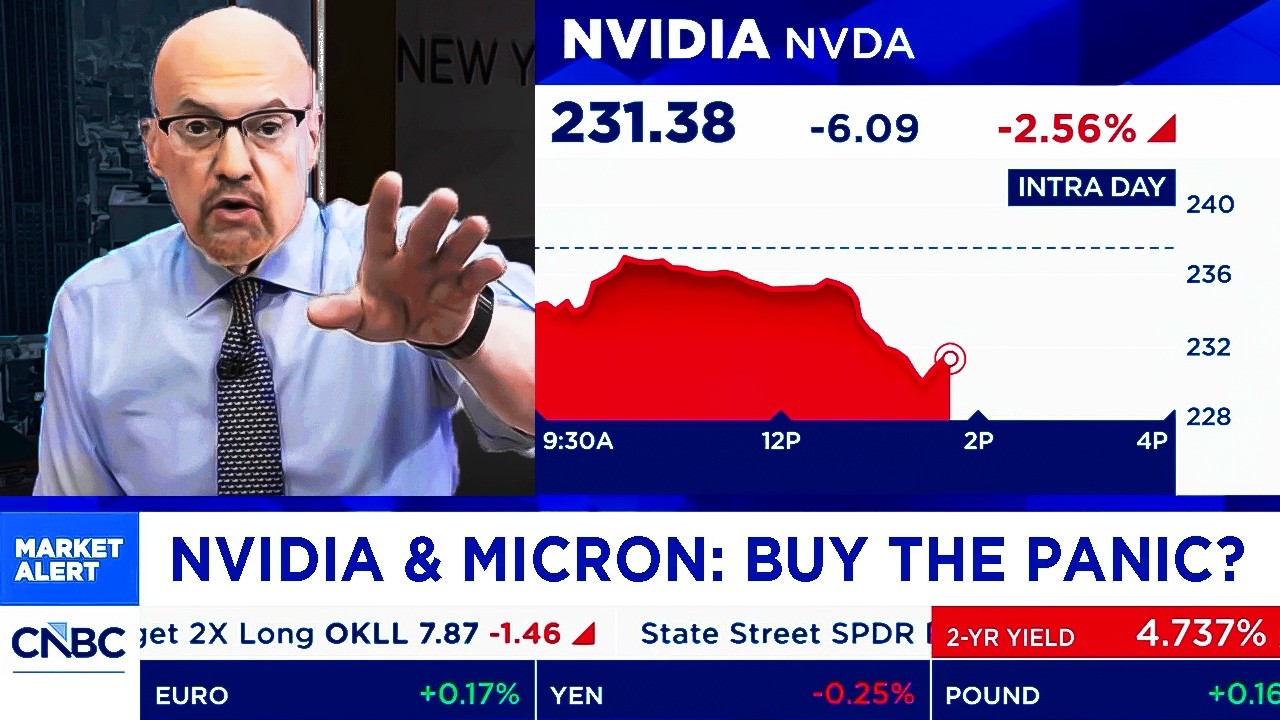
We've got a great guest to have this discussion with right now. Joseph Moore of Morgan Stanley writes the following. We expect the memory shortage to be a constraint on builds. Intensity of shortages may fluctuate, but AI will basically use all supply for the foreseeable future. Joseph joins us now for more. Joseph, good morning. >> Thank you. >> Can we just sit on the capital effort, the race to raise capital right now and how much of that money is just flowing downstream to one place which is the chip stocks that you cover? Yeah, it is a very big focus for investors, you know, and I think we've been in the situation where it's extremely capital intensive buildout, but at the same time, the industry is constrained, as I said in that note, by memory, by foundry, by uh land power shell. There are a number of constraints where you might have seen in prior tech inflections, you see over supply because there's easy money. Here, there's a lot of investment, but there really are bottlenecked by these constraints. And to me, that that lends itself to the duration that we're seeing. And there's a lot of unmet demand right now. So to the extent that you have these financing concerns and things like that, um there's still more demand than we can meet. >> Are doubts starting to emerge about the runway here because of the higher borrowing costs. We're seeing spreads a little bit wider for some of the companies that are issuing this debt. SpaceX an example of that. They're in the news in the last 24 hours. Then when companies like Samsung and TSMC put up great numbers, you're seeing muted responses in equities. What do you think that signals? >> Yeah, I think this is something of a duration bet for our stocks, right? you're looking at. It's less about how good this can get. We all know it's very good. It's more about how long it can last. And I think it's hard for companies on earnings calls. We saw the same thing with Micron a couple of weeks ago. Great numbers, great commentary. Stock doesn't do much because we're sort of trying to figure out how long this is going to last. And I think, you know, it does feel to me quite durable. And we've seen the capital spending endure despite a number of inflationary aspects on the spending side. We've seen memory prices go up. seen a lot of reasons why uh people have had to raise more money and spend more money and so far the market has been relatively enthusiastic for cloud capex and things like that. I think that's the thing to watch. If if you start to see capital spending announcements from the customers that are less wellreceived then you might sort of see people pull back. Right now there's still a lot of enthusiasm for AI and and what it represents. And we're still mindful of the risks. It's part of our our our stockmaking approach is to think about, you know, what happens in different scenarios and and a little bit away from the bottleneck trades and a little bit more to the companies that can endure even if there's there ends up being some of these obstacles. >> What's the scale of durability? I mean, you're talking about how people are skeptical that this can keep going for a long time. You do think it's durable. Are we talking about people only being able to see two years out and then potentially seeing a cycle and you're seeing five years out? I mean, how how big is the mismatch of faith in a long-term trajectory? Well, I think anytime a semiconductor analyst tells you he knows what's going to happen 5 years out, you should be skeptical. Um, our data points tend to not extend that far out. And and then if you would ask me 5 years ago, could Nvidia be guiding to about 700 billion next next year? No, that's impossible. So, we didn't see all of this coming. And I think we have to be mindful of of those risks. But, you know, certainly for 27, you've seen companies like Nvidia and Broadcom talk about 70% growth, 90% growth, and a lot more demand than that that's unmet. And so a lot of that then goes into 2028. And when you hear the financing plans from the customers, when you see what they've laid out, they've raised money for the next couple of years. So certainly for a couple of years, it should remain strong. Beyond that, could there be a digestion? I wouldn't rule it out. You know, I think there is that's the nature of cloud. We've seen 20 years cloud has been the most predictable trend in it. And yet there have been these windows of digestion. You could see it. At the moment there's there's more compute uh requirements than there is supply by a significant margin. >> Yeah. but because of the debt issuance and I think that that's the important aspect and John was alluding to that and I think it's a really important point when you take a look at anthropic cutting prices on its latest and greatest model and highlighting oh this is going to be cheaper and have the same kind of capabilities you see a sort of race to the bottom in pricing with open-source models etc you see that customers are not willing to pay yeah >> while at the same time a lot of these hyperscalers are borrowing tens of billions of dollars in order to finance chips there's a mismatch here at what point is that mismatch going to close the wrong way or the right way? >> Yeah. Well, I think what a lot of the what we think about from an investment standpoint is companies that can benefit regardless of how that goes. You know, Nvidia talks a lot about their strength in these sort of premium frontier closed models, but also a lot of the exposure that they have to open weight uh and the sort of more commoditized models, the lower price models. They're benefiting from each of those trends. And so, I think uh at the moment there's good profitability in all of those. There's investments in all of those. Uh certainly the rate concerns are something to consider, but it's again we we've absorbed a lot already that you say, "Okay, maybe we should slow because this is more expensive, that's more expensive." The appetite to spend is still there. And I mean, I think, you know, you can see it. I feel like everyone who comes on onto your show from the executive side is, you know, AI is changing things. Intelligence is something that we want more of. And so, I think, you know, it does feel like it's enduring. I think we'll have to see through economic cycles. U you certainly need a vibrant capital market to fund all of this, right? It's while I do expect there to be very good cash flow from cloud and from AI over time, it's because it's growing so quickly, there's a lot of capital intensity up front. So capital markets are important, but I still think it's it's fairly robust. >> As a bottomup analyst, you'll have to forgive me for focusing on one day because I know you do so much extensive research, but just one day's price action. I was curious about what happened yesterday for the stories about SpaceX to raise significant money to then go and spend that money on Nvidia that Nvidia finished the session lower. >> Mhm. >> It just raises question. You saw the push back in the credit market to SpaceX even thinking about doing this and you didn't see the equity rewarded on Nvidia. Just made me wonder when the market discussion has shifted just a little bit. You're starting to look at the borrowing costs and credit and starting to say >> on that runway question, the durability of this, it's not that durable. Yeah, I I think that's really framed the the entire year so far, right? I I think um you know, we moved Nvidia back to our top pick in March and it has really underperformed quite materially some of the more spec names, some of the names that have the the the the most kind of potential new stuff that could happen. The the bigger stalwarts have underperformed because people do have these duration concerns. Um, I think it's something that you prove out a little bit at a time, but I would take, you know, in those specific examples, you've seen companies say, you know, we want to spend 8 gawatt next year. Um, and you look at what's actually in backlog and it's a fraction of that. So, I think in some sense, we're talking about how much upside can there be and how much of that can the industry support anyway. I mean, they they can't do it and and I think, you know, Nvidia has right now a really important product uh with Vera Rubin and I think that that's going to help with a lot of these concerns, but I think to me it's a little bit of a grind. It's a little bit, you know, uh, one day at a time as you, as you said. Um, and I think these that's how the duration trades are like when you have a bet on, you know, 6 months ago micron was about how good can it get this quarter. Now it's about how long it's going to last. That's something that takes a little longer to answer. >> 300 price target on Nvidia. >> Yes. Which is still a, you know, submarket multiple. >> Yeah. It's amazing to hear you say it's underperformed this year and it's up 27% year to date. >> Well, semiconductors are >> I know they're flying sort of like vertical. It's crazy. >> But back to the AI trade, guys. you know, Nvidia retreating a bit again. Not unexpected, of course, >> given the overall market. >> You know, look, there there's really NASDAQ down about half a percent. >> Well, look, Samsung preliminary is it's the greatest quarter of ever any company. The numbers from TSMC are just incredible. They reacted not well. And Nvidia is just in lock step with those companies, whether you think it should be or not. And then we had this Australian fiasco, a little company that, thank you Bloomberg, I was not following called Firmus, an Nvidia backed AI cloud company that uh Nvidia invested 1.885 billion Australian in 2025 and they were trying to get a deal of um of 33 billion and so you maybe invest you know there's the thing's really expensive. >> Okay. And there's an open lock up. You can just apparently we don't know. This is I have to tell you this is a little opaque this firmst but I know that this was the chatter that here's an Australian Bitcoin miner that switched. It's got great plans. Uh Nvidia backed it but it looks like the stocks overvalued. All these things have suddenly turned to make it so we think Nvidia should be sold. I'm asking for more than that before I sell Nvidia because how many times have people sold Nvidia who watch this show? How many times you have to soldier through invading? This fight's not worth fighting. >> Soldier through what? >> Vicitudes. >> Ah, >> we have these facitudes. They do have a buyback. I hope that they're keeping their powder drive for a little bit more down, but I just think that we've we've seen this so many. How do you get to 6 trillion? You don't go in a straight line of 6 trillion. Six. It's been a stair step and there's been moments where it's just total despair and people just say, "I'm out of that Nvidia. I don't want to touch it." I had a caller last night said Jim I diversified from Nvidia to microns but you that is not total diversification. Yeah, >> you maybe >> although some would some would come back and say the the latest chapters of that of those vicissitudes have been repaired by financing from Nvidia themselves, right? >> But that's been their model. And if you go back over the somewhat hundred million dollars they've invested, they've done incredibly well. And I think that what it what Jensen had to do is create a world of of generative AI. And he had to do that by investing in everyone including like take take a look at what happened with with Matt Murphy with with with Optic. Optic wasn't doing well and yet Jensen said you know we're going to have to have fiber in so let's give some money to momentum to coherent. Next thing you know uh you you've got an incredible market that's got optical all over it. That was what Matt Murphy was talking about from Marll. I just think that Jensen again I I'm in the visionary camp. There's so many, you know, there are people now saying, "Listen, he's too li about about cyber security." There's always been criticism about him ever since the company's crossed the trillion dollar track because people just don't believe it. And yet Microsoft, a software company, we were happily happily paying three trillion for that. I think that the ecosystem that that Jensen has set up is the most valuable ecosystem I've ever seen. >> Micron shares lower this morning even though Samsung's record profit should bode well for the memory makers outlook. Micron soaring throughout 2026, including a 4% gain yesterday driven by our next guest incredibly bullish call. Let's bring in Gil Lauria, managing director at DA Davidson and Co. raised his price target on the stock to $3,000 now highest among all the analysts covering Micron. Gil, why now? >> Yeah, we think Micron the demand for AI is so great, the demand for memory is so great that Micron has a path to grow over the next three to five years. And if you look at the closest comparable market is the CPU market and stocks there AMD and Intel are trading at 40 times earnings or more while Micron trades at six times earnings. That's one of the biggest dislocations we've ever seen. So we understand this is going way out on a limb but we almost feel an urgency to create awareness that being underweight here is almost a risk. So, if you're a long-term investor, the mark the market cap of Micron is 3% of your NASDAQ 100 benchmark, but earnings over the next 12 months from Micron will represent 10% of the earnings of the NASDAQ 100. So, if I'm right and they tried up to a market multiple, that one position that you're underweight or if you don't own Micron will result in you missing your benchmark dramatically. And if you're short, the company will be will start buying back stock December 9th. That's when their limitations on the buyback expire. And they've said they're going to use 100% of their excess cash flow to buy back stock. And they're going to do that opportunistically. Those are the worst things you can hear as a short seller. So you have an expiry on how long you can be short this stock. So we decided that yes, it's an unusual measure to have a price target that's three times the uh the current stock price, but all that does is represent a market multiple. And if a company can grow more than the market over a cycle, it deserves at least a market multiple. >> Gil, why hasn't it why doesn't it get a market multiple? Why is it only trading at at six times? It's not like anything you're saying really is not well understood or known by the street. >> I would argue that it is not well understood. that people's mindset is that this is still the micron of 2023 that was selling a commodity, a highly cyclical commodity in that market. And what they're selling now is completely different. 3 years ago, memory was entirely used for storage. Now, memory is how AI works. The more memory you put to a model, the better it works. The more memory, the faster the model works. The more memory, the bigger the context window. The product is now going to be sold more than half in five-year deals. That's not just a deal structure. It's because your Microsoft, Amazon, and Google are designing memory into their data centers in a nonfgeable way. So, the product is no longer a commodity. It's no longer sold like a commodity. The market has not wrapped its head around it yet. The stock has gone up only on earnings growth. The multiple expansion hasn't happened yet. And as we talked to many investors, they we feel like many investors still have not wrapped their head around that. The changes have been so abrupt just this year that we think investors as they catch up, they will be willing to pay more of a market multiple for this. Which is not to say that they'll pay a multiple closer to CPU stocks, which again are trading at 40 times and above on what is really an equivalent market with the same cycle. It's the same cycle. The AI cycle is the same cycle for GPUs, CPUs, and memories. When the market wraps its head around that, the multiple should expand very dramatically. >> I keep thinking about what Moro said a couple of quarters ago about humanoid robots using, I think you said, 10 times the memory of an autonomous vehicle, and I wonder whether or not the street needs to see new form factors to believe them. Well, I I I would be talking about that if Micron was already trading at 30 times earnings because that's the next leg of growth three to five years out. The market is isn't even giving Micron credit for what it has right now, which is the AI data center business, it's certainly not giving it any credit for the fact that anywhere you do compute. So as we talk about computing going to the edge to our PCs to our handsets ultimately to robots the memory the GPU content the CPU content the memory content in those is actually going to be even greater than the data center >> and that's really not reflected in any of these stocks not not least of which in memory >> I guess Gil one of the one of the arguments or push backs can be that the shortage eventually will catch up maybe maybe in two years or so And then what's on the other side of that? Especially if we're looking at cooling demand for AI eventually, you know, it's not going to go on like this forever. >> That's right. But that's true for CPUs and GPUs as well. And what I It's the same cycle. So we're going to have excess supply at the same time in GPUs, CPUs, and memory. And yet CPU stocks 40 times, GPUs 20 times, micron six times. >> All right. So then let's dive into the trades that you've brought today. uh because one of them is certainly one that moves the market anytime it moves just based on its sheer size. You've got Nvidia as your as your first play today. So how would you look to trade Nvidia for example purposes Tony? >> Yeah so Nvidia recently broke out above you know that 230 level which has been an important resistance level for for many months now. It's been trading between 210 and call it 235. And we recently just broke out here. And what's interesting is we broke as we broke out here, implied volatility on the options are incredibly cheap. We're under the 5% range in terms of how inexpensive options have been over the past year. So I think this is an opportunity to actually buy some upside using a call spread. And I'm going out to the December expiration. I'm looking at buying the 235270 call spread earlier today. You can pay about $12.40 40 for that debit spread. And what that's buying you is the upside potential into our upside uh 270 target, which is essentially a measured move of the trading range that it's been in over the last few months projected out above that breakout level here into that 270 level. That's our upside target for end of year. And this call spread allows you to potentially uh take advantage of that move here to the upside while paying roughly uh you know about one you know less than 1% of the stock's value in this particular case risking less than 1% of that stock value giving you about a 2:1 risk-to-reward ratio if um Nvidia can get back to that 270 level by the December uh end of year expiration. >> And Tony another thing that caught my attention uh was the implied volatility rank for Nvidia. It's just four out of 100. How important is cheap options volatility to your decision to use a call spread right now? >> Uh I would say that's one of the primary reasons why I'm using a call spread is because options are so inexpensive, giving me uh the ability to buy that upside while risking the smallest possible amount relative to the stock's price. So, an a really important part of of what we're looking for and when we're choosing an option structure to take advantage of our upside potential. >> Uh, feeling pretty bullish. I don't think there's a bubble. I don't think anything's going to pop. I don't think anything's going to crash. I think we're um we're building new infrastructure for a new, you know, type of computing. And, uh, we're in the middle innings. >> Um, interesting. >> And so, I think there's a long way to go. I think Nvidia is going to grow their revenue a lot next year and the year after that. And I think that the big tech companies are making um high return investments in these data centers and they're going to keep going. >> Okay. >> So um we uh we think the outlook for the stock market is really good. >> So no the circular financing the trying to find product the the revenue none of that gives you makes your palm sweaty. >> We uh the circular financing is worth paying a lot of attention to. I think Nvidia has made um guarantees and um you know like backup facilities and stuff like that to about $600 billion dollars worth of of um of loans and that's a heck of a lot but their their EBIDA is over 200 billion now and growing. >> So I think in the scope of their balance sheet and with a $6 trillion market cap um 500 billion is actually manageable and thus far actually Nvidia's made a lot of really good investments. If you look at Coreweave, if you look at um a lot of their model maker investments in in private companies, they've actually invested really well. So, we think um uh management of Nvidia and also the big tech companies deserve the benefit of the doubt and are doing very well thus far. >> Yeah. >> But what else do we know about this this FT story? >> So, Brian, I just got off the phone with a source who's familiar with OpenAI's financials. That $50 billion dollar that the FT is reporting is their revenue number. I'm hearing that is accurate. and some nuance here that 20 billion dollar adjustment. So it was $70 billion was sort of the number that was out there. I'm told that is including some revenue sharing from their big partners. So think about Amazon, think about Microsoft. The $50 billion is what goes directly to OpenAI's revenue numbers to their balance sheet. So it is a cleaner number from what I'm hearing and it's a way that certain investors are taking that and trying to compare it directly to Anthropic. I would just say it speaks to the fact that these companies are private. The fact that it's an entirely new asset class and the way that they have been reporting revenue has included some of these big partnership deals. $50 billion is stripping that out. So, it gives a little bit of color there. But we have confirmed the FT report is accurate in terms of that number, but a little bit of nuance there. Potentially positive news for some of OpenAI's partners though if that revenue is actually their revenue. You think about Amazon or Microsoft. I'm not sure what those stocks are doing, but that is that is one potential beneficiary of this. Those companies report earnings coming up and these are quarterly numbers. So that could be one of the implications of this report. Brian, >> the week. So not only do you say tech broadly speaking is set to rally to all-time highs, but a specific stock, I think it's called Nvidia. I think I've heard of this company before. Me too. >> Yeah. It's just like it's just rolls off the tongue. That might be poised for a new record. Well, we've seen already a good test of resistance for Nvidia. And if it were to confirm a breakout above 237, the measured move projection that you can arrive at for Nvidia based on a breakout would be about 262. And that's very compelling. We all know that Nvidia has the largest footprint in the major indices and also is really essential to market sentiment when it comes to semis and uh the AI trade. So we think it's key to the market and would also encourage folks look at names that have corrected Broadcom for one that have seemingly turned the corner. So we have some different setups that are both intriguing from a technical perspective. I do want to start with that report from the Financial Times because to you does this sort of concern you as a sign of a slowdown or is this sort of hard to understand considering the fact that Open Eye is still a private company? Yeah. And that's why these reports I think it's always, you know, I think it's it's dangerous or slippery slope to always go down every report. You know, that that that's negative. Cuz if you go back the last year and a half, two years, you know how many negative reports there were out there, which ultimately didn't really end up materializing. And in my opinion, everything I see in the AI revolution, it goes counter to that. Actually, things are accelerating. So to me, these are buying opportunities, not the time to be skittish. With that in mind, I mean, we are seeing some of a bit of a slide here when it comes to OpenAI's partners Microsoft Oracle Broadcom Nvidia reacting to this news. So, is this once again, as you're noting here, a sign of the market being on edge or does this sort of raise those financial circul or circular financial uh concerns? Yet again, >> I think, look, it's a great point. I think part of it is just on edge is that any breadcrumb that could be viewed negatively, a report there, circular financing or whatever it may be, it's going to, you know, make investors nervous and you're going to see these reactions, you know, in terms of these stocks. But my whole point is we're going to go through earning season and this is accelerating in terms of the AI revolution. I think we're going to look at opportunities like this just like we've looked at the last three six months nine months you know SAS apocalypse and others and these are buying opportunities we are a third inning of AI revolution >> at the same time we are expecting these IPOs seemingly coming sooner than open AI does this concern you at all when it comes to these IPOs I mean is it no longer safety concerns or this the next wave of what could raise red flags for investors heading into those as maybe one would out win out over the other. >> Yeah, I think appetite's going to be strong relative to the epicenter of the AI revolution is anthropic is open AI. Some of the safety concerns obviously raised and those guardrails need to get put in place. Why? That's going to be a self-regulation. But the reality as this all plays out for every dollar spent on Nvidia chip there's an eight to10 multiplier across the rest of tech and the model players are going to be centering that. Now I still believe in terms of sovereign AI and the data debate you're going to see more and more of the winners outside the frontier models whether that's Palunteer snowflake and others. >> All right I hope you're all doing well today and staying calm in this market. Thursday was a mixed day in a market and it was an especially rough day for many AI hardware and data center jacent stocks for multiple reasons. I'm going to address the FT story about OpenAI in a moment, but let me quickly mention what was happening prior to that story being published. Initially during Thursday's session, many stocks were already trading lower in response to oil and yields moving higher on rising tensions in the Middle East. There were also reports Wednesday evening indicating that Nvidia backed Firmst Technologies in Australia was facing IPO demand problems and its IPO pricing was reduced by about 25%. So that was the backdrop during Thursday's session that initially caused many AI hardware stocks to trade lower and then what really sent AI stocks lower on Thursday was an afternoon story from the FT saying that OpenAI's ARR is $20 billion less than what was previously signaled. As a reminder, Axios published a story on September 29th saying that OpenAI's ARR was nearing $70 billion. The FT is now saying that ARR is closer to $50 billion. The FTE attributes the discrepancy primarily to investor adjustments intended to make OpenAI's revenue comparable with Anthropics. CNBC confirmed, according to their sources, that Open AAI told investors that they hit roughly $50 billion in annualized revenue at the end of September. According to Axios, OpenAI only records its share of partner sales. And so, the larger roughly $68 billion number that was reported at the end of September appears to be gross revenue, which includes revenue belonging to OpenAI's partners under revenue sharing agreements. Some investors included partner revenue in the ARR figure to try and make the comparison between OpenAI and Anthropic's ARR figures more of an applesto apples comparison. It appears that this whole situation was just a big misunderstanding of gross revenue versus net revenue. Put simply, Anthropic includes revenue generated through cloud partners when calculating its annualized revenue. OpenAI does not include comparable partner revenue when calculating its annualized revenue. Some investors attempted to make the two companies ARR figures comparable by including partner revenue in OpenAI's ARR figure that resulted in a roughly $68 billion ARR figure that was reported in late September. Now, it's important to note that under OpenAI's current revenue sharing agreement with Microsoft, Microsoft reportedly receives 20% of OpenAI's revenue, even when that revenue comes through competing cloud providers. And so, if you take the gross amount of 68 billion that was reported in September and you subtract Microsoft's 20% cut from that amount, you get $54.4 $4 billion of net annualized revenue. Of course, I'm just accounting for the Microsoft partnership. There are other arrangements with other companies as well. But notice this, the discrepancy between the $68 billion gross revenue figure and the $50 billion net revenue figure is mostly because of OpenAI's revenue sharing agreement with Microsoft. Some investors decided to gross up OpenAI's ARR by including partner revenue in order to make it more of an applesto apples comparison with Anthropic's ARR figure. This whole situation is just a matter of accounting differences as some people confuse gross revenue with net revenue. That does not change the underlying fundamentals of what's actually happening here. There's not a deterioration in demand and OpenAI was still running at a roughly $70 billion gross ARR at the end of September. That's still the reality of the situation. Even if you strip out partner revenue from the gross revenue figure, nothing has actually changed. The market had a knee-jerk reaction to the FT story and I think the sell-off was largely overdone. The downward action was exacerbated by everything else that's going on with higher oil, elevated yields, and the reports about Fermus IPO pricing. on Wednesday evening. The market was already nervous before the FT story was published. In other news, we got TSMC's September revenue report on Thursday. TSMC, of course, manufacturers Nvidia chips. September revenue was down 0.6% month-over-month, up 54.6% year-over-year, and revenue during the first three quarters of calendar 2026 was up 41.1% compared to the first three quarters of 2025. Mon-over-month declines in revenue are normal for TSMC, and it's nothing to be concerned about. What matters is that the overall trend remains intact. And the trend is clearly intact with September revenue up more than 54% year-over-year. As I mentioned in Wednesday night's video, we got Samsung's Q3 preliminary earnings guidance showing a slight miss on revenue and a slight beat on operating profit relative to consensus expectations. Samsung's operating profit was up more than 782% year-over-year. We did see some slight red action in memory stocks even before the FT story on Thursday, which was likely in response to Samsung's earnings guidance. As I said repeatedly before Samsung's earnings guidance was released, there are some market participants who are impossible to please right now as it relates to memory makers earnings because they are scarred from the multi-deade cyclicality of the memory business. Many of them are entirely unwilling to even consider the fundamental differences between this current moment and the typical memory cycles of the past. Because of that, we're in a lose-lose situation when it comes to market sentiment toward memory makers earnings. If results are very strong, they assume the cycle is peaking. If results slightly miss expectations, they assume the peak is behind us and that the cycle is starting to roll over. That's unfortunate. As I've said many times, there are fundamental differences between this current moment and the memory cycles of the past. And I think this moment will last longer than the typical memory cycles of the past. Also, a brief reminder and a heads up about Micron. I mentioned in Wednesday night's video that the Taiwan Labor Union voted overwhelmingly in favor of a strike authorization. Importantly, the union did not declare a strike and they said they were hopeful that Micron would provide a concrete profit sharing proposal before the union resorts to a strike. That is most likely why Micron traded higher on Wednesday. A strike is not off the table, but the union temporarily held back on declaring strike and they're giving Micron an opportunity to respond and potentially avoid a strike. A two-day Micron board meeting is currently underway. That meeting was scheduled for Thursday and Friday of this week and so we will likely get Micron's response soon. We don't know what Micron's response will be and we don't know how the union will respond. If a strike is declared, that would most likely have a short-term negative impact on the stock. If a strike is averted, that would likely have a short-term positive impact on the stock, assuming that investors are not spooked by Micron directing a higher percentage of operating profits to employees. We will have to wait and see what happens. We will probably get more details at the end of this week or early next week that could impact the stock. So, keep that in mind. In other news, Taiwan exports rose 60.9% year-over-year during the month of September versus expectations of roughly 45.6%. That bodess well for Nvidia and the entire AI ecosystem. Looking ahead, Jensen Hang is scheduled to deliver a GTC keynote at GTC Berlin on October 21st. Now, in case you're new to the channel, I want to make sure that you have at least a basic understanding of the underlying long-term thesis. So, let's cover that. Now, I don't know what's going to happen in the short term, but from a long-term perspective, I am very confident that Nvidia will be worth much more in future years than it is today. When Jensen was on the Lex Freedman podcast not that long ago, he was very seriously raising the possibility of Nvidia becoming a $3 trillion revenue company in the near future. If that happens in the coming years, then it is very plausible that Nvidia could one day be worth tens of trillions of dollars in market cap. That might sound crazy, but that's what Jensen is implying when he raises the possibility of Nvidia becoming a $3 trillion revenue company. I guess the question at that point is what multiple the street will be willing to give Nvidia. I don't know the answer to that question, but I truly do think that Nvidia will be worth much more in future years than it is today based purely on the fundamental growth of the business. Based on everything I'm seeing, the world is still computed and I expect that to continue at least through calendar 2028. In a computed environment, developers will use whatever viable compute they can get their hands on. Today, there are no GPUs that are sitting dark due to a lack of demand. Like there was fiber sitting dark due to a lack of demand at the height of the dot bubble. Back then, companies were laying fiber in the hopes that use cases and demand would eventually show up. Today, we are seeing the complete opposite. As I've said many times, when market participants compare this AI revolution to the dotcom bubble, they ignore the fact that the internet is already here this time. This means that mass adoption of the technology and new use case development at scale are immediately possible. We don't have to wait years for it to show up. It's already here. The world is compute constrained, which means there is not enough supply to satisfy demand. New capacity is utilized as soon as it comes online. The hyperscalers are monetizing capacity as soon as it comes online. Each of the hyperscalers spoke about being supply constrained on their most recent earnings calls. Additionally, many of the clouds are building out into contracted demand. They're not blindly building in the hopes that demand will eventually show up. No, they're building out because they have signed contracts and in some cases significant prepayments from their paying customers. This AI revolution is fundamentally different from the do-com bubble. And 2026 will be a pivotal year for the AI industry thanks to the rapid adoption of agentic AI and the proliferation of agentic systems in the world's leading enterprises. The leading AI labs revenues are surging right now. Agent coding and the implementation of agentic systems in large enterprises are new use cases that are increasing inference demand significantly that subsequently is increasing compute demand. The rapid adoption of agentic AI is why we're seeing an inflection in inference demand. It's why we're seeing the leading AI labs revenue surge. I wish both Anthropic and Open AI were public so the public could see the ramp in their revenues. I think the leading labs surging revenues may be the initial proof point that grabs market participants attention and causes them to realize that there will be a clear ROI on AI infrastructure. I think the leading labs surging revenues will also help assure investors of the longevity of Nvidia's growth since these labs revenues are directly tied to compute. If they had more compute, they would have greater revenues. It really is that simple. Demand is not the problem. The problem is a lack of supply to meet the demand. As I've said previously, I expect the world to be compute constrained at least through calendar 2028, possibly longer. And so, regardless of what happens in the short term, it's important for long-term investors to remain focused on the fundamentals, maintain a long-term perspective, and remember that we are only in the early stages of aenic systems being adopted at scale. This will increase compute demand significantly, and after that, the next surge in compute demand will likely be fueled by physical AI. We're no longer talking about digital agents performing digital tasks. With physical AI, we're talking about physical AI agents performing physical tasks in the real world. NVIDIA CFO has called physical AI quote a multi- trillion dollar opportunity and the next leg of growth for NVIDIA. This industry will fundamentally transform society and NVIDIA has positioned themselves to benefit massively. NVIDIA sells the hardware for the data centers where the models are trained. They offer omniverse where the models are taught and tested. And Nvidia also sells the hardware that allows ondevice real-time inference through NVIDIA AGX, allowing robots to have intelligent interactions with the real world, even when they are not connected to a data center. Notice that NVIDIA is taking a holistic platform approach to physical AI, and they're embedding themselves as the underlying foundation supporting all of it. Over 3 million developers are already building on the Nvidia robotic stack, and this is not getting enough attention. As for production ramps, Blackwell Ultra has ramped and remains in high demand. Vera Rubin is rolling out to customers. Nvidia Gro 3 LPX is in full production. Later on, we're expecting the launch of Reuben Ultra in 2027 and Fineman after that in 2028. We have a clear data center product roadmap stretching into 2028. And Jensen believes that AI infrastructure spending will reach three to 4 trillion annually by the end of the decade. That means Jensen is expecting growing AI demand and an expanding total addressable market underpinning all of this. I don't think we are anywhere near any type of bubble bursting type of event. With all of this in mind, I seriously think that Nvidia still has plenty of runway ahead of it. And I think this company will be worth substantially more in future years than it is today. At least that's my view of the situation. Quick note before I wrap up. All of the compilations on this channel are edited by Finn Vid with original structure and commentary. Occasionally, the same edits appear elsewhere on YouTube. If you're looking for the original version, it's always here on this channel. Thanks for watching Finn Vid. I appreciate your support. Remember to stay calm in this market. Remember to maintain a long-term perspective and do not make any hasty or irrational decisions. With all of that being said, I hope you all have a great rest of the day. And I'm curious to hear your thoughts about Nvidia in the comments below. Please leave a like on this video so more people will see it. And while you're down there, please consider subscribing. It's free and you can always change your mind. Thanks for watching and hopefully I'll see you in the next

Commentaires 0
Connectez-vous pour rejoindre la discussion.
Se connecterAucun commentaire pour l'instant. Soyez le premier à partager votre avis !