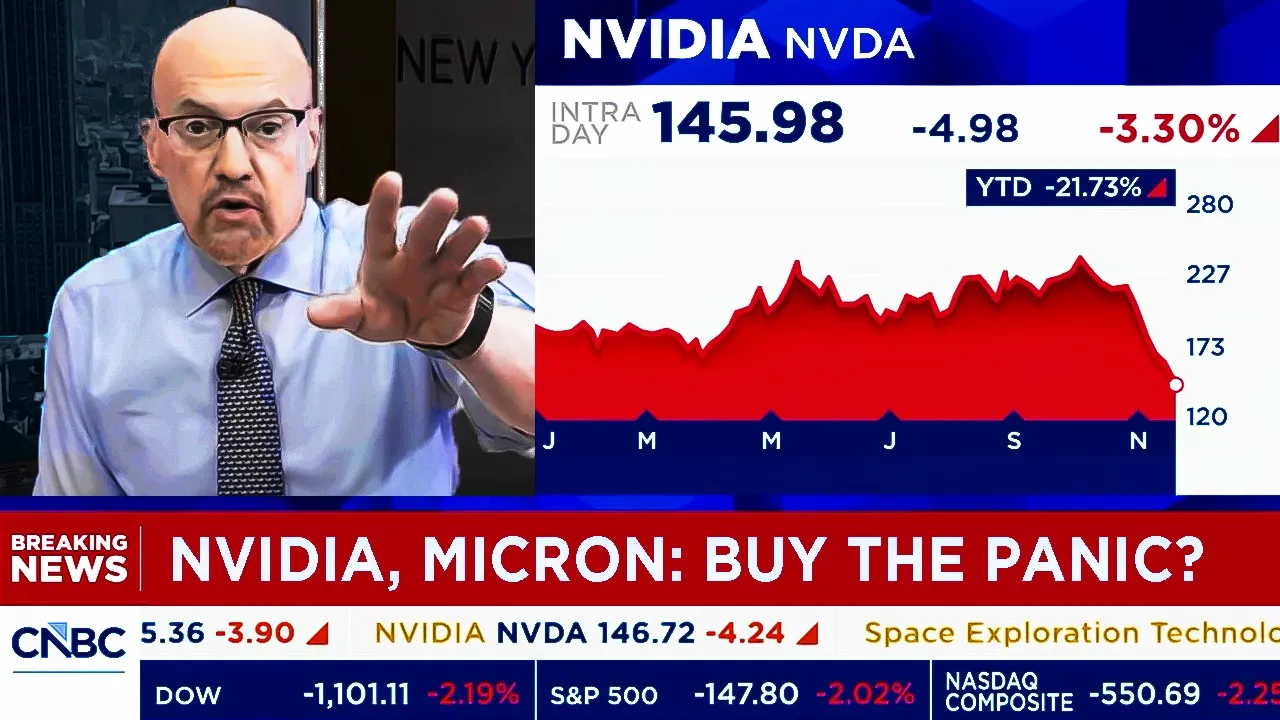
CNBC & Fox Today On NVIDIA Stock, Anthropic IPO, Micron Stock - NVDA Update

- Rendement de la vidéo
- -14,01%
- Appels
- 1
- Achat / Vente
- 1 0
- Publié
Recommandations
L'entrée est le cours de clôture de l'actif à la date de publication. Le cours actuel est la dernière clôture enregistrée.
-
Entrée $145,98 19 nov 2026Actuel $125,53 20 nov 2026Résultat −$20,45vs. indice −10,4% SPY −3,6% sur la même période
Citer cette recommandation Voir le segment source (553s) *
Contexte de la transcription source
…sed its guidance. It still is the company that enables AI. They're going to grow 75% this year on the top line. Uh and the shares are trading at about 10 times earnings. That's half the valuation of the S&P 500 with three times the growth. You have to own Nvidia here. I own it. I've been buying more. It's been painful, but I still like Nvidia. >> But I do think it's important they have a $3.1 billion a month bill that goes to SpaceX for compute. I think it's interesting by the way that Elon Musk really one of the people who was just saying travesty what happened Jensen well you …
You have to own Nvidia here. I own it. I've been buying more. It's been painful, but I still like Nvidia.
Contexte extrait par IA They're going to grow 75% this year on the top line. Uh and the shares are trading at about 10 times earnings. That's half the valuation of the S&P 500 with three times the growth. You have to own Nvidia here. I own it. I've been buying more. It's been painful, but I still like Nvidia.
Transcription Complète
pave the way for for what we can talk about because you have ties with the administration. You you with the Trump accounts and everything else. You know everything that's going on. You know the the secretaries of both Treasury and and Commerce and you know the president >> and you put this that intro with the backdrop of what happened with >> uh with Jensen and then Elon's comments about Michael Jordan and and and some efforts to bring >> Jensen back. How's it all played? and and you also probably heard uh Palmer Lucky say that that the Chinese communist government doesn't want the chips going companies. >> Correct. Correct. >> Well, that's a whole creates a whole new dynamic for for whether this was a bad thing Jensen reportedly was doing or not. >> Well, first first let's start here. I agree with Elon and Palmer that it's crazy to take this person off the floor unless he violated national security laws. Right? If he did that, let me be absolutely clear. Jensen's not above the law. Elon's not above the law. Palmer, no founder is above the law. Okay? Nobody in Silicon Valley that I've talked to thinks that that's the case. What I worried about last Friday, Joe, is this decision to get rid or the pressure on him to resign occurred so quickly. It felt to me like a bit of a rush to judgment. >> Has the board taken their time? And then I know Scott Bessant, the president, other people have opinions about what this company should do. And I was worried about undue pressure on the board. So I wrote the letter last week that said, "Take your time. Your obligation is to shareholders of the company. Take your time. get all the facts and get it right. It's increasingly clear to me that there may not be a violation of law. And if there's not a violation of law, at some point this board is going to have to explain why they did what they did. And I will tell you this based upon the inbounds to me since we wrote the letter. There are a lot of be people who will have an appetite to go after this board. Okay? if it's not clear that there was a violation of law here. And so I think the board move very quickly. It seems to me that they and Besset may know things that I don't know and that we don't know. And if that's the case, then I think it'll be an easy explanation. But if it's if if it's not the case, >> then I think they have a lot of explaining to do to shareholders and other stakeholders as to why they move so hastily to get rid of. have a national policy on exactly what we do want to happen and and how much wiggle rumor is there in this law and did President Trump kind of wink and a nod to Lutnik and and Jensen about doing this? >> Well, I know I I know this the law has been moving around since the since Biden left office. Okay, >> there was a general policy when Biden left office that had export controls on the diffusion of American chip and AI technology. Mhm. >> You heard this president, the AIS are at the time, David Saxs, Howard Lutnik, and others say, "We're going to change that. >> We want the American AI stack to win around the world. We want more diffusion, not less diffusion." And Jensen was very open in Washington that he thought it was a mistake to ban, you know, us from from sending chips to China. it would lead to the ascendancy of the Huawei stack around the world just like happened with the mobile network around the world when we uh slow rolled 5G around the world. So that was a legitimate argument. Those are legitimate policy disagreements between what I think are the more China hawks in Washington and let's call it the more China constructivist or engagement. When you think about the people who want to engage with China, Tim Cook, right, Jensen Hang, the Michael Dells of the world, uh Elon Musk, those people doing business with China, and I think the president is in this camp, they believe the world is a safer place when you're doing business together, when you're meeting with your adversary, rather than poking them in the eye. It's a legitimate policy disagreement. I think the burden of proof is on those who've gone after Jensen to demonstrate not just that they violated what you wanted to be the law, but you violated the actual law. >> Here's the thing. It sounds like u and you know Bessant was on our air. Joe did a great interview with him where he effectively said that he has this position. I think he suggested that Rubio has this position. From the reporting it suggested that Greer has this position, maybe Jay Clayton has this position. That they're all on this side. and then Lutnik and maybe the president is on this other side. >> Yeah. >> Well, first I would say when the president boarded Air Force One to go to China this week, um he was asked this question and he said, "Listen, I have a camp in my administration, probably referring to Bessant that uh wants to wants to be tougher and they're willing to blow up the trade relationship over it. And I have a group on this side that wants to be easier on them and I'm the president of the United States and I'll let them I'll let the cage match ensue." Oh, I thought he was just saying I'm going with the easier side. >> And no, I think he said I'll let the cage match ensue and then I will make the decision B. Now, you might imagine on your way to negotiate with she on this policy having a good good cop and a bad cop on this issue. That's an effective trade strategy. And if you read the art of the deal, >> right, this would be out classic case study out of the art of the deal. So, I don't know where the president is going to come down, but I do believe this is true. Today it is legal to sell H200s to China. The company came out on its earnings call and said, notwithstanding the fact that it's legal, we're going to stop selling H200s to China. At the beginning of this week, it was also legal to sell your most advanced chips to any data center in Indonesia, in Malaysia, in Singapore, etc. They changed the rules earlier this week to say we're going to make it tougher. You have to now have additional licenses to sell to those folks. So the real issue here is this. >> Did Mega Speed did we violate >> Go ahead. Go ahead, Becky. >> Right. That that Brad, that's just it. It's like what happened with Mega Speed? Was Mega Speed a front? Did the company know that? Were those chips being siphoned off and sent back to China? I think those are questions we still don't know the answers to. Um I I hear what you're saying about the changing logistics about what's going to be legal now. And in the question, Becky, but you know, it's it's strange. It's strange that the Singapore line disappeared from, you know, the the earnings release. Um, was that last year when that disappeared? There there are questions around that. >> To me, what another thing we learned this week, there's a release out of the Commerce Department. Is that for 14 months, the Department of Justice has actually been investigating this and I think they said they named 17 defendants, but I didn't see any defendants from Nvidia or Jensen or anybody else. So, it's not like they just learned about this. In fact, I think Nvidia said in that release, they put it on their do not sell list mega speed over a year ago. So, the fact is this. I don't know. I'm not in the intelligence community. I'm not privy to these things. The president is >> and the president has said what he said knowing all of those things. I imagine that the board is in possession of more information. So, I'm going to be, you know, reserve judgment. And all I've said to the board is take your time, do the right thing based upon full information and facts, but I also don't want them to rush to judgment before they've seen all of that. >> The president said, do you mean hire Jensen back? >> Correct. I the the president I I think has implied that he sees no reason. I mean, he wouldn't say that you should bring Jensen back if if he was seeing information that disqualified him from you coming back. And by the way, the other piece, and Becky made this point earlier, if in fact there is a bigger problem at Nvidia, Colette and the board and everybody would be involved in it. >> I mean, you you would think. And so, again, I've been around a lot of boards. I've been doing this for 26 years. I'm a corporate securities lawyer by training. Uh I was deputy secretary of state in Indiana. I I dealt with a lot of corporate issues with respect to boards. So, I'm coming at that this with that perspective. I want to show a lot of difference and respect to this board. It's a hard hard position that they're put in, but they need to know that if they're rushing to judgment here and insinuating that there was a violation of some bigger law and there wasn't, at some point they're going to have to explain that to shareholders. >> Nvidia told employees that it plans to move on from Jensen Hong as CEO. Uh it looks to me like Hong is out. >> I think so. Is Nvidia the same capable of doing the same greatness without Jensen Hawk? >> I hate to say it as a shareholder uh Steuart, but no. And I'll tell you why. Um Colette Crest, the CFO, and by the way, she's been CFO for 13 years. But my point is she is a guardian of the company. Jensen Huang was the founder, the visionary, and admittedly the salesperson, the frontman for AI. So Nvidia without him is not the same company. That said, Nvidia just increased its guidance. It still is the company that enables AI. They're going to grow 75% this year on the top line. Uh and the shares are trading at about 10 times earnings. That's half the valuation of the S&P 500 with three times the growth. You have to own Nvidia here. I own it. I've been buying more. It's been painful, but I still like Nvidia. >> But I do think it's important they have a $3.1 billion a month bill that goes to SpaceX for compute. I think it's interesting by the way that Elon Musk really one of the people who was just saying travesty what happened Jensen well you know what I would if I wanted cheaper GPUs I'd be trashing the heck out of Nvidia and it seems like everyone's doing it who needs GPUs off record or on record. >> It's a pretty tepid bounce for Nvidia this morning. >> No bounce at all. I think it just goes right back to where it was. Maybe it even goes down, right? Because it's not >> the stock is the company's gonna have a hard time getting a CEO if it has someone as powerful as Jensen really saying things that would he he does have to moderate himself if he thinks there can be a CEO unless he thinks he's a CEO. President you made this point that if he keeps saying look I'd be happy to come back. Why would a candidate want to want to consider it? There are people who are being bet on radically on in this site that we're affiliated with Khi who I think they may not real the betterers may not realize are sensitive the idea that if you take the job but chances out there saying he wants the job your life would be miserable. Most these people I look there are people who misery loves money. >> Yeah. >> But I do think that we have to keep and I don't want to put Nvidia front and center but it is interesting. You see all the stocks that are climbing. Nvidia was at 154 this morning at 430. It's done nothing. we go straight down and that again is in part because Jensen lives >> um you know the my understanding is that the uh the search is moving as fast as they can. >> Oh yeah. >> Um >> does what does that mean? Does that mean you even get to you know do you get to a a new CEO early next year? That would be incredibly fast given everything they need to go through at Nvidia. Uh it is fascinating Jim to continue to hear this uproar amongst so many certainly in the tech community talking about Jensen of course as they believe irreplaceable and and don't understand why the board moved as quickly as they did. No CEO who's ever been uh I don't even know how to say what he did with par with perhaps more than one executive uh has been done that and has kept their job >> even look I think money is important but there there's ethics >> look I have a huge position my chat trust I I'm unlike most these people I see on air I'm going to talk against my trust ethics and national security the New York Times piece was death was just incredibly horrible >> incredibly horrible about what the the company knew about sending it right to the PLA even though Jensen said it wouldn't go to the PLA and I'm thinking about national security and I'm thinking about ethics or I just say you know what I want to make a lot of money those things don't matter at a certain point you know how hated rich people are going to be I mean rich people don't have ethic everyone anyone who's watching the 330 million people out there they do this stuff they get fired immediately they're forgotten they're just they disappear but if you're rich enough in this country are you allowed to do whatever you want >> that's it is a fascinating I'm finding this period fascinating in terms of the idea that somehow rules don't apply. And I get it. >> It's amazing. I've gotten some very nice emails from people who are otherwise very cordial, but saying you don't I don't understand why you keep talking about this. These are and we're talking again about Jensen Wong and Nvidia because the stock is not moving today on what otherwise may be a very positive day overall given the anthropic IPO and how strong it's going to be. But they I feel like I'm living in a very different world because the world that I grew up in where I followed governance for all these years, typically when you do violate the rules, when you lie to your board, that is a fireable offense. And everything I continue to hear from the board of Nvidia is in terms of the personal liability for the board members, not to mention somebody used a very colorful phrase with me today, basically just saying no effing way. >> God, I are they bringing him back. could be I have another one that I I'm afraid that if we do two of those back to back >> but you know what I mean you heard Brad Gersonner earlier on >> oh yeah he's been deport a bunch of losers >> obviously spending a lot of time on anthropic but also talking about this continued >> chorus um that he is certainly a part of of it was judged too quickly and >> but to that point guys this is a live picture that we're seeing right now outside of the NASDAQ to your point Jim I mean Jensen's behavior uh certainly does it adds to the mounting concerns about inequality, the impact of AI on employment, the obvious push back from data centers, the what resulted in the midterm blue wave. I mean, it's all the same, >> you know, and I look, I look, there's obviously no one who's been a bigger back, including all these rich hedge fund managers than I was for Jensen. >> I just am unfortunately or fortunately stuck with the ethics and the national security issues. Why? Because like David, I think that rich people should be bound by our rules. They should be bound. We do not have oligarchs in this country. We are a nation of men. >> Yeah. Yeah, >> if you believe I rules fascinating to see given the world that they live in and what they and by the way it also is colored by Elon Musk as well who I as I've made the point many times controls the SpaceX board has significant amount of voting uh stake in Tesla as well and does operate on his own and they all come and they all look at Elon and say well Elon's able to do it and Jensen is almost his equivalent in terms of his importance certainly to Nvidia why shouldn't Jensen be allowed to. But it it is different. >> What happens if the vice I heard someone say, "What happens if the vice president >> typical board does what they're doing?" >> I heard what happens if the vice president of healthcare really liked uh Jensen and Jensen had an open marriage. Who are you to judge? Who are you to judge the the Jensen? And I'm like saying, well, wait a second, you no, I just didn't know the history of war. And the person says to me, you when since when are you not a capitalist? I I I know I'm finding I'm getting the same I'm like same criticism just simply pointing out the things we would have we've sat here how many times through the years Carl and talked about his CEO being dismissed as a result of an affair with a director how about Easterbrook at McDonald's boom >> yeah um >> out so fast his head was spinning faster than a big man >> I mean I know >> we still don't know what happened to the poor guy at Kroger but he you know >> well I do know but you know what >> you've never told >> well it's not my business to know. But I will tell you that it that one could have been worse, frankly. But no, I don't know anything. I don't know. But all I can tell you is this that what I'm watching you are two class of people in this country and I think that >> well >> those I think the pro >> it's only going to get stranger as this company Anthropic continues to move forward and uh >> right and we got to go back to anthropic but >> not just creating wealth but more importantly creating the models that are going to take us to super intelligence when we get to recursive self-improvement so many of their engineers are talking about is fairly close is a 2027 event and what that is going to mean in terms of the changes uh potentially potentially uh in society and again there are different sides of this but many at anthropics certainly view it that way about touching Adela are they smarter than we are what can they be done and the obvious answer is they are smarter than we are but you have to be judicious and remember that the humans should be >> smarter than we are the the agents will be smarter but humans have and then I listened to Nesh Aurora last night with the stock that was the best performer in the market and he's saying listen I have a solution for the open weight models by the way so does Kurts at Crowd Strike >> so does anthropic >> right right so people just look when I talked to the anthropic people they wanted to talk to me about two things and by the way they're delightful I like them uh one about Jim are you worried are you worried as we are about guard rails and the second is do you think that we can be a model for philanthropy and I I was quite taken by both very >> public benefit owns. I'm sorry. The foundation owns 5% of the shares I believe for public benefit as well, right? >> I mean, I know I feel I was taken in by Jensen. Now I'm like, please, you know, I'm so off. I I I I think about it every day. I go my come my wife said, "What are you down about?" I said, "I love Jensen. I don't know how this happened. I don't know how it happened." >> I Jim, you and I are in similar. I I It's fascinating to watch this happen with Jensen. I know we've got anthropic in the IPO. We'll be talking all about it. But this movement, Travis Kalanick, Elon Musk, Brad Gersonner and on and on is fascinating in terms of the way they see the world. >> Uh the rate of growth of this company has been extraordinary. But I I want to understand the unlock and also understand the competition in the space because increasingly you have openweight models. You have competitors in open AI which are trying to offer tokens at cheaper prices. uh you have folks like Microsoft which offer your services and yet are also trying to sell uh their own models and they say oftentimes that some of those models or at least some of the features of their models can do some of the same things maybe not at the frontier level. Um how you think about that in terms of what that means longer term to the margins for the company. So I think I think a couple concepts um one concept is the frontier and we have found that there are these incredible returns to the frontier. You know in most products or goods you have competition on price. Here the competition is really on quality because the returns to greater cognitive ability are so high. Right? As we climb the exponential of cognitive ability, you go from doing chat bots to being able to do coding to being able to do biology and robotics and the economic value of things further along the frontier is so much larger than things earlier in the frontier that that's where most of the value accumulates. The second idea is that if you're good at the frontier, you are also good at producing smaller and more efficient models away from the frontier. So if you look at Haiku 5.5, we were able to drop the price by 4x from Haiku 4.5 and by many times from Opus and and Fable 5 family uh which are you know which which it's which it's much cheaper then and so we are able to also compete using our the same technology that we build our models models on the frontier the same compute multipliers to make these cheap models that compete away from the frontier. Um, I got to ask because it's been in the middle of all this. Uh, Nvidia is an investor in your company and in this offering. Um, at the same time, you've been on the other side of the issue with Jensen Wong as it relates to chips in China. And so, what have you thought as you've watched this whole drama play out? >> Yeah. So, you know, I would say we've been a, you know, partner partner to Nvidia for for a long time. Um, you know, we work with them on uh data centers. we've had a long and productive partnership with them and you know of course we're not always going to agree on policy issues with our partners and so you know we have one policy position that you know comes from our conviction of where the where the technology is going and we continue to hold that and some of our partners have a different position. >> I would also just add I think something that is a little bit unique about Anthropic is just how many different partners we work with for compute. So we work with Nvidia, but we also work with with Amazon, with Google, with Broadcom. And I do think this has been, you know, helpful strategic advantage for us that we have so many different incredible partners who we get to work with together to design some of the best chips in the world. >> You guys think Jensen should come back? I should ask. >> We're obviously not going to comment on anything about >> We're not going to come. That's up to Nvidia. >> As we await the first trade for Anthropic, Millius Research initiating coverage this morning with a buy rating and a price target of $155 per share. Joining us now, the analyst behind the call, Ben Writz. Welcome. So, how do you get to to 155? >> Well, what we did was we compared it to the hyperscalers. I mean, it's the closest we can get. There's a capex intensity that's kind of similar. They obviously are all AI companies in their own ways and a couple are tinkering with models and they're partnering and competing. And so, what we thought was that at maturity, the margins for anthropic will be probably better than a hyperscaler. They have higher gross margins. So we thought on EV to sales is a good approximation of the potential uh valuing it on the earnings power. So what we're valuing it is at um six times our 29 EV to revenues which puts it at the current average of the forward multiple for hyperscalers and that could be conservative and the reason it's conservative is much better growth and the leverage here could be insane like because you have an 85% gross margin. So >> people worry about that margin. They they worry about the price of tokens and what that will do for margins. >> Well, it's going down. >> I mean, yeah, but their cost to serve is going down. 2 years ago, their cost to serve was like $25 per dollar revenue. Now it's 14 and it might go into the singledigit cents pretty soon. The other thing is is that they're a leader in reinforcement learning technologies and other model. They're they're ahead of the game in models, making them more efficient, and their cost to train is going down and the speed to train is going down. So, they're going to be putting out models at such a rapid clip that are on the frontier, then they're going to still get a premium. And so, their cost to serve and cost to train go down that makes them more valuable and worth paying for. So, I think they can stay ahead of it, >> which is why it's so interesting to listen to them talk about safety and guardrails, right? I mean what what cadence of new models is too slow? >> Well, look, you know, we we are entering um a a realm of recursive self-improvement and their models are recursive already and the big limiting factor to RSI. Uh those are models that basically train themselves and improve themselves. The the the big argument is should there be a human in the loop or not? And these things move so fast kind of it's like you know we're like uh you know like you know like like this is like tortoise in the hair like we're like the tortoise and going yeah okay like we're in the loop. Okay. So uh so it is a it actually is slowing them down. They could go faster but they want to make it safer. So, what their big challenge is going to be is how do they introduce recursive self-improvement while keeping a either a human in the loop or convincing us that they've trained it in a matter that's safe? And I'm not smart enough. Maybe those two people you just interviewed are smart enough, but we're going to have to have some trust that they have a safety mission and can do this. And um >> otherwise, we're all in big trouble. >> Well, you know, that's why I have a buy and a big target because I'm dead anyway. It doesn't work, right? I mean, wait, >> world only ends once. >> Have you been to Costco lately, too, or no? >> Yeah. What's the worst thing that can happen? I die. Oh, wait. That's in the risk factors. Okay. So, you know, um, so, so what what the heck? >> Um, what percent to the degree that Claude helps create nextgen Claude now, >> like what percent? I've seen 90% in terms of the the the coding part of that. Are we already there? Well, I I think like like I said, I mean, I don't even know how to answer that question 100%. Like I don't know how much they're throttling it to to get to it in order to be safe, right? >> But um the big question is how like if I were able to speak to them, I would talk to them about how much is human in the loop. How much can you do without that and keep to your mission and make the government happy and then potentially be the leader in regulation so that you make sure however I've been impressed uh I've heard a lot Greg Brown uh Mr. Uh Greg Brown, the tall guy we saw standing there. >> Yeah. >> Yeah. Yeah. Well, he's in DC. Tom Brown. Greg Brown. I've got a lot of names in my head. Uh Tom Brown is uh in the DC area and he's done a lot of work with them on the policy side. So, you know, perhaps they're getting on the right side of the the administration. >> We have a Neil Michael on tomorrow. We'll ask about that. >> Yeah. Yeah. Yeah. Ask him. >> Um compute is obviously the most important part of this. I mean, these new models need to be trained on something. >> Yep. any concerns overall about the ability to actually get that compute uh andor the pace at which it will be made available given certainly the election we had a few weeks ago. >> Oh, sure. I worry about that every day for every company I cover right now. And >> how do you see it at this I mean, again, it's hard to know, but >> so the way I see it is if it's tight, these guys have the resources and the partnerships to lead and, you know, on a pound-for-pound basis, their access to compute is going to be better than everybody else's, maybe even better than OpenAI's. And so they have uh a very their plan is very Broadcom ccentric as well as SpaceX. And we, you know, at Melius have a pretty good line of sight on those gigawatts that are coming for them because we cover a lot of the companies involved and it does seem like there's land power shell at least at least a decent, you know, obviously for 27 and then heading into 28. But David relative to everybody else, they're going to have an advantage. So if others can't if they can't get compute, none of their competitors will. >> That was that was how they answered actually on Nvidia question that they have a lot of suppliers. closed models like theirs are going to run more efficiently on the architectures that we have. So they're going to benefit that way and then the you could argue token prices if we don't have enough compute may even go up due to scarcity. So they're going to be in the pole position, >> right? What about the uh cost of switching for their customers which some see is very low and therefore wonder whether there's a real mode here or whether hey the latest model is I like this one, I'm going to that one and I'm getting rid of you. Anthropic. >> Yeah. I mean there's there's I guess you know people use open AI chat and people use are using Grock more and more. Um look it it's always a threat. I think that's why they're expanding into other uh markets. The the real thing is like the app like they they really are attacking the application stack too. So it's like multiple products get attached then that moat becomes tighter. The more products you use it becomes tighter. Is this going to trade like a hyperscaler, a semiconductor? What? Like how? >> Oh my god. I hope I hope well you know I had a a few really good years there on the semis but you know I I hope it trades uh like anthropic. I think like look this is the pure play. This is what everybody was working towards sort of like an IPO of an AI first disruptor that is going to you know augment labor take some labor create labor that never could have been invented before and it it's going to trade like anthropic. I don't want to sound but the maybe the closest thing is like Google in 2005 kind of thing where you you where they were ahead on the algorithms and then like they just outpaced everybody. It might be the most akin to that that kind of Google like run back in the day. >> That's what I see. >> All right, we're just seeing Anthropic open up almost 34% there. You saw the collapse at the NASDAQ market site. ENT Anthropic is now a public company and the price one, you know, it's above $2 trillion, right? This is historic record-breaker in so many different ways. Carl, >> uh, opened right at 11150. So, we're going to watch this now. We've gotten kind of good at this in terms of the way of large issues and see how we manage through the rest of this morning and into this afternoon. Uh, but what a remarkable moment. Um, and congratulations so far to the NASDAQ and all involved for making this pretty much picture perfect. >> I got to ask you about uh, you know, Nvidia. Uh, so folks, the dark line is your four PE ratio. The stock is hasn't been this cheap. You got to go back to when they were selling only gaming con gaming chips. Uh, so it's the green line is how much sales they have. It's become extraordinarily valuable. I mean, successful and yet it's trading like it's going out of business. What are you telling clients with Nvidia? >> Patience. There's going to be a >> Are you buying the dip at all? Do you dip? I don't buy dips. You don't buy dips? >> No, I buy dips. I buy reality. >> So, where would you buy? Because a lot of people are saying, "Okay, if it holds this, I think 150 and we start to turn around, that might be an area not catching a falling knife, but you I mean, you want to take advantage of the opportunity once the coast is clear. I think the opportunity starts to formulate at the 145 level, but I've got institutional clients that are thinking it's going lower than that >> really. >> And that's just because Jensen, you know, not only was he the father of uh super intelligence, but he was the capital allocator and he had such an influence um globally uh on that trade that with him out of the picture that that's somewhat problematic. And I think every single deal that they've done is going to be turned over uh by not only the the SEC but everybody that's going to go and look what they did uh in China and what deals they structured. So you got a huge overhang for a lot a lot of time here. So >> go through that. The dims have to be sworn in. They'll exactly. >> So in other words, just be patient because this isn't about value right now. It's about getting the a okay of the clearance I guess that the coast is clear legally. >> You don't catch a falling knife until it hits the ground. it stopped spinning and we're we've hit the ground. We're spinning and it's getting slower, but it's not time yet. >> Great stuff, Dad. Thank you very much. We're crunched for time. We don't have that much time. I know you like Google. I know you like SpaceX and I know you're buying Micron. I just I just want to ask you quickly if you can answer it in 15 seconds. When does Micron turn around? >> Uh buybacks December 9th. Um Sanjay Meeroth, I heard him yesterday. He said December 9, the buybacks will kick in. Their LTAs which are secured till 2030. They are very hard to break. So that is free free cash flow and they are going to do most of the FCF towards buybacks. That's a huge amount of money to support the market cap. >> Annie, thank you very much. Got I owe you some time next time. >> All right. I hope you're all doing well today and staying calm in this market. Thursday was a rough day throughout the market as Anthropic began trading on the NASDAQ and there was an AMD short report related to China which weighed on AMD and AI infrastructure stocks more broadly during a time of severely negative sentiment. I'm not going to spend much time on the AMD short report. It appears that the writers of the report found that a Chinese server manufacturer was added to the US entity list. That company continued publishing server BIOS updates incorporating newer AMD firmware after the blacklisting. And the writers argue that AMD attributed more than 20% of its 2025 revenue to customers build in China and Hong Kong. And they also argue that some companies associated with the blacklisted company could become subject to additional restrictions. Importantly, the short report does not demonstrate that AMD supplied anything illegally. The writers of the report do not know how the blacklisted company obtained the newer firmware or whether any transfer was licensed. But given the fragile sentiment in recent weeks, market participants chose to sell first and ask questions later. This situation with AMD reminds me a lot of the Deep Seek situation in early 2025 where the market got it completely wrong. That's all I'm going to say about that for now. The Wall Street Journal published a story saying that the $500 billion initiative that Jensen Hong announced back in August alongside six of Wall Street's top financiers has yet to fund a single deal and its first transaction may not close until 2027. This is also interesting given that Anthropic is now public as the $500 billion was primarily meant for the Frontier model companies. This story weighed on tech stocks Thursday as there have recently been concerns about the cost and availability of capital. Market participants are also wondering what the future of Nvidia's financial support for ecosystem partners will look like given that Jensen is no longer at the company. Jensen was probably the main advocate for the $500 billion arrangement and now his absence raises questions about what the initiative will look like moving forward. In other news, Nvidia announced it will present at the 30th annual UBS Global Technology and AI conference on December 1st starting at 6:35 a.m. Pacific, 9:35 a.m. Eastern. Originally, Jensen was scheduled to deliver a GTC keynote on December 1st at GTC Washington DC, but that keynote has been cancelled in light of recent events. In other news, the House Foreign Affairs Committee released Commerce Department licensing information covering Nvidia and AMD chips. Approximately 3.4 million chips were requested, nearly 900,000 were approved, and this covers December 2025 through May 2026. Approvals included 150,000 for 10 cent, 75,000 for Alibaba, 43,000 for Bayu, and 4,000 for BYD. As a reminder, Nvidia told us on the recent earnings call that they have stopped shipping H200 products to China. There have also been recent reports that hundreds of thousands of Nvidia GPUs are stuck in Hong Kong because the Chinese government is not issuing the necessary permits. So, put simply, it appears that the Chinese government does not want the chips coming into the country, but Chinese tech companies do want the chips. There's a slew of additional stories and headlines related to Nvidia China, the Commerce Department, and the president. I don't know which stories are true and which are false. It's worth mentioning that this is all happening as the president visits China, so that may have something to do with it. The Nvidia China headlines also weighed on sentiment Thursday. Also on Wednesday, Moody's revised Nvidia's credit outlook from positive to stable, citing Jensen Huang's departure, succession, uncertainty, and investigations. That said, Moody's reaffirmed Nvidia one credit rating. I noticed that Wed Bush's Matt Bryson reiterated his by rating on Nvidia and actually raised his price target from $275 to $293 per share. According to Tip Ranks, Matt is ranked number 20 out of more than 12,500 analysts. So, that's nice to see given that many analysts have recently abandoned their ratings and lower their price targets. There's a lot of uncertainty in the short to medium-term, which is weighing on the stock. That said, as I've said repeatedly in recent videos, Nvidia's product roadmap for the next couple years is largely already set in motion, and I think the team at Nvidia will likely execute successfully on that road map with or without Jensen. That hasn't changed. The main question has to do with the outy years and the long-term vision for the company. That remains uncertain, but the roadmap for the next couple years remains intact. And last I checked, Nvidia was trading at roughly 10 times next 12 months earnings, while the S&P 500 was trading at roughly 17 times next 12 months earnings. Meanwhile, Nvidia is expected to grow revenue more than 70% next year, while S&P 500 revenue growth is expected to be somewhere around 10% over that same time frame. So, I understand the nervousness in the short term given Jensen's sudden departure and questions regarding the future of company leadership. I even said repeatedly going into earnings that to put it bluntly, market participants don't really care about quarterly results given fundamental uncertainties about the future of company leadership. That said, if we can just get through this challenging period in the short to medium term, and considering that the stock is very cheap given the growth that's ahead, and given that I expect Nvidia's team will be able to execute on the product roadmap over the next couple years with or without Jensen, I can't help but think that this is a very attractive setup. This is not financial advice, and I'm not telling you what to do. I'm just sharing some news, my opinions, and some thoughts that I think may be helpful to consider. If you need help with your unique situation, consider reaching out to a certified financial professional who can help you with your unique circumstance. I think the stock's very cheap. I think the product roadmap is largely intact for at least the next couple of years. I expect Nvidia to grow revenue and earnings at a significantly greater rate than the S&P 500 over that time. And yet, Nvidia is trading at a roughly 40% discount to the index on a forward P basis last I checked. I know the past month and a half has been rough for AI infrastructure stocks and especially rough over the last couple weeks with the news about Jensen. I understand the short-term nervousness and the uncertainties that are weighing on Nvidia stock over the short to medium-term. But based on what I can see currently, the fundamentals remain very strong. The stock is very cheap and I think the situation will largely be resolved over the coming months. That said, I don't know where the bottom is, and I don't know how long this will last. With that in mind, it's important to remember that as an investor, you never have to buy a position all at one time, and you never have to sell a position all at one time. There's nothing wrong with gradually dollar cost averaging into a position consistently in small increments over a long period of time. And that's usually a good way for most investors to gain exposure in a relatively stress-free manner. That way, if you buy and the stock goes lower, great. You have money left over to buy more at the lower prices because you didn't buy it all at one time. On the other hand, if you buy and the stock goes higher, great. You're up on your position. Again, I'm not a financial adviser and I'm just sharing some thoughts that I think may be helpful to consider. I'll briefly mention some memory news. Trendforce is projecting a decline in NAND flash prices in 2027 due to substantial cuts to enterprise SSD orders from Chinese CSPs coupled with a potential contraction in consumer electronics demand. At the same time, Trendforce reportedly projected that HBM4 prices could rise substantially in 2027 as DRAM supply tightens. Trendforce reportedly projected at its road show and sold that HBM4 prices would reach 3 to $5.50 50 per gigabit versus $25 per gigabit this year, representing a year-over-year increase of approximately 46 to 168%. I know that's a wide range, but the underlying point is that they expect HBM4 prices to be meaningfully higher in 2027 than in 2026. I also noticed that Micron CEO and CTO spoke at the Tomorrow Xummit on Wednesday. Key points include 75% of Micron's planned 2027 output is already sold. Management expects memory supply to be tighter in 2027 and 2028 than it is in 2026. Demand remains robust with no recent deterioration, and management discussed stronger shareholder returns after restrictions related to the chips act expire on December 9th. I continue to be bullish on Micron despite the recent sell-off. While there are similarities between this current moment and the typical memory cycles of the past, there are also fundamental differences. I expect Micron's pricing power and therefore the durability of both earnings and share repurchases to last longer than the typical memory cycles of the past. Looking ahead, Nvidia is scheduled to present at the 30th annual UBS Global Technology and AI conference on December 1st, starting at 6:35 a.m. Pacific, 9:35 a.m. Eastern. Now, in case you're new to the channel, I want to make sure that you have at least a basic understanding of the underlying long-term thesis. So, let's cover that. Now, I don't know what's going to happen in the short term, but from a long-term perspective, I am very confident that Nvidia will be worth much more in future years than it is today based purely on the fundamental growth of the business. Based on everything I'm seeing, the world is still compute constrained and I expect that to continue at least through calendar 2028. In a computed environment, developers will use whatever viable compute they can get their hands on. Today, there are no GPUs that are sitting dark due to a lack of demand, like there was fiber sitting dark due to a lack of demand at the height of the dot bubble. Back then, companies were laying fiber in the hopes that use cases and demand would eventually show up. Today, we are seeing the complete opposite. As I've said many times, when market participants compare this AI revolution to the dotcom bubble, they ignore the fact that the internet is already here this time. This means that mass adoption of the technology and new use case development at scale are immediately possible. We don't have to wait years for it to show up. It's already here. The world is compute constrained, which means there is not enough supply to satisfy demand. New capacity is utilized as soon as it comes online. The hyperscalers are monetizing capacity as soon as it comes online. Each of the hyperscalers spoke about being supply constrained on their most recent earnings calls. Additionally, many of the clouds are building out into contracted demand. They're not blindly building in the hopes that demand will eventually show up. No, they're building out because they have signed contracts and in some cases significant prepayments from their paying customers. This AI revolution is fundamentally different from the dotcom bubble. And 2026 will be a pivotal year for the AI industry thanks to the rapid adoption of Agentic AI and the proliferation of Agentic systems in the world's leading enterprises. The leading AI labs revenues are surging right now. Agentic coding and the implementation of agentic systems in large enterprises are new use cases that are increasing inference demand significantly that subsequently is increasing compute demand. The rapid adoption of agentic AI is why we're seeing an inflection in inference demand. It's why we're seeing the leading AI labs revenues surge. I think the leading labs surging revenues may be the initial proof point that grabs market participants attention and causes them to realize that there will be a clear ROI on AI infrastructure. I think the leading labs surging revenues will also help assure investors of the longevity of Nvidia's growth since these labs revenues are directly tied to compute. If they had more compute, they would have greater revenues. It really is that simple. Demand is not the problem. The problem is a lack of supply to meet the demand. As I've said previously, I expect the world to be computed at least through calendar 2028, possibly longer. And so regardless of what happens in the short term, it's important for long-term investors to remain focused on the fundamentals, maintain a long-term perspective, and remember that we are only in the early stages of aic systems being adopted at scale. This will increase compute demand significantly, and after that, the next surge in compute demand will likely be fueled by physical AI. We're no longer talking about digital agents performing digital tasks. With physical AI, we're talking about physical AI agents performing physical tasks in the real world. NVIDIA CFO has called physical AI, quote, a multi- trillion dollar opportunity. and the next leg of growth for Nvidia. This industry will fundamentally transform society and Nvidia has positioned themselves to benefit massively. NVIDIA sells the hardware for the data centers where the models are trained. They offer omniverse where the models are taught and tested. And Nvidia also sells the hardware that allows ondevice real-time inference through NVIDIA AGX allowing robots to have intelligent interactions with the real world even when they are not connected to a data center. Notice that Nvidia is taking a holistic platform approach to physical AI and they're embedding themselves as the underlying foundation supporting all of it. Over 3 million developers are already building on the Nvidia robotic stack and this is not getting enough attention. As for production ramps, Blackwell Ultra has ramped and remains in high demand. Vera Rubin is rolling out to customers. Nvidia Gro 3 LPX is in full production. Later on, we're expecting the launch of Reuben Ultra in 2027 and finement after that in 2028. We have a clear data center product roadmap stretching into 2028. I don't think we are anywhere near any type of bubble bursting type of event. With all of this in mind, I seriously think that Nvidia still has plenty of runway ahead of it. And I think this company will be worth substantially more in future years than it is today. At least that's my view of the situation. Quick note before I wrap up. All of the compilations on this channel are edited by Finn Vid with original structure and commentary. Occasionally, the same edits appear elsewhere on YouTube. If you're looking for the original version, it's always here on this channel. Thanks for watching Finn Vid. I appreciate your support. Remember to stay calm in this market. Remember to maintain a long-term perspective and do not make any hasty or irrational decisions. With all of that being said, I hope you all have a great rest of the day. And I'm curious to hear your thoughts about Nvidia in the comments below. Please leave a like on this video so more people will see it. And while you're down there, please consider subscribing. It's free and you can always change your mind. Thanks for watching and hopefully I'll see you in the next
Commentaires 0
Connectez-vous pour rejoindre la discussion.
Se connecterAucun commentaire pour l'instant. Soyez le premier à partager votre avis !