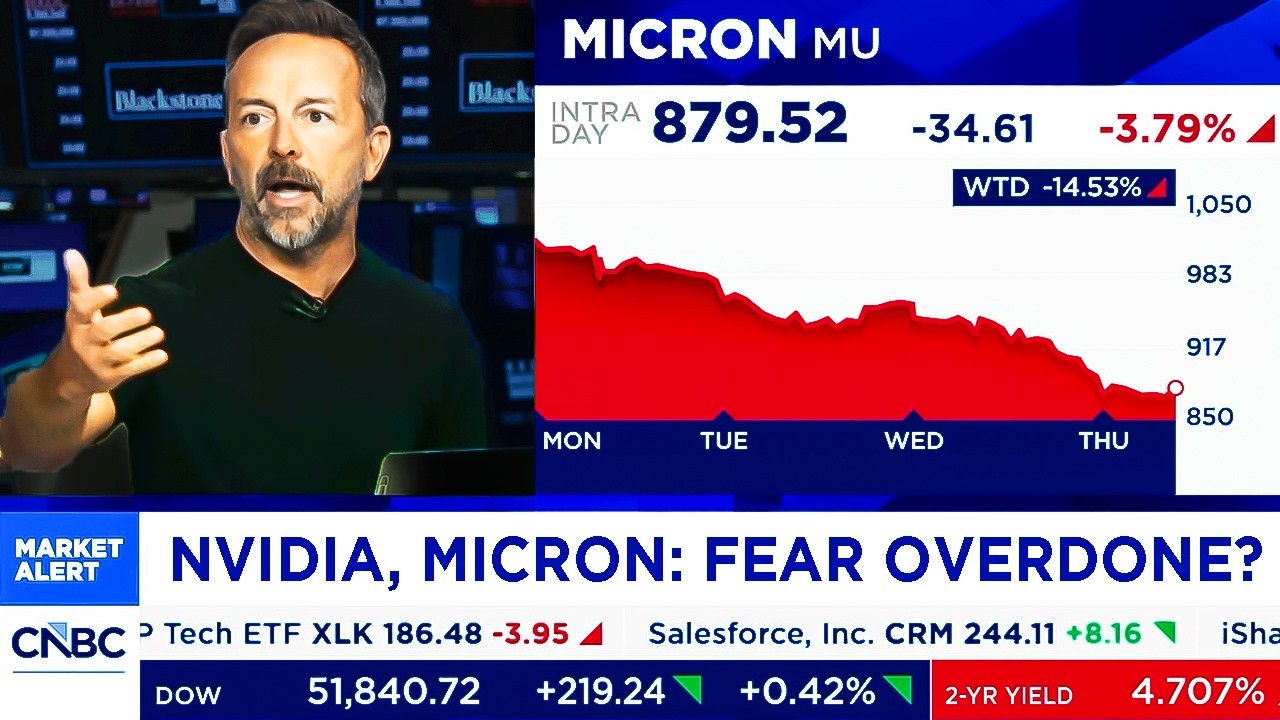
CNBC & Fox Today On NVIDIA Stock, Micron Stock, SK Hynix Stock, CoreWeave, Anthropic - NVDA Update

- Rendement de la vidéo
- —
- Appels
- 1
- Achat / Vente
- 1 0
- Publié
Recommandations
L'entrée est le cours de clôture de l'actif à la date de publication. Le cours actuel est la dernière clôture enregistrée.
-
Entrée $69,69 15 oct 2026Actuel $69,69 15 oct 2026Résultat +$0,00vs. indice +0,3% SPY −0,3% sur la même période
Citer cette recommandation Voir le segment source (1442s) *
Contexte de la transcription source
…t have the same multiple that I'm giving to an Anthropic or a SpaceX." And that is the type of market behavior that we want. It's separating winners from losers. It's applying appropriate multiples. So, I wouldn't panic in this moment. And frankly, I think if I were if you put a gun to my head today and you said buy or sell cororeweave, I'm a buyer of core today. >> We'll leave it there. >> And then you have uh concerns from CMXT comments from the Broadcom CEO Elon Musk throwing fuel in the fire on X. All of that doesn't help. >> Yeah, let's talk about that because to your point so folks understand…
frankly, I think if I were if you put a gun to my head today and you said buy or sell cororeweave, I'm a buyer of core today.
Contexte extrait par IA So, I wouldn't panic in this moment. And frankly, I think if I were if you put a gun to my head today and you said buy or sell cororeweave, I'm a buyer of core today. >> We'll leave it there. >>
Transcription Complète
Let's get right to the markets and the pain in this AI trade. Names like Coreweave, Skhinx, Micron, all down sharply on the week, Jim. I think in the case of Core Weeave, down what 30% in six or seven days. >> Yeah, I mean a lot of people are focused on the uh the public debt. Some people are focused on the private lending, the actual loans apparently trading a little bit higher because they're more they're asset back. I don't want to get too far in the weed. I I I what I want to say is that I think that people are terrified. I think there's a moment of fear among people who own these stocks where that is worthy of having TV cameras in front of the New York Stock Exchange. I think there people feel that it's that it's over. Uh that Larry Frink represented the last harrah that he wants to be able to figure out how to be able to raise money because there's we are out of money that interest rates aren't going necessarily lower because of flight to quality but because there's not going to be so much crowd out because the core of the world won't be able to issue any more bonds because they trade in say 15%. And what I I want I don't want to be I don't want to be like a calm voice because no one's listening calm but uh when you see something like and I was making a facicious reference to it like with SKH Heinox selling at two and a half times earnings and you see the collapse of the Korean market and you see that ever since the July 10th issuance of SKH here what you get is a notion that it's get me out >> right >> get me out and get me out has a habit of creating these kinds of prices we're seeing right now >> and it was a lot more obviously than coreweave yesterday as we come into today. It was any number of these neoclouds whether it's the nebuses of the world. It was also many of the names that provide all the stuff that goes into the data centers that these companies are building. So >> perhaps not a surprise to see shares of Dell down 11%. Oracle obviously was very very weak yesterday in part as well because of concerns about constraints around capital and that's what it's about right now. That's the narrative. It's around >> is there and we've been asking this question at this desk for a long time already. Is there enough capital to satisfy at a price that will make sense? >> Um I don't think we have the answer. I'm not hearing about any deals dying or not being able to be um completed. The question though simply becomes are they getting completed at levels that uh will not make them nearly as profitable. >> Well, we was you know when you build one of these sorry when you build one of these data centers and you and things get started the >> the the companies that are that are the tenants. So in this case like an Oracle once things get moving and and OpenAI is in there they can become incredibly profitable very quickly once you start generating the cash. So I do wonder, you know, will there be something that changes this narrative? But to your point, Jim, right now when you look at a company like Corweave where it isn't really about the contracts, which they continue to sign, but it's about the funding further out, >> right? >> And and you know, the psychology and narrative around cost of capital becomes the story. >> You start to see moves like this. >> Absolutely. Now, it's interesting to see that the loans that are backed by Yes. Nvidia chips are holding up very well, the actual loans. But the publicly traded debt is uh what is what you feel that Michael traders could be able to raise capital at. And if that's the case, then maybe they aren't worth doing. If they aren't worth doing and and then you have a Broadcom, a hawk tan saying, "Well, wait a second. This is going to be harder to finance." >> What what happens? >> Well, Broadcom, by the way, is a huge borrower right now in the bond market. They're doing a $60 billion deal with Anthropic and it we have seen rates go up. SpaceX did the $40 billion deal. Remember bond deal? I think they're paying at least 9%. Anthropic did something I think it was last week 5 billion just for compute. Small small deal paying double digits. The numbers have moved up >> right be all over the place. But I think that the central narrative last night with from the Bulls was, you know what, if we can see Anthropic do a blowway number, we can all go home and enjoy ourselves. Now, what's blowway? I mean, there are people who say that they announced a number that can give you a run rate of of a hundred billion. Then there are other people who say, "Oh my god, I thought we were going to get a $20 billion number. We got 16 billion and now we're like scared." this that's why I was going about fright and people you know I I you know you make your calls and people return the call and you hear things and then they sometimes they don't return the call and when they don't return the call it's it's going to be a tough day now I do think that we are um you know I mean that that's why I'm saying it's just the fear factor is much higher than what we think it is here uh and does it spread in other words tomorrow do we come in and it's like everyone realizes wow we are right to be fearful Or do we people say you know what this thing has already gotten out of control over in Korea? It's come here. They've exported the fear. Coral wave is really bad, but we know that anthropic still going to do 100, which is pretty good. And maybe we're this is all much to do about nothing. We should just sit back and enjoy the fact that rates have gone down. But how about the fact that Taiwan semi last a guy we love? All I can say right now is the demand is extremely robust and we did not see any sign of a slowdown. Whether it's a high 50% compound growth rate, it doesn't matter. It will probably be higher. Who cares? >> I know. To David. >> To David's point, you can have the backlog, but if you don't have the financing for the hardware, who cares? >> I I know. Listen, I'll go to Dell now because we I did I mean, this is the basic conundrum. It's like he says there's a lot of demand, but what about the capital? Take a listen to Michael Dell uh the other day. Fueling all of this, of course, is the capital markets. uh the >> maybe there's not enough capital >> that there you go. All right, that's my question. I mean, is that a concern for you? You know your way around the capital market. >> I think all these things are concerns, right? You know, maybe maybe it's regulation, maybe it's capital, maybe we don't have enough memory chips, maybe some some of all the above. But what we see right now is uh a lot of those are being addressed and there's incredible demand and we're still at the beginning of the scurve of this. I mean any cycle for technology is sort of a combination of you know excesses and um you know uh incredible opportunity and skepticism all at the same time. >> No, I mean look how many quotes did I see last night about the railroads? Don't forget there were many railroads that went under. I mean just a second don't forget. Was I trading was I tra you were a kid. Seven I think it's 70% of them all went went bankrupt and the existing railroads at the time of the boom >> you don't want to go back to the rails because in the end the rails got down they divided the country they split it up they got the ICC to ratify it and it was the end of all these wars but while you're in the war you know do you want to be Jay Gould >> Commodore Vanderbilt who do you want to be >> I don't it would have been fun to have been either one of those guys yeah true >> yeah they had a interesting run both of them I mean it didn't end that well >> constantly refer to it is to say to me you really have no anal analog in the last 150 years. I mean it's very difficult. >> No. So but what at the same time we have this concern around capital and what it's going to cost and how much of it can be deployed as a result at or andor borrowed in order to generate the returns that we think are coming. We also have the equity side which is certainly embraced in part by anthropic and that big meeting yesterday that we all kept a very close eye on. We got the number 16.8 billion in third quarter uh revenues for the company. The question is all about, well, what does that mean for the run rate? You raised this, right? >> Uh what do they end the year at? What do they do next year? Now, the Bulls will tell you they're all in on a $200 billion revenue number next year. They believe that that's a real possibility. What does that mean? It means if you price this thing for its IPO at 10 times next year's revenues, you're getting a $2 trillion valuation. >> Behind all of this optimism is a belief that we have no choice. We have to spend because otherwise China wins. >> So what does that mean Jim? If our capital markets won't cooperate, will the US government have to come to the >> They will. Yes. The US government could come to come to its aid. They have to do it. It's just too important. US government, not invalid, what Nvidia's up to. But >> you you mean more equity stakes or like pure nationalization? >> Yeah. No equity stakes. I think they won't let us lose >> because we've already done like 30. >> No. Sure. Look, I don't I think it's endless because this president doesn't want to lose to China. But I do think at the core of what's going on is you need the securization and what is the worth of an Nvidia H100. Now you have Larry Frink and you have Michael in trader for you Michael and Trader still matters saying that this stuff has held its value. It's 9 years so therefore it can be securitized. As a matter of fact, some of the values are up and yet here's Nvidia obviously in the throws of just a horrendous drop. Well, even Larry raised the prospect of huge advancements in chip architecture that could weigh on the duration >> value. But he he seems to be a firm believer that they are going to be successful in creating this securitized market that the collateral for which is the chips, >> right? >> Even though I I have spoken to other people who are like, well, what do you how are you going to seize the chips when they're in a data center in Iraq? Like it's not all just a commodity that can be easily. >> It's like when the banks didn't want to own the house and and and everybody's got their different techniques, right? Corweave puts them in differently than this company does and this one. It's all their secret sauce. So it's not commoditized. >> How about if Corwe has a six-year loan against what it has against it chips? >> Yes. >> And the it owns remember it owns the tail. Yeah. >> After 6 years, what are they worth? Well, it turns out that they're worth a ton. they are and then he can securitize those and get money. >> So far that question about the depreciation of the chips that we put to intrader so many times has been going the right way for them. Listen, we we wanted in trader to to come on he often does. I think during a quiet period >> is a quiet period. >> Um the last time I spoke to him I think that we did was about a month and a half ago, month or so ago at the Goldman Sachs conference and I did ask him about the question of their continued borrowings and need for capital. Take a listen. when we uh have built our business, we really built our business around the idea that you go uh you you make an investment, you have a long-term uh offtake uh with a counterparty and uh you go out and you borrow money to support that uh deal in and of itself. And I said this to you and I've been saying this to you for quite a while that the deal level economics are excellent. We've added between five and 10% of operating income, operating margin to the more recent deals, right? So, not only are they were they good, but they're getting better, right? And they're getting better in spite of the fact that the price of the inputs are increasing because the amount of people are willing to pay for them is increasing faster because the demand. >> There's the bullish case, Jim. >> Right. Now I think against that just in terms of zeitgeist was the interview in the FT with a person we really haven't heard much of from Brandon McB co-founder of Cororeweave who was talking about the unlimited pools of capital in the insurance money and when you read that it came off as being uh totally out of sync >> that was yesterday >> right and you your your reaction was oh really so you can go fleece the insurance companies now it just didn't read right and I think that this plus the net net note that Michael Intrader put out to his staff both seemed out of touch with what is really a fire drill moment where there may be a fire and that's not what we want. We don't want this. We we don't want arrogance. And this fellow uh I don't know Brandon McBe. I've never met him. But the piece came off as being all right. Well, look, stop worrying. We got we got the insurance. >> Well, Jim, for for a note that said the market is acting irrationally. I mean, people are passing around the list of insider sales of Core We couldn't even put it on the screen. The type would be so small. >> No, I look it's been front and center. There's been a huge amount of insider selling and now Michael Trader still remains the largest shareholder. I I do think that when you David when you see these things it's just like you know in the background people are saying you know what it can't be it's got to be bad because of and I turn to you because we have a similar situation at Oracle but I don't hear everybody just picking on Oracle. >> Yeah. At the same time Scott in the semiconductor space I do not think that AI and the food chain I don't think it's dead. We haven't seen any kind of um any kind of change in the $1 trillion dollar spend that we're seeing from the hyperscalers. Rates certainly going to hurt some of the bad players that have bad balance sheets. Core Weeave has 50 billion in debt. Oracle has 167 billion in debt. So sure, higher rates are going to hurt them, but you've got cash generators uh that are actually down just as much that are opportunities. Nvidia and Broadcom, Micron, I know we'll get to all them later, but you have very healthy companies that are getting caught up in this tailwind of um of of just concern and I think you're going to see opportunities in tech as well as beyond tech. >> You you Brad have really said and I think you you said it as much already that sort of all roads kind of lead back to open AI and anthropic, right? uh and the hope that their revenues are going to grow fast enough to meet the commitments that the market expects them to make. It's kind of the whole story at this point. You were at the investor day yesterday. >> I was. >> You have. I was. >> You've been an early investor in Anthropic. Um what' you make of what you heard? >> Well, I I I can't get into anything that was uh you know that was said in the room yesterday, but what I will say share is this. Um, if I had to do a vibe check coming out of the room, right, I found it very fascinating. You know, you had a lot of the most important investors in the world in the room and I would say the vibe check was a nine or a 10 out of 10, >> right? Very bullish in terms of how they feel about this company. Now, they're probably looking at it over a 1, two, three year time horizon, not over the next 30 days. >> If you look at what was reported that was said in the room and the reaction in the market to that was quite negative, right? or at least my interpretation of it was quite negative. So you had this, you know, this asymmetry between I think how people feel about it. Certainly from an altimter perspective, the information I've ga gathered over the last few weeks, including yesterday, make me more bullish on Anthropic, their IPO, and the road ahead, not less bullish. But, you know, they're going to have to wait until they flip the S1 and they can share some of that information with the world, do their road show and and I can't wait for this company to get public because retail investors are going to be excited about this and long only and mutual funds and sovereigns and, you know, lots of folks and they should get the chance to invest in this business and, you know, and then I'll be able to share a lot more, you know, of what we want to say. But the fact of the matter is I think that AI, like I, you know, I just did this podcast with Jensen, um, you know, I think it's accelerating. It's accelerating because we're entering a recursive loop where the machine is building more of what comes next, right? The machines are building 80 90% of the code that, you know, that drives the next product release. That is a recursive loop that accelerates. Some people call this the singularity, right? But I think that that's what we're going to see in 27. So remember the breakthrough we saw with Opus 4.5 last December that led to claude code. Without that, we wouldn't have had any of these revenues. Okay, that was one product. Now imagine having a variety of those breakthroughs for cyber, for knowledge work, for bio, for material sciences. I think we're on the verge of having cloud code moments for a lot of these industries and it's going to drive a lot of excel. I know you're limited, as you said, uh to what you're you're allowed to say, but I appreciate you >> um >> confirming that you're in the room. The not good enough, uh seems to be the the trending outcome. Uh whether it's Piper Sandler today, and that's what they're saying. The numbers are obviously huge. You you said, you know, you dropped the podcast that you just did with Jensen into which he's as bullish as he ever has sounded. It sounds to me about where he thinks revenue growth is going to go for the labs. Right. >> Right. I think I think Jensen in the podcast um I asked him the question, are you confident that they're going to 2x revenue next year, which if they exited this year at what is reported to be a h 100red billion or something like that, that would be like 200 billion exit next year. So I wanted to know what his opinion was on that. He's a big investor in anthropic. He's a big investor in open AI and he said I I I I'm pretty sure something to the effect that at least 2x next year. So I think that a lot of the investors that are closest to the pipeline of what is happening on the models, remember this, all of the revenue is derivative of model capability. None of the revenue would have happened this year without claude code. Claude code became better than any software engineer at writing software. So it replaced them and that revenue skyrocketed. They're looking into the the models that are already completed, Scott, not speculating on what they might do. the models that are already complete completed in the labs and saying with high confidence it's going to unlock other products like claude code. I happen to agree with that but that's what makes a market. I I also like the consolidation in the chop. I think the debate you're seeing in the market is the right debate. The questions are the right questions and so we'll see when this thing comes public. I suspect if they choose to come public there's going to be tremendous demand based on everything I know about the company. Remember in the SpaceX IPO, I think it was a hundred billion offering. You had, I think, about $350 billion of demand for that offering, and the stock's done incredibly well coming out of that. I suspect here you would have over $500 billion of demand for this offering. So, I think the stock would do fine. Where it prices, none of us, like I don't really care. I don't think the company really cares. Is it at 15? Is it at 175? Is it at two? Like, those things are irrelevant if you're going to own the stock over the course of the next year or two. So, we have very very healthy competition. I might argue this is the most competitive market in all of technology. Okay. And they're posting these results with that in mind. With that said, if you said to me, Brad, are they extending their lead over everybody else or is the lead shrinking? I think the consensus view in the world shrink >> is that it's shrinking. I think and I am on the exact opposite side of that. When you think about recursive loops of intelligence, they increase at an accelerating rate and intelligence is the log of compute. These guys are adding the most compute next year. So you're ahead, you're entering a recursive loop and you have the most compute. Now you're comparing Chinese model to their released models. Each of these labs has models complete inside the labs that they're doing safety testing on and lots of other things. So they may be generations ahead to the benchmarks that you're looking at and comparing to. For example, Navier Stokes was not solved by Astra. So you have to ask what solved it? What solved the Millennium Math problems at OpenAI? Well, clearly an unreleased model solved those things that is much further along than the open source model. So you disagree then with Gavin Baker who post quote why are the Frontier models cutting price? Might it possibly just possibly be the result of the fact that they're losing share to openweight models? Do you agree with that? >> So so look at what in fact happened. Um number one every generation of model becomes much much more capable. Okay. So with the same amount of compute you're producing a lot more intelligence density and you get to choose what to do with that game. You can either harvest it in which case you keep the margin or you share that margin back and you get more competitive. What did AWS do over the last 10 years when they had those improvements right 100 price cuts over a course of 10 years to expand their competitive mo it was beneficial for the consumer also beneficial for the company. What I would say is look at their lower level of models, Haiku and Sonnet. They're going to have closed source models that are cheap, as cheap as or cheaper than the open source models. But on the frontier, the frontier intelligence, people are still going to pay a lot of money for Frontier Intelligence. >> Let's hit Coreweave. Okay, let's do it. >> Uh stocks down again seems to be the poster stock right now at the heart of all of the concerns that we see. Steph was talking about 50 billion in debt, yields are like 15%, CDS, you know, blowing out, etc., et, etc., etc. Um, where does your position currently stand in core? >> Yeah. So, I don't I don't own core today. >> You don't own it. >> Um, but you know, listen, we were we were we were >> preipo. I know you were preipo and you've been you've been a big big you've been a big investor in this name. >> We have. Um, but you know, I told you that over the course of the last 3 months, we took our exposures down to the lowest levels we've had. Not because of anything specific to core, but just because I said AI is overshot. We're going to have a period of consolidation. We wanted to make sure that, you know, we bought we moved 10% of our book two months ago into Meta. We moved 10% into Tesla. We were diversifying into other names that we were excited about. We had to go somewhere to get that capital. So, we diversified out of AI and took our overall exposures down. Let me say a few things though about Core Week. Number one, the team that's running Core Week, one of the best in the business. 90% of the stuff that I read out there is like misinformation with respect to Core Wee. like the idea that they have to pay 15% on their debt. No, 15% is the public mark mark on 20% of their debt. They're still paying 9% on that. And all the stuff that is secured by the GPUs, which is 80% of everything they b borrow is rock solid and relatively cheap. So, I think there's probably opportunity today in core in both the equity and the debt. I'm sure my team is back at the shop working away on that and somebody will make the pitch to me. But you know, this is what happens, Scott, in these moments. Everybody freaks out. Oh my god, Anthropics revenue was a little less than we thought it was going to be. Oh my god, we're not going to build out all this compute. So they just sell everything in the compute stack because it had gone up in a parabolic fashion in April on May. >> So Jensen was speaking in Sweden today. Says Nvidia doesn't need to backs stop Cororeweave. Says Cororee's cost of capital is quote actually decreasing. says coral strength is improving every day. Um but the market seems like it's going to be jittery around this name for a while simply because of the amount of debt that it's taken out. You've got the data center debate which is now still feels like it's escalating. Yeah. I mean I think there were some probably some weak hands that got funded by venture capitalists maybe even some in the public market some of them that had their IPOs pulled. So I think you'll see some washing out. Um, but the fact of the matter is I think Cororeweave, like I said, Mike in in Trader who runs that business, one of the best. I think their capital stack is good. I think their partnerships like they have with Nvidia are fantastic. They're going to be one of the new AI hyperscalers. You know, these NEOClouds that make it to the other side, but on a mark-to-market basis, let me just say one thing. They went public, I think, at 30 bucks a share. I don't know, the stock's at 60 bucks a share today. It's still a double off the IPO, which occurred sometime in the last two years, right? Like, not terrible. It's just that the stock went up to maybe $180 a share when people said, "Oh, I'm going to give it an AI multiple." And now they're saying, "Oh, maybe it's a GPU rental business and maybe a GPU rental business should not have the same multiple that I'm giving to an Anthropic or a SpaceX." And that is the type of market behavior that we want. It's separating winners from losers. It's applying appropriate multiples. So, I wouldn't panic in this moment. And frankly, I think if I were if you put a gun to my head today and you said buy or sell cororeweave, I'm a buyer of core today. >> We'll leave it there. >> And then you have uh concerns from CMXT comments from the Broadcom CEO Elon Musk throwing fuel in the fire on X. All of that doesn't help. >> Yeah, let's talk about that because to your point so folks understand what you're talking about. So Musk a couple days ago talked about Micron being reasonable and it felt like it was out of left field. ironically was he was replying to ex post from one of my frequent guests and then yesterday he laid it on even thicker saying China's going to make a lot of RAM and it's essentially what's up is that he's angry at these Korean uh semiconductor guys right everyone's driving a hard bargain right now and so he's insinuating that CXMT is going to make it's made big strides but I don't think anyone in the industry believes it's a legitimate threat particularly for those high uh margin you know HBMs that are coming online >> no I totally agree with you. Here's what's really interesting about that that report is one uh it's unsubstantiated and two the ability to produce uh what's being talked about uh Samsung SKH Micron has all worked on this technology and they've abandoned it uh for areas that that have the ability to produce these chipset yield right it's one thing in a laboratory setting uh to produce something it's the ability to actually sell that and scale that so even if this were to happen it's not coming till 2028 2030 Uh but right now investors are taking uh any news that's sour and then amplifying it. >> Let's talk about the DRM. You your your your famous ETF. Everyone uses it as the quote, you know, it's the most successful ETF launch in history. It's the selloff here is intriguing because the volume's up, but this is not panic level volume. Are you starting to see buying in it already? >> Yeah. So what's what's interesting about DRAM is that it it obviously had a really sharp rally post uh its launch and then consolidated and was actually in a in a trading range for some time. Yesterday we saw a breakdown today breaking down a bit further than that. Um but we are especially with some of the reversals that we're seeing in the market today seeing investors step back in and reassess and say hold on um these stocks still trade at incredibly low multiples uh and they have revenue uh growth that's astronomically high compared to uh nearly any other company. So do we need to really throw the baby out with the bathwater because it did get it is getting a bit extreme. If you look at RSI measures we are in oversold territory. So, I do think investors are kind of becoming more comfortable stepping back in, especially as it got uh so so negative so quickly. >> Knowing what you own helps. And my next guest is just absolutely amazing. She's telling us that maybe the sell off in memory. Well, she says it's kind of odd considering the timing and the visibility. Nevertheless, media headlines have focused on maybe 2029 being over supplied. We talked every day on this show about competition from China. So, let's bring in Beth Kindig, IO founder, uh, fund founder rather, and lead tech analyst. So, so Beth, what do you make of the intensity of all of this? All of a sudden, it feels like it came out of left field. >> Good to see you again, Charles. Yeah, especially when it comes to memory. I cannot think of a better time to buy memory stocks because HBM, high bandwidth memory, is the number one constraint across all AI. uh these memory companies have never had the visibility that they have right now. Um as you know, Micron has 5-year uh contracts for visibility. That is in and of itself very different from the boom bus cycle that memory went through before. But it really goes back to the fact that the biggest constraint in the AI trade is memory. Um this is not the time to question uh that industry. It's so amazing to me to your point now how many businesses you know have visibility out five years you can take the hottest retailer in the world that could be the hottest stock for the moment and you know all of a sudden blue jeans got in style a year later whatever it is it's so amazing to me you can see that the pullback we were almost at 1100 we're down to 900 bucks what about the notion that this Chinese competition or or or you know I don't know I mean it's a cheap stock and when it get this cheap sometime Beth you wonder is it so cheap for a reason that we just can't figure out? >> I don't think that's the case right now, Charles. In fact, I'm incredibly bullish on memory, even more so over the past quarter. And here's why. It takes years to build memory fabs. It will take years before this constraint is alleviated. 2028 optimistically, but Charles, much more likely 2030. We have a long runway with memory, and the entire AI trade depends on HBM right now. All right, I hope you're all doing well today and staying calm in this market. Thursday was a mixed day in the market with most of the major indices closing in a green. We did see red action in many tech hardware stocks, but it was nowhere near what we've seen in recent days. We saw many non- tech stocks catch a bid and we also saw treasury yields move lower, likely in response to the concerns surrounding corporate debt and access to capital. So, non- tech stocks trading higher while treasury yields move lower is likely indicative of a flight to safety given the recent concerns in the market. We got a hot PPI print Thursday morning, which is not positive for inflation. And yet, Treasury yields still traded lower despite the hot PPI print. That's likely due to the core weave situation I mentioned in Wednesday night's video. There are concerns surrounding corporate debt, and so some investors are flocking to safety in Treasury bonds. We got TSMC earnings Thursday morning that were very strong. They did report a slight miss on margins versus consensus expectations. And leadership spoke about how the company is planning prudently for 2027 because of macroeconomic uncertainty and pressure on consumer markets that weigh on many of the already fragile AI stocks Thursday morning given the nervousness we've seen in recent days. But let's not miss the forest for the trees here. TSMC's quarterly revenue was up 41.2% year-over-year, up 16.2% quarter-over-arter, and gross margin was a solid 66.4%. Jensen Hong helped calm some nerves regarding Core Weeave after he told reporters in Sweden that Nvidia does not need to step in to provide financial support to Coree and that Corey's financial strength is improving every day. He also argued that Corey's cost of capital is decreasing. As I mentioned in Wednesday night's video, the FT published a story saying Anthropic's Q3 revenue was $16.8 billion, which fell short of some market participants expectations. Revenue grew roughly 46% sequentially versus sequential revenue growth of roughly 143% in the prior quarter. So that quarter over-arter deceleration in the growth rate spooked some market participants. Still though, let's not miss the forest for the trees here. Quarterly revenue was more than 3.5x what it was just 2 quarters ago. Yes, that's right. Based on media reports, quarterly revenue was more than 3.5x what it was just two quarters ago. But the timing of this news versus market expectations during a time of market weakness ahead of a potential $2 trillion IPO for Anthropic. All of that put together was not an ideal setup in the short term. In other news, it's being reported that Germany is planning a wide-ranging agreement with Nvidia involving hundreds of millions of euros worth of investment with a focus on physical AI, robotics, autonomous vehicles, and industrial AI models. The announcement is expected next week. According to reports, in other news, it's being reported that Nvidia's Rubin will rely predominantly on 12 high HBM4 despite rumors that Nvidia is shifting toward eight layer configurations. Increasing some eight layer HBM4 usage remains a possibility, but most Reubin configurations should retain 12 layer HBM4 according to reports. In other news, at the opening of a new advanced assembly and testing facility in Taiwan, Micron's president and COO said Micron has already sold out all the capacity for 2027 and that the new factory will build and they expect HBM to grow faster than the rest of the DRAM industry all the way through 2028. The president of Taiwan also attended the opening and encouraged both Micron and the labor union to negotiate sincerely. Other than that, I'm not aware of any update on the Micron Taiwan labor union situation. On Thursday, we got a new episode of the BG2 podcast featuring Nvidia CEO Jensen Huang. I encourage you to go watch it. Based on comments made during the podcast, it sounds like it was recorded last Friday, October 9th. I'm just going to rapid fire some important points that stood out to me. Jensen said that in the coming years, the cost of intelligence will fall rather quickly. The cost of intelligence will come down, which is what they want because the consumption of it is going to more than make up for the decrease in cost. As I've said so many times in these videos, there's a fundamental reason why Nvidia is driving token costs lower with each new generation architecture and software optimizations. They stand to benefit greatly from lower token costs. Interestingly, Jensen mentioned that the Frontier Labs will soon have to create a digital twin of the internet that they can use to train their models, similar to what Nvidia has done with the physical world by creating a digital twin of the physical world in Omniverse where models can be taught and tested. When asked about semi- analysis forecast of 43 gawatts of new compute coming online in 2027, Jensen said quote the demand is there and more and he then spoke about the supply constraints throughout the industry. Jensen said quote my guess is that land power in Shell the buildout resources will be one of the most important obstacles that bodess well for Iron by the way. Jensen also mentioned that if there's a problem with a specific data center or local government, Nvidia can simply redirect supply somewhere else around the globe since customer demand far exceeds what Nvidia can supply. While some communities don't want AI factories, there are many communities that do want them, and there are many countries around the globe that want them as well. Jensen reiterated the importance of using Nvidia's architecture rather than their competition because of the power constraints that exist. Nvidia's architecture produces the most tokens per watt. If you're going to spend tens of billions of dollars on a data center in a power constrained world, you better choose the architecture that produces the most tokens per watt. When asked about SpaceX, Jensen mentioned that Elon was previously included in Nvidia's non-hyperscaler ACIE segment, but now Elon is included in Nvidia's hypers scale CSP segment. That's important to be aware of when it comes to Nvidia earnings moving forward. As I've said before, I don't think the market is giving Nvidia adequate credit for what SpaceX will likely contribute to Nvidia's business in the coming years. We're talking about a new hypers scale customer that specializes in bringing large amounts of capacity online quickly. And in contrast to the other hyperscalers, SpaceX has committed to building exclusively on Nvidia's platform. Jensen made the point that Nvidia is a fairly large company even without any AI labs. He also said that most people only see two frontier labs, but Nvidia works with all of them and Jensen sees five or six frontier labs. He mentioned that Meta's Muse is doing fantastic and he said it's vastly Nvidia. He said the frontier labs represent about 25 or 30% of Nvidia's compute. General processing accounts for another third and the remaining third of Nvidia's business is mainly from the thousands of startups renting Nvidia compute. Jensen said quote it's a real big mistake to recognize just a couple of companies and think that they're funding the infrastructure. He later said that we're putting way too much pressure on two labs. So put simply speaking in rough numbers about onethird of the compute coming online next year is for things like general processing that would be happening irrespective of AI. Another third is for enterprises sovereigns neoclouds etc. And the remaining third of Nvidia's compute coming online is from multiple frontier labs, not just two labs. Jensen still believes there will be three to four trillion of AI infrastructure spent per year by the end of the decade, and he seems to think that $1.5 trillion of that will be just for compute. When asked about Nvidia's revenue guide of 70% in fiscal 2028, Jensen said, quote, "The challenge that we have is that we have giant order books." He went on to say that he was allocating to customers, and what he allocated to customers was a lot less than what they wanted. Brad interjected and said, quote, "So pretty much every customer would buy more from you if you could deliver more." Jensen responded by saying, "By far." And then since then, of course, we have new orders almost weekly and daily. He also said, "Nvidia is getting more supply, and some of the supply that is limiting Nvidia is land power and shell downstream." He also briefly mentioned other bottlenecks like substrates, silicon photonics, and supply chain partners. Jensen said it's going to be hard to close the gap between customer orders and what Nvidia can actually supply for a few years. Brad brought up the point that Wall Street consensus for Nvidia's growth has shifted up by more than 100% in one year and yet the stock was only up roughly 20% year-to- date when the podcast was recorded. Jensen indicated that Nvidia's competitive mode is increasing at scale. Many market participants simply struggle to understand Nvidia as they've never seen a company operating at this scale with accelerating growth. Near the end of the episode, Jensen spoke about software licensing as a business model that Nvidia has been working on for a while and that it will be accelerated in the near future. He pointed out that the large hyperscalers can run their own software stacks, but there are many enterprises that cannot do that. Nvidia provides the entire stack. Jensen said, quote, "Software license for enterprise business will be very, very large. If our software license is roughly a couple thousand per GPU per year, and we have millions of GPUs, we ship, you know, 20 million GPUs a year. Half of it goes in the world's enterprise. It adds up. I'm fairly certain this is going to be a very big part of our business software licensing." Jensen also mentioned there are some clouds that rely on Nvidia for their full stack. They rely on Nvidia for their offtake and they also rely on Nvidia as an investment partner. They need Nvidia support in those three areas. And in those situations, it's likely that Nvidia will move to revenue share moving forward. Nvidia will make the investment. Nvidia benefits from a sale upfront, but Nvidia also gets the benefit of the revenue share going forward. Nvidia is not a cloud service provider, but they're going to be providing offtake and software support for these clouds for four, five, 10 years. Notice those two new growth vectors Jensen described of software licensing and revenue share. and notice the similarities between this approach and Apple's monetization of its ecosystem through the app store. Nvidia is finding additional ways to monetize its install base and offtake beyond just hardware sales. Brad mentioned Nvidia's plans to return 50% of free cash flow to shareholders and Jensen pointed out that Nvidia actually returned closer to 60% in the recent quarter. He then mentioned that Nvidia invests in many highquality companies and they have inside knowledge of the ecosystem and so they know where to invest. But he said that those investments as a percentage of Nvidia's total cash generation is going to decline very rapidly. For example, the opportunities to invest in OpenAI and Anthropic are not going to come around again. Additionally, Nvidia's cash flow generation is growing fast. So, in other words, Nvidia is going to have a lot of cash to return to shareholders moving forward. Also, while Jensen expects global infrastructure spend to reach $4 trillion annually by the end of the decade, he would not at all be surprised if longer term it runs around $10 trillion of spend per year. Looking ahead, Jensen Hong is scheduled to deliver a GTC keynote at GTC Berlin on Wednesday, October 21st, starting at 11:00 a.m. Central European Summertime. For those of us in the US, that's October 21st, starting at 5:00 a.m. Eastern, 2 a.m. Pacific. Now, in case you're new to the channel, I want to make sure that you have at least a basic understanding of the underlying long-term thesis. So, let's cover that. Now, I don't know what's going to happen in the short term, but from a long-term perspective, I am very confident that Nvidia will be worth much more in future years than it is today. When Jensen was on the Lex Freedman podcast not that long ago, he was very seriously raising the possibility of Nvidia becoming a $3 trillion revenue company in the near future. If that happens in the coming years, then it is very plausible that Nvidia could one day be worth tens of trillions of dollars in market cap. That might sound crazy, but that's what Jensen is implying when he raises the possibility of Nvidia becoming a $3 trillion revenue company. I guess the question at that point is what multiple the street will be willing to give Nvidia. I don't know the answer to that question, but I truly do think that Nvidia will be worth much more in future years than it is today based purely on the fundamental growth of the business. Based on everything I'm seeing, the world is still computed, and I expect that to continue at least through calendar 2028. In a computed environment, developers will use whatever viable compute they can get their hands on. Today, there are no GPUs that are sitting dark due to a lack of demand, like there was fiber sitting dark due to a lack of demand at the height of the.com bubble. Back then, companies were laying fiber in the hopes that use cases and demand would eventually show up. Today, we are seeing the complete opposite. As I've said many times, when market participants compare this AI revolution to the do-com bubble, they ignore the fact that the internet is already here this time. This means that mass adoption of the technology and new use case development at scale are immediately possible. We don't have to wait years for it to show up. It's already here. The world is compute constrained, which means there is not enough supply to satisfy demand. New capacity is utilized as soon as it comes online. The hyperscalers are monetizing capacity as soon as it comes online. Each of the hyperscalers spoke about being supply constrained on their most recent earnings calls. Additionally, many of the clouds are building out into contracted demand. They're not blindly building in the hopes that demand will eventually show up. No, they're building out because they have signed contracts and in some cases significant prepayments from their paying customers. This AI revolution is fundamentally different from the dotcom bubble. And 2026 will be a pivotal year for the AI industry thanks to the rapid adoption of Agentic AI and the proliferation of agentic systems in the world's leading enterprises. The leading AI labs revenues are surging right now. Agentic coding and the implementation of Agentic systems in large enterprises are new use cases that are increasing inference demand significantly that subsequently is increasing compute demand. The rapid adoption of Agentic AI is why we're seeing an inflection in inference demand. It's why we're seeing the leading AI labs revenue surge. I wish both Anthropic and Open AI were public so the public could see the ramp in their revenues. I think the leading labs surging revenues may be the initial proof point that grabs market participants attention and causes them to realize that there will be a clear ROI on AI infrastructure. I think the leading labs surging revenues will also help assure investors of the longevity of Nvidia's growth since these labs revenues are directly tied to compute. If they had more compute, they would have greater revenues. It really is that simple. Demand is not the problem. The problem is a lack of supply to meet the demand. As I've said previously, I expect the world to be compute constrained at least through calendar 2028, possibly longer. And so regardless of what happens in the short term, it's important for long-term investors to remain focused on the fundamentals, maintain a long-term perspective, and remember that we are only in the early stages of Agenic systems being adopted at scale. This will increase compute demand significantly, and after that, the next surge in compute demand will likely be fueled by physical AI. We're no longer talking about digital agents performing digital tasks. With physical AI, we're talking about physical AI agents performing physical tasks in the real world. NVIDIA CFO has called physical AI quote a multi-t trillion dollar opportunity and the next leg of growth for NVIDIA. This industry will fundamentally transform society and NVIDIA has positioned themselves to benefit massively. Nvidia sells the hardware for the data centers where the models are trained. They offer omniverse where the models are taught and tested. And NVIDIA also sells the hardware that allows ondevice real-time inference through NVIDIA AGX, allowing robots to have intelligent interactions with the real world, even when they are not connected to a data center. Notice that NVIDIA is taking a holistic platform approach to physical AI, and they're embedding themselves as the underlying foundation supporting all of it. Over 3 million developers are already building on the Nvidia robotic stack, and this is not getting enough attention. As for production ramps, Blackwell Ultra has ramped and remains in high demand. Vera Rubin is rolling out to customers. Nvidia Gro 3 LPX is in full production. Later on, we're expecting the launch of Ruben Ultra in 2027 and Fineman after that in 2028. We have a clear data center product roadmap stretching into 2028. And Jensen believes that AI infrastructure spinning will reach 3 to4 trillion annually by the end of the decade. That means Jensen is expecting growing AI demand and an expanding total addressable market underpinning all of this. I don't think we are anywhere near any type of bubble bursting type of event. With all of this in mind, I seriously think that Nvidia still has plenty of runway ahead of it. And I think this company will be worth substantially more in future years than it is today. At least that's my view of the situation. Quick note before I wrap up. All of the compilations on this channel are edited by Finn Vid with original structure and commentary. Occasionally, the same edits appear elsewhere on YouTube. If you're looking for the original version, it's always here on this channel. Thanks for watching, Finn Vid. I appreciate your support. Remember to stay calm in this market. Remember to maintain a long-term perspective and do not make any hasty or irrational decisions. With all of that being said, I hope you all have a great rest of the day. And I'm curious to hear your thoughts about Nvidia in the comments below. Please leave a like on this video so more people will see it. And while you're down there, please consider subscribing. It's free and you can always change your mind. Thanks for watching and hopefully I'll see you in the next
Commentaires 0
Connectez-vous pour rejoindre la discussion.
Se connecterAucun commentaire pour l'instant. Soyez le premier à partager votre avis !