Good day, fellow investors. I made a deeper dive into Genuine Parts and the whole automotive and industrial parts sector that is very interesting to look at at this moment. I'll go stock by stock to also see a key interest for me, which is Genuine Parts, a relatively good buy, very good buy compared to others, and also an absolutely interesting stock to look at. We'll go through other companies, and let's immediately start with Genuine Parts company. Great value because there is a hidden gem within the company. The stock practically followed al…
Genuine Parts, a relatively good buy, very good buy compared to others
Contexte extrait par IA
Good day, fellow investors. I made a deeper dive into Genuine Parts and the whole automotive and industrial parts sector that is very interesting to look at at this moment. I'll go stock by stock to also see a key interest for me, which is Genuine Parts, a relatively good buy, very good buy compared to others, and also an absolutely interesting stock to look at. We'll go through other companies, and let's immediately start with Genuine Parts company.
Transcription Complète
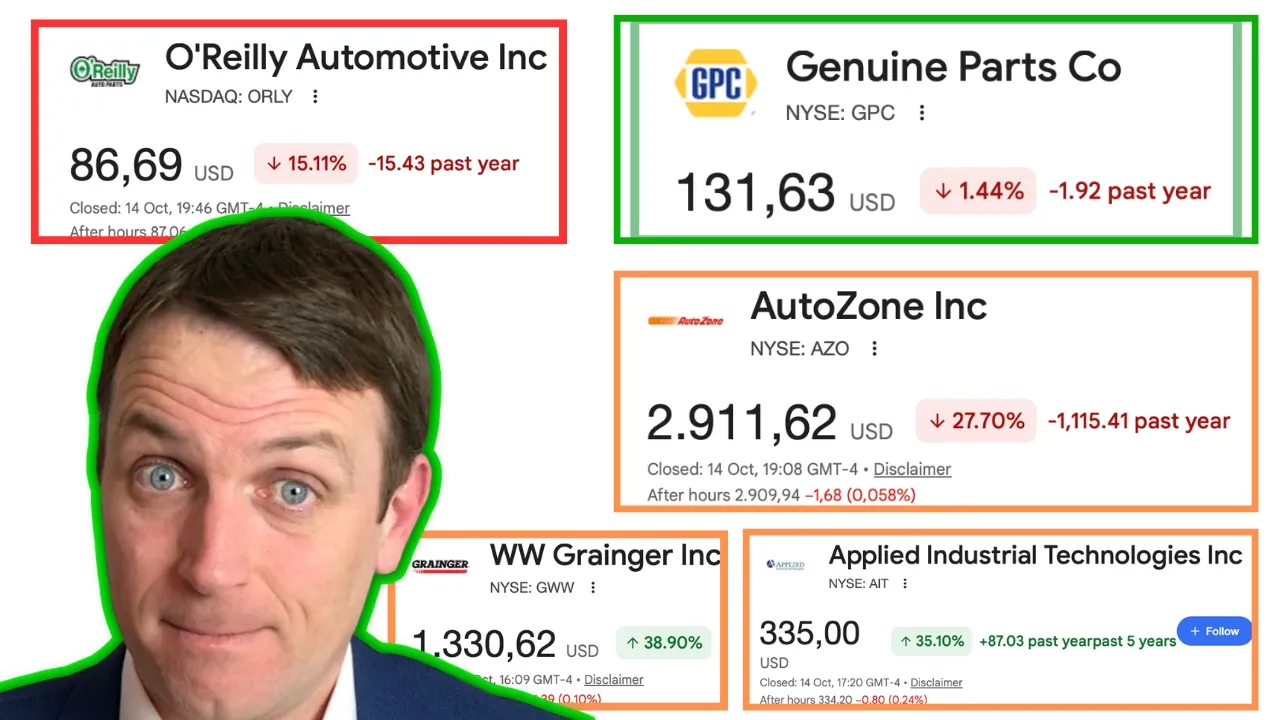
Good day, fellow investors. I made a deeper dive into Genuine Parts and the whole automotive and industrial parts sector that is very interesting to look at at this moment. I'll go stock by stock to also see a key interest for me, which is Genuine Parts, a relatively good buy, very good buy compared to others, and also an absolutely interesting stock to look at. We'll go through other companies, and let's immediately start with Genuine Parts company. Great value because there is a hidden gem within the company. The stock practically followed all parts companies, just went up. However, we have now a P ratio that's not really correct. There wasn't one-off. The dividend yield is 3. 32% and have been going up for the past 70 years. That's a crazy chart to look at. The market capitalization is 17 billion. Keep that number in mind for later comparisons. The most important thing is the separation of the automotive and industrial business because that separation from a market valuation perspective should create a lot of value. If we look at the business, wholesale distribution of auto parts and industrial replacement parts with Motion One brand and the automotive NAPA the other brand. Over the last 10 years, revenues grew, the company grew, dividends grew, everything was okay. And now the management has decided to separate the business to unlock the value and to give more focus to specific business etc. Now, when it comes to this management separation of businesses to give more focus, to be better aligned with what the businesses need, in simple true business terms, that's a lot of BS. Because if you are a $17 billion company, I think that you can have alignment, you can have good capital allocation, you can have everything optimized so that you create as much profit as possible. Plus, on top of it, there will be dis-synergies because now the accounting and everything that you are paying for one company, you will be paying for two companies. So, 100 to 150 million per year incremental run rate costs as separation dis-synergies. That is something to really think about when it comes to creating so much value by just being a single company in order to justify those costs. But, the board is supportive because, of course, two boards and two boards check are better than one board check. Also, two CEOs is better than one CEO. Nevertheless, here are the businesses. Global automotive, good sales, 15 billion, 1.2 billion in EBITDA, similar EBITDA with the industrial, but much better margins and higher growth. And this industrial business is now also implementing sensors with the customers so that they can replace the parts on the conveyor belt and things like that before those parts actually cause the stoppage of the process, production process. So, once you implement those sensors, it's likely you have a very sticky business. You can charge perhaps higher margins, but the customer gets more value and you get more value. And the industrial part is growing faster. Therefore, we'll see later with the comparative peer valuations, it is much more expensive. With the engine and parts, that is not the case. The automotive business servicing the non-discretionary vehicle maintenance demand. So, it is there. It is a good business. Nothing wrong with it. The parts business is expected to grow going forward a little bit faster than the economy. By the way, why am I looking at these businesses? Why am I analyzing them? Because that's my job. I have a research platform. We look at various businesses and we try to follow those that might offer or are offering value investment opportunities for our free portfolios on the research platform. Check it out in the links in the description below if you're interested. The industry for industrial parts is still fragmented, so M&A might work. If you're a single company, okay, M&A might work a little bit better. You can move easier. Okay, I can take that. Two, the market is expected to grow, is growing faster, also good growth ahead. Of course, all these projections are always linear. So, straight up equal, but you have to implement recessions into that. Therefore, if there is an interesting company, I cover it. Then when it is in a recession, you come back to it, you say, "Okay, now it's a truly great buy." And so, we have to always accept volatility in whatever forecast we are looking at. But, a strong tailwind like this one is always a positive. You can look a little bit There are many cases on Motions' website. Look at how they are doing it. Very, very interesting and a nice business that might get revalued when it trades alone. Okay, I can give them that, too. All in all, the business is doing okay, nothing crazy, but also nothing too spectacular. Good growth there. There are significant capital expenditures to keep the business running, and what is left for development is paid in dividends. The outlook is there a little bit faster for growth for the industrial segment than the automotive segment. If we look a little bit deeper in the financials, the bulk of the value is in the inventories. That's logical. There's some goodwill from acquisitions. Okay, nothing bad. 4 billion in long-term debt That is okay. Accounts payable cover for the inventories. We'll see that also in other companies, so they're financed by the suppliers. Also, nothing wrong with that. Equity is there where it is, but the focus is on the cash flows and on the dividend. Now, there is one discrepancy that I have found here, and this is for 6 months, but net income for the year comes at 1 billion. And then, you compare it to the market capitalization, you have a P/E ratio of 17. But then when you look at what they are doing, how much capex they are doing, then the true owner's earnings, because not all of this capex is for growth, you should be growing faster. So, the true owner earnings are practically half of the net income, just covering the dividend. That's a negative for this company because when you look at true owner's earnings, you say, "Okay, true value creation is not as good as it might seem." And the money goes to acquisitions of other businesses, capex, and things like that that are necessary to grow the company. You can see here huge cash acquisitions over time, even in billions, that didn't create so much growth as one would expect. Total sales growth going forward, 3 to 5%. That's in line with inflation. And the free cash flow represents the true owner's earnings at around, let's say, 600 or as they say here, from 550 to 700 million per year. And then I can assume 300 million in in value creation per company going forward, one growing at 4%, one at 7%. If I then go to the analysis, I look at the calculation, I make an intrinsic value, I look at the inputs. Okay, if we go to 1 billion in EBITDA, which is very conservative and it assumes a lot of separation costs, but times 10 for the automotive, times 15 for the growing industrial part, we subtract 4 billion of debt, we get to 21 billion, which is not far from the current market capitalization. But you'll see later, there might be much better valuation if we compare to the peers. If we go to the intrinsic value calculation, I have at the genuine parts here and you can download this for free on my free investment course in the link in the description below. So, I have taken free cash flow per share from their given range adjusted the growth for both companies. Let's say 5% growth going forward and the terminal multiple on the cash flow close to the dividend of 25 which assumes just a 4% dividend and the intrinsic value is 105 not far from the stock price. If I change my expected return on discount rate to 8, we are there. We can expect an 8% long-term return from this company. Nothing wrong with that. If they grow faster 8% and the market is happy with the dividend of just 3% due to the growth, the present value for a 10% expected return is much higher 150. Margin of safety and this is where Klarman doubled his position just 4% growth rate, 5% expected dividend 84. So, Klarman doubled his position likely at around 90. You can see here Q2 Seth Klarman doubled his position bought much more shares in the second quarter of 2026. So, to conclude GPC looks cheap from a relative perspective when the industrial business separates if compared to peers as we'll discuss now. P/E ratio of about 30, that is something the stock will trade at perhaps 15 billion for the industrial segment. We give a 9 billion for the auto parts. That's 24 billion. That's 50% higher and it's a tax-free separation for US investors. I'll watch for the separation to happen in 2027. Maybe there will be some forced selling because I want to avoid the tax that won't be free for me, I think. Now, if we'll just look at competitors a little bit, AutoZone priced for perfection. It had a great run, but it is a dream of every investor to have just a company that just goes up like this. Now, it has retreated a little bit, but let's see if the decline offers true value for investors. The business is still there, 7% growth, everything looks okay, opening new stores in Mexico, Brazil, similar inventory, 7 billion compared to 6.2 of GPC, double the debt, however, because they have been aggressive buybacks. They did everything to buy back the company, and that is also one part of the huge growth in earnings per share and the increase in the stock price. You can see here the debt went from 5 billion 10 years ago to the current 9 billion, but they are spending more or they have been spending more on repurchases than the true free cash flows. It's a higher margin business because they have their own brand, they own the whole distribution, even their retail. So, that is also something to think about, perhaps to look for ways to increase margins with GPC. If I look at the cash flows, net income is 2.5 billion, but capex is 1.3 billion, while depreciation and amortization is half of that. So, is it all for growth? I don't think so. I have to adjust the free cash flows coming at around 2 billion. Therefore, it is pricey for just 2 billion in free cash flows. Perhaps at a P/E ratio of 15, you would be at 40 billion, which is significantly lower, 40% below current market cap. I have to correct this. O'Reilly also priced for perfection. The P/E ratio here is higher, 70 billion market capitalization. Another leader in the company, 7% sales, good margins, opening new stores, also Mexico, Canada, and a lot of repurchases. You see here 1.5 billion in free cash flow, 2.4 billion in repurchases, and these are aggressive share repurchases. I would call it financial engineering. Just a nice chart, no electrification fears now in the US, and this is probably all Tesla. They are growing, they do their thing, profitable, okay, all good. Earnings per share growing also thanks to buybacks. But, if you look at the share repurchases and the free cash flow, you can see that those are often much higher than the free cash flow. That means that the company is aggressively using the buyback strategy, but that can work only up to a point. As the stock price goes higher and higher, at some point it doesn't pay to do so aggressive buybacks because of the price relative to value. 2 billion free cash flow times 15, mar- 30 billion, and not 70 billion as it is now. So, this is just bothering me. Wall Street loves it, but okay. That's the world we are. Wall Street marketer analyst are all for strong buys. Advanced Auto Parts, here things are not looking good, so they are in distress. Stock is down significantly. Results show no growth, higher leverage ratios, and they are trying to survive what's going on. They have sold, I think, some subsidiary or the distribution. They did some buybacks a while ago when the stock price was high. Without doing those buybacks, they could still have the valuable distribution. This is a clear turnaround, not attractive to me, especially given the debt levels, I think. Okay, interesting to see how things can go wrong, but not for me. LKQ, the cheapest of the bunch. They have been having some issues in Europe with the implementation of a new ERP system. That usually takes a company a few quarters. So, if that improves, it could be interesting. The P ratio is 12, the dividend is 5%. They have not been growing for a few years, which then also creates an issue. That also can become an issue if the current free cash flow situation is not solved. A cheap turnaround, if you want to check how the ERP is going, if they can improve these numbers, the stock will be repriced. But, it is, again, an if, and I have no insights if that will happen. Now, let's go to the industrial situation. This is Motion's target valuation at a P ratio of 30. The business is doing well because there is good demand, good tailwinds, sales up 10%, earnings up 14%, EBITDA up, everything looks good, good cash flows, low leverage ratios, capital allocation to M&A, CapEx, dividends, store buybacks, the whole bunch. Everybody happy, everything looks good. But then again, earnings per share is 12 compared to the stock price of 300. So, all the good seems to be priced in. And if that also happens to Motion, similarly as Grainger, market cap of 60 billion, but not that staggering from that perspective. Another one, Fastenal, 44 P/E ratio, great returns on invested capital. The businesses are doing great. MSC Industrial, P/E ratio 30. So, if Motion gets priced like that, that is just a double in that valuation, that 50% up for Genuine Parts, which is the hidden value. I've made a little table here. So, you can see that valuations for the bigger companies are not 15 like Genuine Parts, but 20, 30, 40, even. If they can separate, if they can keep the one at 15, 20, and the other at 30, that's 50% up from an investing perspective. If RP works, that's upside. The rest I would call fairly or expensively priced for premium companies. And that is the catalyst also for GPC. If you're interested in this, it's something interesting to follow from a relative perspective. From an absolute perspective, I would first want to see the separation and then the revaluation not working because this is just hope that it will get repriced as these. Perhaps these will get repriced as this. That's also something that can happen. So, we'll be following. It is here on the comparative table. It's already interesting also from that perspective. But, that keep in mind this is all on linear growth expectations. If there is a recession, if there are other issues, then it will be the time to dig deeper. Thanks for watching. Check my research platform. I'll see you in the next video.

Commentaires 0
Connectez-vous pour rejoindre la discussion.
Se connecterAucun commentaire pour l'instant. Soyez le premier à partager votre avis !