…on intrinsically did not change that much, but the stock price did. So, as this is going up over time, it's actually a gradual climb if you look at it over a longer time period, but we can use these time periods of dips to accumulate more. As long as the fundamentals remain solid, which it has for Amazon the entire way up, investors should be buying during these dips. And that's another way to lower your cost basis on the company. So, this one has turned out to be a a really great position, $70,000 in the green. When I highlight it in my portfolio, it just looks great. So, I love showing it off. And whe…
As long as the fundamentals remain solid, which it has for Amazon the entire way up, investors should be buying during these dips.
Contexte extrait par IA
From 2023 onward, the stock has continually risen with a lot of volatility. Now, again, you're always told this that every individual stock, it's going to have volatility. The average stock trades up and down 20 30% in a single year. These stocks go up like crazy and the core of the business is much more stable. If you look at Amazon, nobody could really argue that the intrinsic value of the company should have gone up 200% and then dropped 50% and then went up another 50%. The value of Amazon intrinsically did not change that much, but the stock price did. So, as this is going up over time, it's actually a gradual climb if you look at it over a longer time period, but we can use these time periods of dips to accumulate more. As long as the fundamentals remain solid, which it has for Amazon the entire way up, investors should be buying during these dips. And that's another way to lower your cost basis on the company.
Transcription Complète
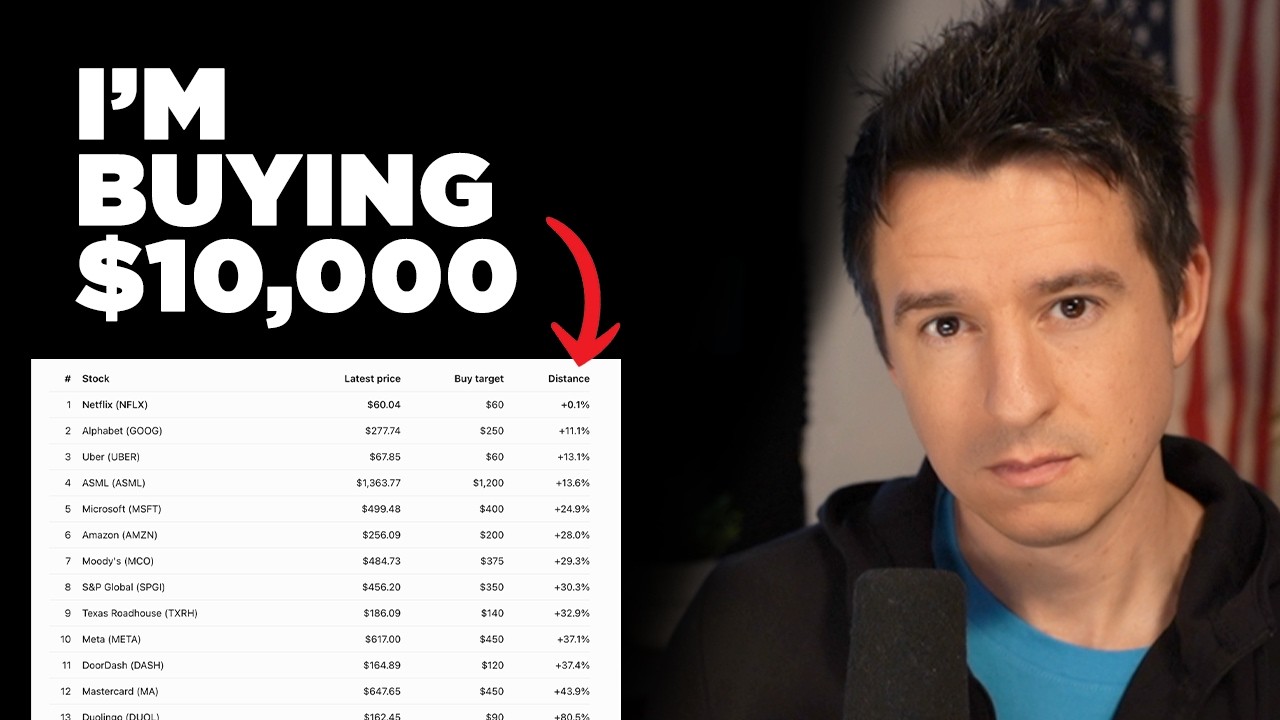
Welcome back everyone. Thanks for joining. Two months ago on a previous episode, I said that I'd be buying $10,000 of a stock, one that's in my portfolio, but I didn't know which one because I set price targets on each company well below where they currently traded at the time, and the first company to hit that price target would immediately execute a buy into that stock. Now, a lot of you said that this wouldn't happen, that the price targets were too low, that these stocks wouldn't fall. It would take years for one of these companies to possibly hit this low price target. Well, it just happened in only two months. And the stock it happened with is Netflix. Netflix is down roughly 50% from its all-time highs. The company's going through another scare, the engagement issues, AI, YouTube, all of these competitive forces against Netflix, causing the stock to drop to $60 per share. Now, I just added to this position, and I'm going to be showing you the reasons why, as well as the rest of my portfolio. Today, we're not going to be talking just about Netflix. We're going to be going over the whole portfolio, every single company in it, all my gains and my losses, and my history of owning each company. I'm going to show you the stuff beneath the surface, where I've been in the red on these stocks, where I'm in the green, the complete transparency of every single position. And not only that, I've had some feedback. People have said, "Joseph, you only ever talk about your winners. What about the stocks that you've sold at a loss? What about the losers that you've had?" Well, I agree with that, and we're going to talk about those as well. In this episode, we'll be going over my historical realized gains or losses, the companies that I've previously owned that I've sold at either a gain or a loss. And there are a couple losers throughout my history, like Salesforce and into it. We'll be going over those as well. So today we're going to be looking over my buys and sells as well as a transparent history of my portfolio. So hopefully this will give you some ideas of stocks to look at. Now of course we have a fail of the week as well. In this case it is Leopold Ashen Brener of situational awareness once again. I've highlighted him before as a messianic figure that someone could see the future of AI and he bet heavily on it. Seemed like he was winning big until his fund imploded and had to be bailed out by Ken Griffin. Well, he's back at it again, and there's recent articles showing that he's once again severely damaged his fund. So, I'll be looking at the potential damage over the past month. Now, as we go into this, just a reminder, you can try out qualum.com with a 7-day free trial, no strings attached. Qualrum is a membership that I made. It includes this stock analysis platform. So, everything you see here is me using that. It has unique KPIs. It has a discounted cash flow calculator. We have hundreds of exclusive episodes and more coming out every single week. as well as I just released a teaser for the new build that I'm going to be releasing soon. It is exceptional and the feedback has been overwhelmingly positive. So, there's lots of cool things going on. Try it out now risk-f free at qual.com. Now, to kick things off, before looking at my entire portfolio in history, we'll look at the new buy. I just added another $10,000 to my Netflix position yesterday. And the reason why was because of this video. If you recall, about two months ago, I made a video saying that I'm buying $10,000 of this company next. The issue is I didn't know specifically which one, but I outlined a buyin price for each company in my portfolio. I'm going to play the relevant portion of this episode two months ago when I talk about Netflix and the potential buy. Netflix currently trades at $80 per share. The buyin target I'm setting for this company is $60. If Netflix is the first company to reach its buyin target, it'll earn the additional $10,000. If we look back at when Netflix has reached $60, it's been some time. So investors have generally been enthused about Netflix. They've liked the company, but recently you can see that it's in a downtrend. So I do believe there's a chance if investors get really soured on Netflix with their next earnings report for whatever reason, we could see the stock drop rapidly. We've seen it before with Netflix. So that's what I said two months ago. And here we are with Netflix now at $60 per share. And I've executed the buy. Now to put this in perspective, here is the list of companies that I covered in that episode. It was every position and this is the buyin price of each one of them and how far away they currently are from that buyin price. So Netflix currently hit it. That's why it says.1% away. It hit it yesterday. The surprising thing here is Google's actually the second closest. Google's only 11% above my buyin price. I said I was going to buy it at 250 and it's at 277. Uber's number three. Uber's at 13% above the buyin price, but Uber actually got really close. Like a week ago, it was only a couple dollars above the $60 share point. Now, outside of Netflix, Google, Uber, and ASML, most of them are far above the buyin price that I set. Now, that was analysis I did two months ago to find prices I found attractive for each company. Prices that I feel like the riskreward is highly skewed. And I believe that's the case with Netflix. The valuation is worth highlighting because in cases where you have a high-quality company, valuation both protects the downside and it gives you ample chance for multiple expansion. The way that you get large outperformance is by the combination of earnings growth and multiple expansion. Earnings grow because fundamentals remain strong. Multiple expansion happens because growth accelerates. Investors become excited or they believe the company's becoming less risky. They lower the discount rate and there you have multiple expansion. The combination of multiples going up and earnings growth leads to significant outperformance. And I believe there's a chance of that happening going forward with Netflix. For example, right now Netflix trades at a 16 times next 12 months PE ratio. So at a 164 PE, I don't believe it's expensive. Now some people will say it can go lower and that's true. It can always go lower. Every stock can go lower. So if the company's fundamentals deteriorate, if engagement becomes more of a problem, if short form video eats away more and more market share, if YouTube just dominates the TV and everybody cancels Netflix, this valuation is meaningless. It doesn't hold any water. It it doesn't matter. So valuation only matters if the company will do well in the future. And I understand that. But in cases where the company actually does surprisingly well, it continues to grow, margins go higher, and it retains its subscribers, then this valuation will be very important in the future. So, I would not be an owner of Netflix if I was concerned about the future relevancy of the company. But I'm not as concerned as the market is, and I believe this is where I have a distinct view on it. The market believes that Netflix has serious engagement problems, that YouTube is eating away at Netflix viewership time. And while that's true, there's reason to believe that that's not an apple to apple comparison. It's apples to oranges. For example, YouTube counts things like music as watch time. If you open up a YouTube playlist of music and you have that in the background, that's counting as watch time the entire time. People also set different playlists and ambient uh watch lists on YouTube all the time. Uh YouTube also competes on a different type of content. A lot of it is leanback television. Turn on podcasts, daily shows, things that you consume while you're doing yard work or you're doing a grocery run while you're just wanting to listen to something. Netflix is more eventdriven television. It's more actively engaged television. So, I believe they play different roles and the way that the engagement is being measured is not a fair comparison to Netflix. It makes it look artificially less important than it actually is. And one of the tells about this is the churn rate. For example, Netflix said in their last earnings call that churn went down year-over-year, meaning that fewer people chose to cancel year-over-year. If it was true that people are becoming less satisfied with their membership, that they just wanted to watch AI slop and short form and and YouTube all day, then wouldn't more Netflix subscribers be cancelling? Another thing that's important here is Netflix has made changes to try to address some of the problems with engagement. They want more relevancy. They want more hits. Netflix has gone quite a time without a big hit like Stranger Things or Squid Game. So, they've been changing up things to try to get back on track. They are seeking bigger hits. Here's Ted Sandos going over some of the changes that they've made with their leadership. And these aren't just simple layoffs to increase margins. This is a massive shift in the structure of Netflix with the goal of creating higher quality content. Every once in a while when you're in a in in my seat, you have to look forward and say there's people who are good for the business at one stage who may or may not be good for it at the next stage. And you want to get ahead of that as far as you can. I think as Netflix has grown and matured and the business has grown and matured around us, that hit rate really matters and you've got to get ahead of are we on on a path to continue to maintain that hit rate um in the US particularly, but everywhere in the world. The hit rate that they're talking about is the percentage of content that they make that becomes viral sensations. You think of shows like Wednesday, Squid Game, or Stranger Things. Those are hits. Those are viral sensations. And we have Netflix doing this to some degree, but it's just not enough. Netflix needs to be in the discussion. They need to have huge relevancy. That's what drives a lot of acquisition across the globe. With Netflix going without a massive hit for some time, investors will extrapolate that to say they'll never have a big hit again. And my thought is that that's not accurate. I think they're going to have some big hits in the future. It's only a matter of time with how much content they're making, how many different storytellers they're employing, the changes the company's making. I think they will have viral sensations once again. Now, there is a chance Netflix goes wrong. Maybe the holding ends up being a failure. That's why we diversify and I have more companies in my portfolio. I'd never put all my eggs in one basket and my portfolio is well diversified beyond just Netflix. If we look at it today, we have time weighted returns of 191%. Over a comparable time period with the S&P 500, it's about 170. So, we're beating it slightly, but with this year's underperformance, it's come a lot closer. Regardless, it's at around $500,000 in gains at $1.46 million. Now, I'll go ahead and go through each holding, and what I want to do here is illustrate what's happened with these holdings over time. So, what we're looking at here with this chart is my personal ownership of this stock. The horizontal line is my cost basis and then the chart starts where I first owned the stock. So you can see that with Mastercard, I started buying this company early 2023. So January of 2023, I initiated a position into the company. And I initiated it on the basis that Mastercard was a great company. It was trading well below its 5-year and 10-year historical average PE ratio. And I thought the future is really bright with the stock. So with a lower valuation and attractive entry point, I started building my position like almost every stock does. In fact, I'd say around 95% of them, you're going to enter into the red for at least a time, for at least a day, at least a week. It's very difficult to buy a stock and immediately go into the green. So this stock was first bought, then you can see in the following weeks, it went into the red, but then it quickly was in the green. In fact, Mastercard is a stock that over its entire ownership, my entire time owning this company, I've been overwhelmingly in the green on this one. There was a time period mid2026 where it started to trend downwards. People are concerned about uh crypto and stable coins and they're concerned about government payment systems and whatnot. But I'm not super concerned about that stuff. I continued to hold the company and now you can see that it rocketed back up near all-time highs. And right now I have the most significant gains in this stock that I've ever had at around $70,000 in gains. So when you look at owning a stock, I think this illustrates something. Over time, it's very volatile. There's many time periods where you could become nervous, like when it was trading down in early 2024, the big dip in early 2025 with the tariff panic. We had another big dip early 2026 going into mid 2026, the most significant one. All of those give investors reason to panic, reason to second guessess their position. But if you just draw a line from where it started to where it is today, the stock has done well over time. And what I plan on doing is continuing to hold it. So no change in Mastercard. I'll continue to hold that position. Now moving on from Mastercard, we get into Amazon. This is my second largest position around similar gains as Mastercard and slightly smaller position. So my expectation is that Amazon will grow slightly faster than Mastercard. I believe it's better, more attractive buy today and I think that it will surpass it and become my number one holding. So, if I have to guess a year out, I think Amazon is bigger than Mastercard, but we'll see. When I look at this chart, this one is also very fun to look at because you can see when I first started buying Amazon, check this out. I was barely in the green. In fact, I was basically at my cost basis for the first while owning it. So, no outperformance, nothing going on. It seems like a very boring company, boring position to hold. and I was making videos and exclusive content on Amazon saying how it's a really great company and how big AWS is. Those are are older videos. Then we get into Amazon actually trading down after I bought it. So 2021 there's a big spike and then I went in the red dramatically in 2023 and this is where my portfolio, the Story Fund at the time was dramatically underperforming the market. Like it was terrible. My entire portfolio was underwater. And I'd make episodes coming out and saying,"I still believe in these companies. I'm buying more of them." And I was able to lower my cost basis of Amazon by buying during 2022 and 2023. If I went through my history, I have an entire series of buys during that time period because I looked at the company and the reason the stock was going down was the market was going down. Amazon was doing a lot of investments at the time, big capex into their locations. They were opening up more warehouses, more logistics centers. That was very expensive. the capex threw their free cash flow negative. I accumulated a lot more shares and grew my Amazon position. From 2023 onward, the stock has continually risen with a lot of volatility. Now, again, you're always told this that every individual stock, it's going to have volatility. The average stock trades up and down 20 30% in a single year. These stocks go up like crazy and the core of the business is much more stable. If you look at Amazon, nobody could really argue that the intrinsic value of the company should have gone up 200% and then dropped 50% and then went up another 50%. The value of Amazon intrinsically did not change that much, but the stock price did. So, as this is going up over time, it's actually a gradual climb if you look at it over a longer time period, but we can use these time periods of dips to accumulate more. As long as the fundamentals remain solid, which it has for Amazon the entire way up, investors should be buying during these dips. And that's another way to lower your cost basis on the company. So, this one has turned out to be a a really great position, $70,000 in the green. When I highlight it in my portfolio, it just looks great. So, I love showing it off. And when you just see the holding, it seems like it's so easy. Like, you just buy the company and it goes up. But this shows a clear picture. This has come with a great deal of patience, volatility to get the gains on the other side. One helpful thing about holding a company through some big downturns is it helps you do the same thing in similar circumstances with other companies. For example, the stock that I introduced this year was Meta. It's my new large position. I've grown to like the story of Meta. The fact that they have such a fast growing ad revenue business. The fact that they are undisruptible by AI. They are an entertainment based company of scrolling and they have the short form content and I like their wearables. I like what Mark Zuckerberg's doing with Muse. I like all of it. So, Met is a company that I entered into this year. Now, I'm currently down $17,000 on the stock. And again, this could become discouraging if you don't have a solid history or reference. When I look at my ownership of Meta, this is what it looks like. Now, imagine you bought a company like this and you're doing this publicly like I am. So, I bought Meta and then I'm immediately underwater in the position. It just goes down. But then Meta decides to trade back up. Why does it trade up? I don't even remember. I don't remember the news of what caused it to go down and trade back up. Who knows? There's a different reason every time. But Meta was basically the same company this entire time. Then it started to trade back down as investors get nervous again and then there's some news article or story and it spikes back up every time stopping right at my cost basis. So it's trading back and forth near my cost basis. Then we get to the more recent time. This was in uh August of 2026. It traded down big and then it started to trade up when they released Muse. There's a lot of enthusiasm, I believe deservedly so about Muse. Muse is a great agent. It was different than what chatbt or Anthropic were doing and it reached the number one in the app store for days on end. In fact, weeks on end. Now, Muse is still doing great and investors were very excited initially about it. It raced up and I was at one point about $27,000 in the green. So, at one point I was $40,000 in the red. In fact, at multiple points I'm $40,000 in the red just this year. This year in the red by 40 grand. Then more recently, I'm $27,000 in the green. And then as of right now, I'm back down to $17,000 in the red. All within just a number of months. In fact, going from 40k in the red to to 27 in the the green and $17,000 in the red. That's all happened since August. That's a few months for this level of volatility. You look at this and you think, "Wow, Meta must be an incredibly volatile, rapidly moving company." Not really. You look at the fundamentals and this is what the revenue looks like. Does that look so crazy? The company continues to grow every single quarter on schedule. In fact, it's growing much faster than most companies in the market. We look at the daily active people and we have it at all-time highs. Looks very good to me. The company continues to grow. Advertising revenue continues to grow. They have Muse that's doing great, expanding globally. And the amount of capex they're spending is a choice by Meta Management to invest in the future of the company. It's not something that they're being forced to do. So, after what I've gone through with different positions that have been highly volatile, and I've gone through periods of looking foolish for a long period of time throughout 2021 through 2023, I looked very foolish holding a lot of companies that I did. Those companies are now some of my biggest winners in my portfolio. After experiencing that, this doesn't give me much pause. I don't really care too much about being in the red on this company. Meta is at a low valuation. It's executing incredibly well, and I believe that over time, this will look like a massive winner as well. Moving on from Meta, we get to Google. Owning Google hasn't always been amazing. In fact, buying it in 2020. I had slight gains and then it went slightly back into the red below my cost basis. So, I had a long time where I was just holding on to it. But like Peter Lynch says, many of the stocks that you'll have the best performance on, they happen after year three. You have to let time for the thesis and the story to play out. Google dropped down in 2023 and then it started to rise. This is where I started to get into the green. In 2025, it was up at a high point. Then we had the big scare, chat GBT. That's when everybody came out against Google and that's where I really doubled down and I dramatically increased my position. So I actually raised my cost basis during this time period. My cost basis was a little bit lower, but I bought more of the stock. It rose up dramatically. At one point, I had over $100,000 in gains on Google. So that was earlier. Now it's given up a lot of those gains. It's down to $71,000 in gains. I've chosen to continue holding Google. It currently trades at a 19 Ford PE ratio. It currently is growing rather quickly. Google Cloud is still amazing. I believe there is some risk to search with all the AI LLMs, but Google's handling that. They've implemented a lot of technologies within their stack and they're moving more of their growth and their earnings over to cloud from search. Cloud is going to become the biggest part of this company soon enough. In number five, we get to S&P Global. Now, this is another one that I I feel like I bought it at a really good time. This was a welltimed buy. I remember doing the research on S&P Global. It was during a massive sell-off. The stock was trading well below its 5-year and 10-year historical average, lower PE ratio, but the fundamentals remained fine. The downsides of owning S&P Global is even though you're getting a very strong company, it's very secure, the growth rate of it is much slower than companies like Google or Meta. Meta is growing dramatically faster than S&P Global. So, while I like this company and I like having it in my portfolio, I'd rather own more of a company like Meta than more S&P Global. After S&P Global, I have Microsoft as position number six, a $18,000 position with around half of it now being gains. So, this one's been a very good performer. I've actually owned Microsoft for a long period of time. You can see the history of it. I've owned it since 2018. Now, the gains at that time period, they look insignificant. When I started my portfolio, I didn't have a lot of money. So, I was only investing a couple thousand dollar. It made good gains, but it just wasn't meaningful. I didn't have enough money to invest at the time. So, over time, as I grew the portfolio, I continued depositing money. It started to make gains. It went through the 2021 sell-off. That again was a terrible time. My whole portfolio was in the red. Microsoft went into the red, but I continued buying more of the stock. I remember buying Microsoft heavily at around $220 per share. So, it's a company that I I really pushed into at an attractive price and that's why the gains subsequently have been so strong. Microsoft, like every other company, has gone through significant volatility. So, in 2024, it traded down. Uh then it spiked back up. Single quarters, it's traded back down. Then, two quarters ago, it spiked back up. Now, it's trading down again. What these charts show over and over again is that holding stocks is difficult. There's always reasons to sell them. There's always scary narratives, but you have to look at the fundamentals and the future of the company. If the story remains good, if your overall story that you've outlaid for the company is intact, then you can hang on to the stock and you don't have to pay attention to the daily market bid. The next largest position in the portfolio is ASML. It got on my radar and as I looked at the company, I found it exceptional. I was wowed by the technology. I realize that ASML has a moat that is so substantial in so many ways. It is a monopoly. Now, people like to call Apple a monopoly, but with Apple, there's Android and Google. ASML, there's no Google or Android. There's no free version of what they do. There's no real alternative. All roads to making high-end chips pass through ASML. China has tried to replace them and do their own thing, but they can only make a couple wafers doing it. They don't have the throughput. they can't make them on the scale that ASML does. So, the company is truly one of one. It's incredibly unique. It's just one of a kind. And the stock was trading at a low valuation and was trading with a lot of scared investors back in 2024. So, that combination became incredibly intriguing to me. I invested quite a bit of money into this one. I put about $50,000 into the position. ASML today trades at $1,386. And earlier this year, it got up to $2,000 per share. Now, not only did I buy the stock at around $722 per share, but when it got to around $1,900, I announced to my Discord and membership that I was selling 20% of the position. I was trimming some off the top because I thought that it was at a point where there was a lot of positive sentiment in the company. It no longer represented great value. I believe there's going to be a pullback. Now, after ASML, my next largest position in my portfolio, bigger than Netflix, bigger than Dualingo, bigger than Uber, bigger than uh Door Dash, bigger than Texas Roadhouse, it is Costco. Costco is the next largest position. Now, a lot of people don't think of my portfolio as having a large position in Costco, but it does. And the reason it does is because Costco continues to go up. That's the reason this position is so big. I'm not adding money. I'm not even reinvesting the dividends. I just hang on to Costco and it continues to grow and grow and grow. And this is also a company that makes people frustrated. It makes people angry all the time. Why is Costco outperforming Nvidia? Why is it at a higher valuation than Nvidia? People look at the share price of Costco and they're just a gasast and disgusted that this stock continues to climb at the rate that it does. They look at the valuation, the Ford PE ratio. They say Costco trades at 48. Investors are crazy. Why would they ever hold a company like this? Well, I'll tell you why Costco trades at the valuation it does. It's pretty simple. Costco is viewed as an indestructible company that has a very long duration and it's a company that fits into every investment profile. Costco pays massive dividends. So, it's a massive dividend payer. In fact, I just earned I think $2300 or something in dividends. A special dividend that was over $2,000 and I just earned that and it's one of many. You also have Costco as being an all-weather stock. During economic booms, Costco's making tons of money. During economic weaknesses, Costco's making lots of money. During moderate times of just consistent economic growth, Costco's making lots of money. It has a subscription business and it has products that people need. During times of panic, when the entire world seems like it's caving in, people aren't running to buy Nvidia chips. They're running to buy toilet paper. They're buying so much of it that Costco has to restrict toilet paper per customer. This is a company that is dependable. It's so dependable that investors view it as more dependable than a treasury bond from the US government. It deserves a higher valuation because it's like a treasury that continues to raise its payout every single year. When you have a stock like this that also has international growth expectations, it can open up 30 to 40 new locations every single year. Every single one of them is flooded with new patrons. 60,000 plus people every location. A turn rate on membership that's so low they have to replace roughly 6 to 7% of their membership every year. It's a subscription business. It's an all-weather company. It has no real competitors. Amazon couldn't destroy Costco. Walmart with Sam's Club can't destroy Costco. Now, the reason that I bought Costco early on in my portfolio, dating back all the way to 2018, this is one of the OG companies in my portfolio. I started buying it because I love Costco. I like going there on Sunday evenings when it's less busy and it's a a store that actually takes care of their customer. They have interesting merchandise. And I realized something interesting. There's many uh things that are sold at Costco. There's iPhones and there's MacBooks. There's Sonos speakers. There's Shark Ninja products galore. Lots of kitchen products. There's food. There's uh clothing. There's all sorts of different things. But those things come and go. Different companies will be in Costco and then they may not be in Costco in the future. You can have companies like Tattoo Chef making food that goes into Costco. And if that company struggles and goes bankrupt like it did, it doesn't matter. Costco always remains. Costco is the constant. Costco is not just a company. It's a platform of distribution for every other company. If they want to get their product out, they have to do it through Costco. Costco charges a small fee to do that because they take a little bit off the top. And then they also barter for good deals for their customers, creating unmatched brand loyalty. The ingredients of this company are very difficult to create. They're nearly impossible to replicate, and Costco is the only one that has the scale to do what they're doing. So, when I looked at that, I realized that this stock is worth owning. I didn't do sophisticated valuation work on it when I initially bought it. I just kept buying it during dips. I stopped buying Costco in around 2023. The stock started to go up significantly. It got a massive bid. The valuation expanded. Ever since then, I haven't bought a share. I've just continued to hold. So, I haven't put any money into Costco for quite some time. But the stock continues to do well. When I look over the past 5 years, the stock is up 108%, not counting the huge dividends they pay. Year-to- date, it's up 29%. One of the best performers in the market. Now, moving on from Costco, we get into the next largest position. And this one, I believe, is my all-time best investment. It is the one that I've made the most money proportionate to the holding itself and the one that I believe has the best timed entry point into a wonderful business. It's Texas Roadhouse. My average cost basis on Texas Roadhouse is $89. Currently, the stock trades at 191. So, already it's up multiples from where I bought it, but it's also paid huge dividends all along the way. Every single quarter I'm getting big dividends. I started buying Texas Roadhouse soon after CO. I was looking for opportunities to capitalize on the depressing fact that many restaurants went out of business during CO. That's not what I wanted to have happen. I would have I wish something else happened, but during CO lots of restaurants went out of business. Texas Roadhouse though retained an excellent balance sheet. It was at no risk of going out of business. And Texas Roadhouse continued to gain massive market share postcoavid. So while many unfortunately mom and pop restaurants went out of business, the big chain Texas Roadhouse that could afford the hit to to closing down and having less business, they went into land grab. They grabbed massive market share. The amount of visitors they had every single week continued to grow. The frequency grew, their tables, everything continued to expand. Texas Roadhouse grew so much in 2023 and 2024. I still really like Texas Roadhouse. The valuation is not nearly as attractive as it once was. But if catalot sizes in the United States improve, if we have more cattle over the next couple of years, the earnings will grow substantially if cattle prices go down. That's going to be a big factor in Texas Roadhouse because that's by far their biggest input cost. After Texas Roadhouse, we get into Moody's. For the past couple of years, it really hasn't done much. So, this one has been mostly flattish. Now, I've continued to hold the company, but I have been putting the majority of my new dollars into positions that are growing a bit faster. Now, after Moody's, we get into everybody's favorite position. This is a company just universally loved. I never get I never get people questioning why I own this one. It's Dolingo. Okay, I get a few people asking me why I own this stock, but let me explain. First of all, Dualingo is a $40,000 position, $7,300 in the red. Now, looking at that, it doesn't look that bad on the surface, but this was a stock that I got the most criticism for by far owning. And that's because soon after buying it, it went into the red and it continued to go into the red a lot. We have so many concerns along the way. I could spend a long time going over them. A lot of people looked at Dualingo as just being an app, right? They say, "It's just an app. What's the big deal?" A lot of people said that they were only popular because of social media virality. A lot of people said that AI and chatbt would replace this product that you wouldn't need Dualingo because you could just chatbt and ask it to teach you a language. On top of that, management said that the user growth had plateaued because they were overmonetizing the app. So, it also had fundamental problems that were very real. The stock traded down further and further into the red. At some point, this was down around 50%. Now, what's not shown here is that I continually bought the stock the whole way down, and I even did a number of buys right around $100 per share. Those buys at $100 per share really helped out because now it trades at 160. So, those helped lower my cost basis and get me closer to the green in this position. So, right now, my cost basis on Dualingo is 193. It trades at 160. So, we're not quite there yet, but we're getting closer. And as I look at this, the reason that I've remained bullish on Dualingo is simply because of the fundamentals. Remember, I come from a background where this is not unusual. I've seen this happen many times. I've been through it myself. Being in the red on a position doesn't mean much to me. Just means that I bought it and the stock went down. Doesn't mean that the long-term potential of the companies done. I've been in the red on Amazon. I've been in the red on Google. I've been in the red on many companies that are my biggest winners. That's why this doesn't concern me so much when I look at Dualingo. The reason that I find this company attractive is because of the fundamentals. The revenue has decelerated causing investors to panic, but it's still growing quite fast. We have 22% revenue growth over a trailing 12 months. But more importantly, their focus has been on users. We have the monthly active users, which has continued to rise over time. There's nothing wrong in this chart. It it just shows that they have more users over time. Then we have the daily active users. Again, it's continued to rise over time. 2023 was 26 million. Now they have 64 million. In fact, they gained more daily active users in the last quarter than they ever have in a single quarter in their history. So, they're not only growing, but they're increasing the rate of their daily active user growth. And that's very difficult of a statistic to explain for the people saying it's being disrupted. It's in the numbers that this company's not being disrupted. We have other factors like the company is highly free cash flow positive. Even factoring in stockbased comp, we have a great balance sheet, tons of cash, no debt on it. So overall, I like the story. The valuation is debatable. There's lots of people still concerned about the product, but this is one that I'm willing to continue to hold as long as I like the story. Right now, I continue to like the story. Now, we get into the network companies. I have two digital platforms. I decided to split the investment into both of them, which is Uber and Door Dash. They're both small positions when you look at them individually, making up around 1 and a half to 1.7%. Uber's $25,000 $1,000 in the red. And this one, like many of the new companies, just like Meta, I don't pay too much attention to this. The big question is if Uber will be successful in the future. There's an argument to be made that robo taxi will take all of the demand from Uber, it'll be everywhere and Uber will go to zero. I don't believe that. I think there is a massive market for ride sharing. I think the numbers are incredibly huge for Uber and what they're already doing. And I believe they're going to integrate robo taxis into their network. So I think that there's a good story for Uber. They're also pushing hard into delivery. They just have a deal with Amazon to have food delivery as well. And so I like the future of Uber. As of right now, it's just a wait and see. But I still like the story. Very similar with Door Dash. This is a company that most of the time I've been in the green. The reason that this one's dipped into the red is Uber just signed that agreement with Amazon. That caused investors to become a little bit concerned. and so many sold out of the stock. I don't think it's too much of a problem. Door Dash is already incredibly huge, well established. They've been fighting off different delivery networks for a long period of time. So, I still remain invested in both of these companies. I like having them in the portfolio and it may take years for their story to play out. Now, that's the entire portfolio as of now, every single position. But, I have read some feedback that I only talk about my winners. I only mention the companies where I'm doing well on. That's not really accurate as I show my portfolio fully all the time. And if you want to follow this channel and see more updates, you'll see them week by week. Uh, but it is true that I spend more time on my current positions and typically ones that are winning than I do losers of the past. Part of the reason why is because I simply when I sold out of a company, I no longer really think about it. It has nothing to do with whether or not it was a winner or a loser. I mostly think about the companies that I'm invested in and the future. I'm not constantly thinking about the companies that I sold. So naturally, I do spend more time on the companies that I'm holding that are progressing that are that are still in my thoughts. But regardless, I wanted to address this criticism and look at some companies of the past and give you as transparent of a look at what I've done in terms of the companies I previously held, ones that I've sold at both a gain and a loss. The big takeaway here is that I'm not trying to hide anything by not talking about the companies that I've recently sold. And part of that is that overall my sales, every company that I've sold at a loss and every company that I've sold at a gain has a net gain of $76,000. So this is nothing to be ashamed of. I'm not trying to hide anything. I've sold companies at a gain overall of $76,000. There's literally no reason or no motivation for me to hide this. Now, this isn't all of my gains. I still have $492,000 of gains, but those are of the current holdings. So, those are companies that have unrealized gains. But of my realized gains, all the companies that I've sold, all of it combined is plus $76,000. Now, this table shows all of the companies that I've sold either at the biggest gain or the biggest loss. So, it's just ordered by the biggest sale amount in terms of gains or losses. My biggest gain or loss that I've ever sold before was Apple. I've closed out of the position. It was a $35,500 gain. Now, that was a significant gain because I held Apple for years and years. I bought it when it was a much smaller portfolio. So, this is actually significant gains at the time. I sold Apple on the basis that it was already at a very high valuation, 30 plus PE ratio, and it was growing around 4% per year. I found more attractive opportunities. But Apple's a company you should never count out. It was a mistake to sell it, frankly. It just continued to go up. It resumed growth once again, and the PE ratio is even higher than when I sold it. So, Apple's a stock that really continues to impress. It's just unstoppable. That's one that's my biggest realized gain ever. After that, my biggest loss comes from Salesforce. It's no fun to lose money on any company, and there's something that investors try to do frequently that I think they should avoid. They should avoid hanging on to a company just because they don't want to realize a loss. Just because you want to wait until it gets back up to your cost basis. That's an emotional reaction. If I wanted to wait until Salesforce got back to my cost basis, I would be investing emotionally. When I looked at Salesforce, I became more and more discouraged about the story going going forward. I felt like Claude was eating away at Salesforce's business, disintermediating the Salesforce user and Salesforce itself. Mark Ben off tried to combine them and paint them as a a positive thing, but overall I became more and more concerned about these software businessto business companies. Salesforce isn't a bad company, but when I became discouraged about this one, overall I decided it was time to move on. I put the majority of the cell of this one into Meta. Meta is growing dramatically faster. Meta is not being disrupted or disintermediated by AI. I think that what they're doing is a lot more futurep proofed. Now we have ASML. This is still a currently held position, but I've realized $18,000 of gains on this one. We have Texas Roadhouse. I sold $17,000 of this one. And then we have my second largest holding. And really, this is the the two big ones are Salesforce and into it. I closed out into it the same time that I did Salesforce because I realized that the Agentic technology to organize and execute on taxes was getting better dramatically. It was becoming easier to do taxes. And as someone that I do have complicated taxes I have to do myself, AI is getting really good at helping out with it. Now into it's going to have profitability for many years in the future, but it does raise questions about their pricing power. Are they going to be relevant in helping people figure out something so scary when many people can throw their taxes into Muse? They can throw it into chatbt and that can help solve and answer a lot of the questions. I just don't know where into it stands in that future. Another thing that frustrated me about this company is you can't really rely on quarterly updates because really the tax season happens once a year. So you're waiting a long period of time before feedback and you don't really know what's going on in the meantime. So I decided to exit that one and once again I put that money into Meta. So those are my two biggest losers. Outside of that, I have many companies that I've sold and taken a gain on. Booking Holdings was one of them. Chipotle was one of them. And the list goes on. But these are the most meaningful, impactful ones overall. Now, moving on, we get into the fail of the week, which is Liupold Ashenbrer of situational awareness. And that may sound awfully familiar. You may be going, Joseph, that sounds like someone that I've heard of before. Isn't that the guy that ran this fund that that he put all this money into leverage bets on AI stocks and then it imploded in a month and it had to be bailed out by Ken Griffin? You'd be correct. So, you may be thinking, with this historical news of his fund exploding and the adult in the room, Ken Griffin, having to bail him out, uh, why is why is he in the news again? What's going on? Well, he has his own fund back. They gave him his fund. He's got investors money. And he did the same thing again to a large extent. He took money from investors, then he invested it into AI positions using using a lot of leverage. Now, he said he's not going to do it quite the same way. He says he's going to be smarter this time, but it looks like he may have lost a lot of money for a lot of people once again. The Ashen Brener situational awareness made AI bets again before the October route. According to the new regulatory filing, as the fund got back on its feet, Ashen Brener took an equity position in Australian Neocloud company Sharon AI valued at $440 million along with equity stakes in AIcentric plays. CleanSpark, Iron, uh, Bit Dare Technologies, Fermy. These are companies that most of them I haven't heard too much about, but they're AI stocks. How badly has his new positions performed? Sharon AI's price is down 63%. Iron down 59%, Bit Dare and Ambius down 54%, 57%. Uh, Sandis, CleanS, Spark, Firmy, Bloom Energy, all of these are down nearly 40% or more. Total devastation. his entire fund is down 90% in assets. Now, that's only of invested money. So, maybe he moved it all to cash to stop the bleeding. We don't know exactly when that would happen. We don't exactly know that he owned these companies, this entire decline. But, it doesn't look good. From the snapshot we got of where his portfolio ended and what happened with those companies in between, they have gone through a massive decline. And this is the biggest issue I have with Liupold. Anybody can add leverage to the S&P 500 and go up more if the S&P 500 goes up more and go down more if the S&P 500 goes down more. There's no alpha in doing that. You're just increasing volatility and beta and it is going to end up the exact same way. He will eventually blow up his fund like he's done before. That is why he is the fail of the week. That's it for this episode. See you in the next one.

Commentaires 0
Connectez-vous pour rejoindre la discussion.
Se connecterAucun commentaire pour l'instant. Soyez le premier à partager votre avis !