
- Rendement de la vidéo
- -0,84%
- Appels
- 1
- Achat / Vente
- 1 0
- Publié
Recommandations
L'entrée est le cours de clôture de l'actif à la date de publication. Le cours actuel est la dernière clôture enregistrée.
-
Entrée $82 380,00 08 oct 2026Actuel $81 691,00 09 oct 2026Résultat −$689,00vs. indice — BTC est l'indice de référence — il n'y a pas d'excédent à mesurer
Citer cette recommandation Voir le segment source (1327s) *
Contexte de la transcription source
…all of that. So play with it, read it, study up on it, get somewhat educated and then leave me in the comment down below what you think the percentage is. cuz I'd love to hear from you. All right, hopefully you enjoy it and uh yeah, shoot. Stay long. All right, that's what I got. To your success. I'm out.
Stay long.
Contexte extrait par IA All right, hopefully you enjoy it and uh yeah, shoot. Stay long. All right, that's what I got. To your success. I'm out.
Transcription Complète
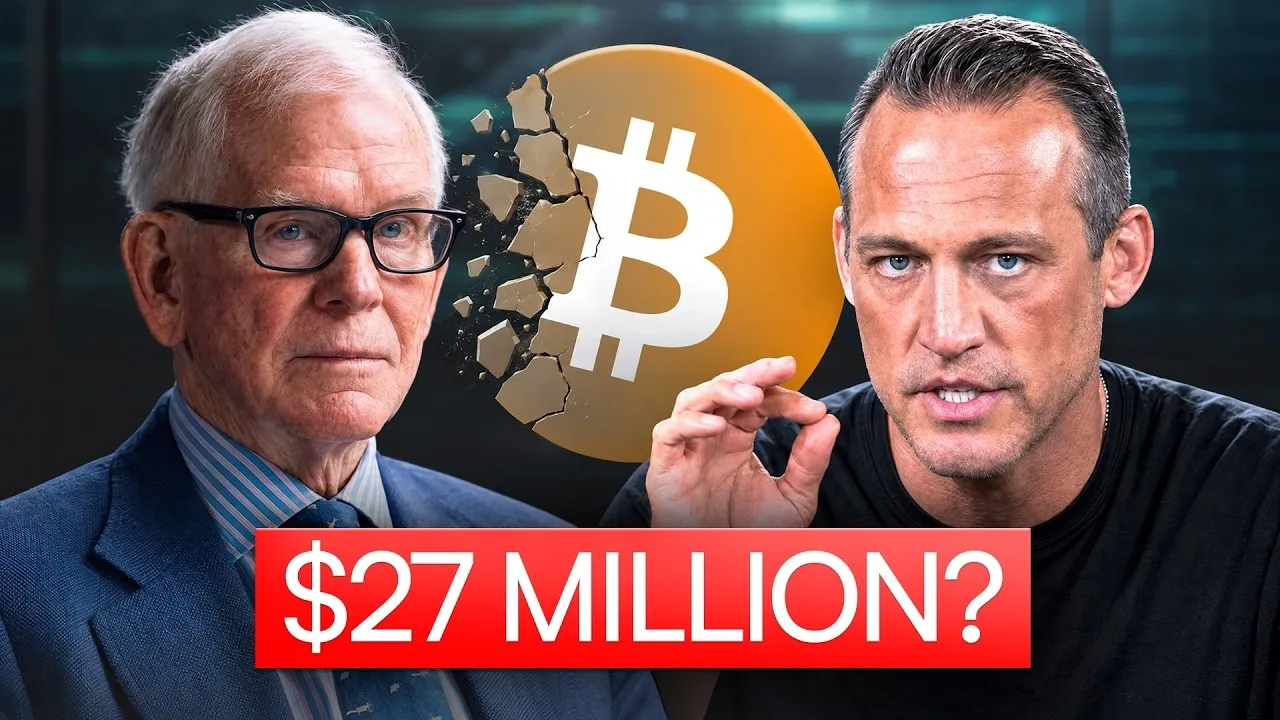
Jeremy Grantham is probably the most famous bubble investor alive. He warned about the dotcom bubble. He warned about the, [music] you know, 2008 housing crash. And he says that Bitcoin will eventually dwindle away to basically zero. So, I just spent the last couple of months building an entirely different way to value [music] Bitcoin. Now, under one of my scenarios in this model, Bitcoin ends up worth more than $27 million per coin. Now, obviously, those two views can't both be right. So instead of giving you another Bitcoin prediction, I want to show you exactly how I got there. Because most Bitcoin models, they start with Bitcoin itself. They try to look at its past. They try to look at, you know, the adoption curve and they use metastas law or the power law, something like that, and they try to project that curve forward. I did something completely [music] different. Now, I've been investing in venture capital for over 10 years. And venture capital has to solve a very specific problem. How do we value something today when the market that it's going to dominate doesn't even exist? Now, you don't have to start by predicting the stock price. You ask, "What markets is [music] this disrupting? How big can that market become? And what percentage of it can this company realistically [music] capture?" So, I applied that exact same framework to Bitcoin. We identified the markets Bitcoin's competing for. We went back and rebuilt that model to look at the historical trend moving forward and then we used actual macroeconomic data to project that forward. And then finally, we asked only one question that really matters, which is how much of that market could Bitcoin actually capture. Here's where it gets [music] really interesting because the model didn't just confirm what I already believed. At one point, the model actually argued with me. So, let me show you what I found. Let's go. All right, let's get into this. Uh, I've been working on this for months. And, uh, actually, it goes back even farther. I've probably been working on this model right here. I've been working on it for years. uh I just didn't have all the skills and the data that I needed to actually build it and now I got superhuman digital intelligence. Now we have a lot of people like I said Jeremy Grantham we got Warren Buffetts of the world of course Peter Schiffs of the world saying that Bitcoin is going to go down in value but there's the the consensus around Wall Street and most analysts today um show Bitcoin going to hundreds of thousands of dollars millions of dollars uh into the future. What I found lacking from these models is that they were all using Bitcoin's past to try to kind of predict out the future. But if you've learned one thing in investing, it's that the past doesn't guarantee the future. And so just because it's been doing this doesn't mean it will continue doing this. Uh we call that like recency bias. So I wanted a different way to think about the the Bitcoin value. And so I used the skill set that I have. I've been um like I said at the intro, I've been uh deploying money into venture capital for over a decade. And you see the way venture capital works is we have to underwrite a future. And so we have to imagine something that doesn't exist today and try to assign a value to it. Now before I explain to you how my model works and of course why I think it's the best, if we think back to some of the other numbers that we've seen, uh, you know, Bitcoin predictions getting to hundreds of thousands, millions of dollars, whatever. Typically, probably the main models that I I like and I use is, uh, the power law. So the power law is based off of math and it's like uh it shows how numbers move up over time. We have something called medcaf law that shows that the more nodes on a network the more valuable becomes. Uh we have like a stock toflow model. So that's like the existing stock or the existing supply and then the new incoming flow or the inflation. And so we can we know that bitcoin has become harder. The stock toflow number has been is harder than even gold today. Um there's having cycles and so that we know like every four years the supply gets cut in half and so when you change supply and demand that changes the price. Uh we have regression models. So we have all these different types of models that we can use and and I like them all and I use them all because we want to look at them from different ways. All right. So those are all important things. I don't want to I don't want to discount those and I use those. But again a venture capital has a very you know if we're going to deploy real capital and not just our money but investor money we have a real problem. How can we assign a value to something that doesn't exist? And here's how we do it. Let me give you an example. So if uh we were in Silicon Valley whatever a decade ago and you were um we were receiving pitches and somebody sits down and says hey I have this uh this app. It's like a ride share app and you can use this app on your phone to call a ride. And I'm like uh you mean like taxis? They're like well yeah it's kind of like taxis except for it's better because you can get black cars and you never have to get money out and you know things like that. And so they're pitching Uber right now. There was no such thing as Uber at the time. In in hindsight of course it looks obvious. And so we're like, well, how much could it be worth? And so what we do is we'd say, well, what are the markets that are being disrupted? So with Uber's case, it was disrupting taxis and limos and vans and things like that. And then we'd say, okay, so um how much of that market do we think we could capture and over what time frame, right? And then also how big will that market grow? That market's not static, right? And so we want to understand that how big is that those markets today, but also how big do those markets continue to grow and what what percentage can we capture. Now Uber did that, Airbnb did that and it doesn't mean that taxis went away. It doesn't mean that hotels went away. It just means that Uber got a little bit from taxis and limos and uh maybe a lot from limos and then uh Airbnb took a little bit from hotels, but of course they're still there today. So what I wanted to do is I wanted to take that model and apply it to a Bitcoin lens so we could understand it because Bitcoin is basically the same problem. It's what we call an underwriting problem, right? Venture capital gives us that question um the question to ask but it doesn't give us the answer. So the question is then what markets is Bitcoin even disrupting? Um today we see that it's sort of like a a a debasement hedge, right? So it's an inflation hedge. As a matter of fact, JP Morgan came out and said that both Bitcoin and gold are both debasement hedges. So as the governments print more money, as we have more inflation, as they continue to debase the currency, then gold and Bitcoin benefit from that. And so we can certainly see that that makes sense. I mean, if they keep printing more and more money, Bitcoin has a fixed supply and so it obviously acrews that. Now, so Bitcoin is that um but it's so much more. And really, what does it compete against, right? So in that scenario it competes against gold but it competes against more than that and it's not competing against other cryptocurrency. It's not competing against other payments like medium exchange. Um it's competing against all of that. Bitcoin competes for capital that people are trying to preserve across time. Okay. So where do we try to preserve our capital across time? Well, we put it into equities. We put it into stocks, right? We put it into stocks and equities and hopefully that it doesn't melt like an ice cube in like in dollars and it grows over time. I'm trying to preserve and grow that wealth over time. Um I we put it into real estate. Certainly we live in real estate, but then we invest into real estate um commercial real estate, apartments, duplexes, all of those types of things. And so we're also using real estate to preserve and grow that wealth. Um fixed income. So I don't want to spend down my capital, but I do need income to live. So I can put my money, my capital into assets that can pay me over time. So that's fixed income. Uh money of course. So so we we do save money, right? We keep our operating expenses, buffer accounts. We spend that. So Bitcoin is competing there. Uh is competing against gold. Uh we already talked about that. And then fine art collectibles. I mean, it's fun to have maybe some of those collectibles in fine art, whether that's stamps or gold coins or baseball cards or Pokemon cards or old cars or paintings. Um but we're als we're just trying to store our wealth and our value. Okay, so that's the markets that it's competing. Now the question then becomes well how big is that basket? How big is that pie? And how big will that pie become in the future? And then of course what percentage can we capture? Now you're going to love the math that I did on this. We went really deep. And again I I I started building this model a couple years ago but without superhuman digital intelligence AI became very difficult. And today we can be a quant. So, here's what we did. We took that basket, that store of value basket, again, so that's uh bonds, stocks, uh money, real estate, uh collectibles, fine art, gold, all of that. And we looked at how big was that basket in 2010, in 2020, in 2025. How big has that basket been growing? And what were the fundamental drivers of that growth of that basket? What is the mechanism that's underneath that that causes those assets to go up? So, what are the things that cause it to go up? Well, as we talked about, debasement. So, the more um money that's created, the more debasement that happens, uh the more liquidity that enters the system, the more debt that enters the system, but also the more value that's just created, right? So, when we create new things, it creates more money, more value. And so, we looked at all of those factors, the growth of the debt, the liquidity, the money supply, all those things going back to 2010. And then we looked at how it correlated to that basket over time again 2010, 2015, 2020, 2025 and we understood the mechanism there. Okay. So now we have that store of value basket growing per the monetary growth that we're seeing. Okay. Then what we did is we want to predict that model into the future. Now all models are guesses. Nobody has a crystal ball. But what we did is we took the data from the IMF, the International Monetary Fund, the the you know, Central Bank of Central Banks, the BIS, the Bank of International Settlements, uh the CBO, the Congressional Budget Office, and we took all of these estimates and CBO, they they project this out to 2050. Okay, so this is what they project out will be the levels of debt and the deficits and all of those types of things. And so looking at the historical relationship to the store value basket asset and then taking the predictions of the major financial institutions, global institutions, we can then predict out how big that basket will grow into 2030, 2040, 2050. All right. So I'm going to show you those how we how we uh what those numbers are and then we'll talk about what percentage we think it can capture. All right. So let's just take a look at this. Uh what we can see right here, if you can see my screen right now, is this calculator I built out. Uh and I'm going to give you a link. You can play with this completely for free. I break down the model, the markets, all of that is in here. So, let's just go over here to the market tab, and we're going to start here. And we can see that uh here at 2025 is our baseline that we're capturing. And so, again, we looked at the basket from 2010, 15, 20, 25. Here we are at 2025. And we can see that that basket is about$1 quadrillion dollars today. about $994 trillion and that was up from about $300 trillion in just 2020 uh 2010. So it's growing really really fast. So nearly one quadrillion and you can see how it's broken down. We have gold it's about 31 trillion. Real estate is the biggest market of them all. Maybe maybe you knew that it's about $48 trillion. Um debt securities so fixed in income securities about 167 trillion. Um other credit loans 70 trillion. equities, stocks, uh, 150 trillion, 152 trillion. Uh, broad money, uh, fiat about 144 trillion. And then art, you know, fine art, collectibles, things like that about 20 almost $27 trillion. So that's again where it's at today, 2025 or as of last year. And again, that grew from only 300. So it tripled in size in the last 15 years. So we can see that. Now the question is again using that methodology I explained how big does it get into 2030 20 240 and 2050 right we understand it's not frozen in time so what I did here is you can see here 2025 I created this donut chart so you can see and we have these different paths now again because we're projecting into the future and so we're using it based off of their data and then we have sort of like a bull case and a bare case so we'll just use the reference monetary path now what we can see if we go into 2030 that grows to about $1.5 quadrillion dollars. Now again, we have a conservative thesis, Mark's thesis, and a high adoption thesis, but we'll stick with the Mark's thesis here because it's my model. And in 2030, that grows from about 900 trillion to about 1 about one and a half quadrillion. By 2040, we can see this grows to about three quadrillion. And again, now Bitcoin uh is growing. All of these things are growing with that. Um then by 2050 we're at six quadrillion dollars. Now again this is using the BIS, the IMF, uh the CBO estimates of where things go. And this is just where it ends. Now it's my guess. That's I guess it's my prediction that I think that uh the BIS and the IMF are going to way underoot how much money and debt is actually going to be created. And I say that because historically they've always way undersshot it. They're always way too conservative in their projections. Okay. Then the next question that we have to ask now that we know that the basket size we have a model for how big that basket size gets over time. Now we have to figure out what percentage of that basket do we think is realistic. Now from a venture capital lens we have to answer this question. We have ways that we think about this. Now first of all uh just for some historical basis Uber and Airbnb both were able to capture 10% of their markets in less than 10 years. Now again, I just want to make the case this doesn't mean that um taxis and limos and hotels went away. It just took a little bit of the market, but the market also kept growing. And it's important to understand that because a lot of people hear like when Bitcoin hits a million dollars, well then the dollar is worthless and you know gas will be $500 a gallon. No, it doesn't have to mean that at all. As a matter of fact, it could hit a million dollars and not have the dollar die or have that high inflation because it's taking value a little bit from gold, a little bit from real estate. Okay, so that's how this works. Now, why? How do we think it could capture some of those? Let's look at some of these categories here. So, real estate, it competes for savings rule, not the building. So, we still need homes. I'm not saying people aren't going to buy houses. We still need houses to live in. But, as my career started as a real estate investor, most of my rental properties, I still own quite a few properties, but my rental properties that were just straight rental, you know, three-bedroom, two baths or fourplexes or apartments, I've sold all of those. I don't think the return profile is good enough for the risk that I'm taking. And I've sold all those and I've put it into into Bitcoin. And some people will as well. And I'm not saying all of it, but what if 2% or 4% or 5% of the wealth that would have gone to real estate now went into Bitcoin? I think that's pretty realistic. What about bonds and equities? Well, again, different economic claims. Now, again, we're still going to buy equities. There's still going to be companies. There's still going to be AI companies that are going to need money. And there's still going to be stock markets. I'm not claiming that. But if you own any Bitcoin, then you have money that would have otherwise gone to equities, right? So maybe it gets 5% of the equity market or 10% of the equity market over a long period of time. What about the bonds? We use bonds as fixed income debt securities and we can see that now we have digital credit. So like stretch and SATA built on top of Bitcoin that are rapidly capturing market share. Now right now it's tiny tiny tiny but we can see how that's growing over time. When a product is not just a little bit better, when it's a hundred times better, when it's a thousand times better, then it rapidly gains market share as Airbnb and Uber both demonstrated. Okay, so now you understand how it captures a little bit of the market. A couple points here and there, 2%, 5%, 10%. Doesn't mean it goes away. Of course, we still need new houses. As I said, we're still going to buy stocks. But let's take a look at this. So, obviously, Bitcoin is a new asset. And what we can see is that right now um the largest financial advisor networks in the world, Charles Schwab and Black Rockck etc. are starting to tell the financial adviserss they should start allocating to Bitcoin. So this is happening. It's been pretty small. We can see right here um in the United States 29 of the top 30 registered investment advisors, the IAS now own Bitcoin, but the median allocation remains small at 0.1% but it's growing each year. So this is this is all just happening. It's a process. Be patient. It's only at 0.1%. But it's going to get to 1% 2% 5% etc. We can see that it's the access is just coming online. Like Charles Schwab is just now trying to bring it on right now. We can see the top 25 banks in the US are rapidly trying to bring those products on. But here's where I want to show you. Wall Street now understands the benefit of having it. And specifically because now they can sell it to their clients because you can buy it in a brokerage account. Now they want you to buy it. So now they're recommending it. We can see this. This is the recommended portfolio allocation to Bitcoin by the world's largest financial institutions. And they're telling people to buy an asset that nobody owns. So let's take a look at this. So here is JP Morgan. They're saying take like a 1% position. Black Rockck is saying take a 2% position. Morgan Stanley is saying take up to a 4% position. And same with Bank of America. Fidelity is saying take up to a 5%. Charles Schwab is saying take up to a 6% and BBVA is saying take up to a 7% allocation to Bitcoin. So that would be money that would otherwise been allocated to gold or equities or bonds or something like that. 7%. Now how fast will their clients actually take the 7%? We don't know. We have to guess. But what happens if 7% of the money goes in there? Well, they have some numbers right here, but I want to show you back on the calculator. So, we we can stop guessing a price. We model out the markets, okay? Because we don't want to predict the future. We want to underwrite a future and we want to under we want to identify what it has to become. Okay? So, let's take a look at this. So, under the assumption, so we already have modeled out the growth of the store value basket asset by 2030 if Bitcoin can get 1.5% of the market share. Now, of course, Bitcoin, that's Bitcoin is now over 20 years old, and Uber and Airbnb got 10% in less than 10 years. So, here we are 20 years later. If we can get to 1.5% to the basket, that puts Bitcoin over a million dollars. That's Bitcoin capitalization, 21 trillion, which gold is 31 trillion. And by the time we get to 2030, gold's going to be even much bigger. So, Bitcoin is still nowhere near the size of gold. JP Morgan says that Bitcoin will overtake gold. So, we're still nowhere near the size of that. So, if we can only get to 1.5% that puts it at a 21 trillion market cap or 1 million per bitcoin by 2040 what percentage can we get? Do you think going back to this chart um all these clients of uh BBVA, Charles Schwab, Fidelity will have taken that 5 6% allocation? Okay. Well, then let's say that we get to like an 8% allocation here. So, now we have 8% Bitcoin's captured 8% of that market. Now we're at 2040. So, now we're 30 years in, not 10 years like Uber and Airbnb. 30 years. That would put the total market cap of Bitcoin at $239 trillion or $11 million per Bitcoin. Again, this is not that the store value basket is growing, growing, growing growing growing growing. We're just getting a small percentage of that basket. And by 2050 if we could grow to 15% allocation. So now here we are you know 25 years from today and we have these investment portfolio recommendations already at 7% today. Could it get to 15% in 25 more years from now? I think the answer is yes. That would put the market capitalization at $922 trillion and put the Bitcoin price at $43 million per Bitcoin. Now, again, I'm going to give you this calculator for free. Uh you can play with it and you can sit here and you can see what you think is realistic. You're like, well, I mean, they said 7%, I think everybody probably comes to 6 or 7%. So, what if we get to 7%. And I can just put that number in. Okay, that's $20 million per Bitcoin. But the question is whether it's 5 million, 10 million, 20 million or the 40 million, we understand that it's going to be worth a lot more than it is uh in the future than it is today. And so the question is thinking about not as the what is the value of that dollar today, but what is it in the future? So for example, a lot of people love to trade and uh they make a,000 bucks here, they lose 300 bucks there, and they make 500 bucks here or 5,000 here and they lose a,000 there. Well, that thousand that you just lost isn't $1,000. In 20 years from now, it could be hundreds of thousands of dollars. It could be millions of dollars. And so, we want to start thinking about the future value of what we have today, which is one of the reasons why we never want to sell the Bitcoin. We don't want to pay the tax, lose it, and we don't want to lose out on the future growth of it. And so, models like this are important for us not to understand the exact date and time that something is worth that price. We want to understand the directionality of where it's going. And we have to have a thesis. Never buy an asset until you know what it is that you're buying, what you're expecting from it, up or down, why it would go up, what is the underlying drivers, what is the mechanism of that, and over what time frame. So, I'm not saying it's going to hit a million in 2030. It could be 2032, could be 2033. Doesn't really matter for me because we're going to hit a million. Uh, we're going to hit $11 million and $14 million. Is it going to be 2040, 2045? It doesn't really matter. It's the directionality that we want to be sure of and the mechanisms underneath that so that we can continue to watch this market play out and we can adjust that. Why? We want to identify what has to become true and then we want to watch the evidence. All right, I'm going to put the uh the calculator for free in the show notes down below. Play with it and then drop a comment. Let me know what percentage you think is realistic to capture. And just real quick, going back to the calculator, you have the model here so you can understand how the model works. uh you have all the markets so you can understand the different markets it's disrupting. You have the adoption um cycle here. You have the methodology of how we got there. You have all the sources of where I got the data. IMF, BIS, world economic forum. Uh everything is right here and uh a lot more resources here. Uh how venture capital works, sensitiv sensitivity, all of that. So play with it, read it, study up on it, get somewhat educated and then leave me in the comment down below what you think the percentage is. cuz I'd love to hear from you. All right, hopefully you enjoy it and uh yeah, shoot. Stay long. All right, that's what I got. To your success. I'm out.
Commentaires 0
Connectez-vous pour rejoindre la discussion.
Se connecterAucun commentaire pour l'instant. Soyez le premier à partager votre avis !