…tore value, that's in the trillions and so that becomes kind of a call option. So that that's that's where I think we'll see the real adoption. First fundamental second regulatory and then finally, last but not least, it'll be, okay, well, the underlying asset, the productive money of this whole ecosystem is going to be ETH. So let's have some percentage of our portfolio in it. Multiply that by every human on the planet and it becomes quite substantial. >> Final question here for you for today. What is the one thing that you think is coming for Ethereum no one's really talking about yet, but you think could be ab…
the underlying asset, the productive money of this whole ecosystem is going to be ETH. So let's have some percentage of our portfolio in it.
Contexte extrait par IA
First fundamental second regulatory and then finally, last but not least, it'll be, okay, well, the underlying asset, the productive money of this whole ecosystem is going to be ETH. So let's have some percentage of our portfolio in it. Multiply that by every human on the planet and it becomes quite substantial.
Transcription Complète
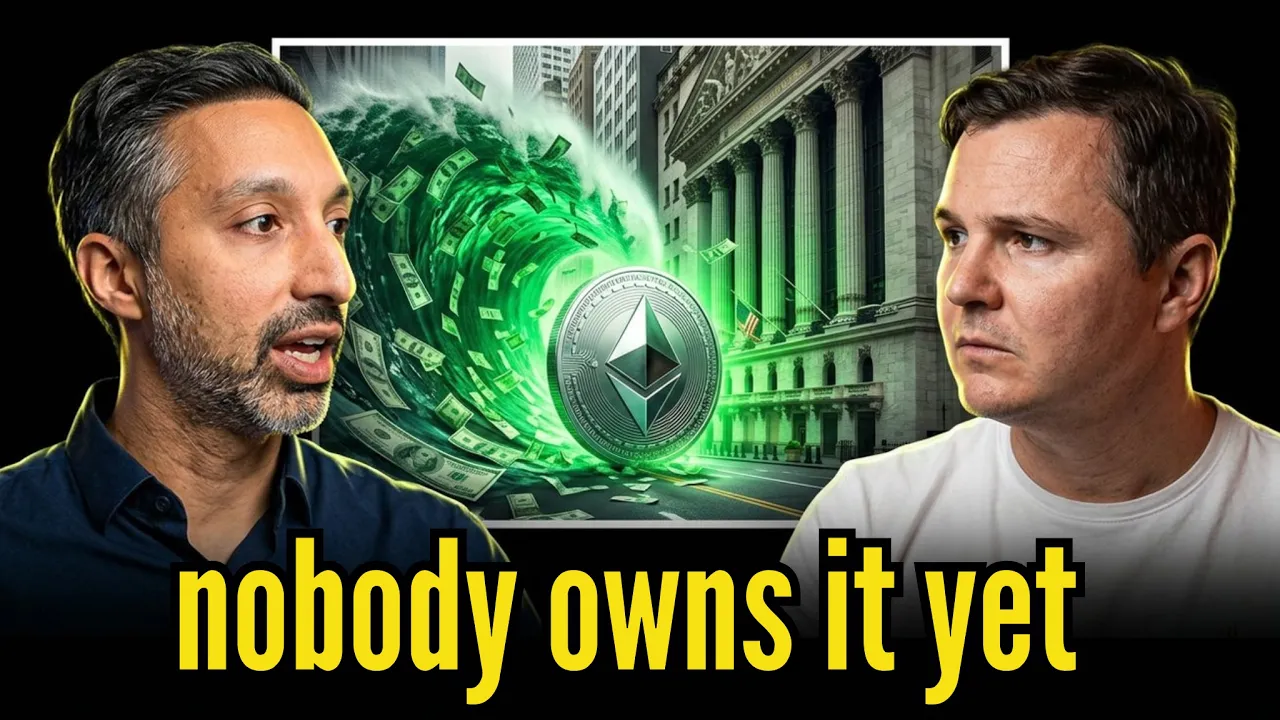
I think the asset is the only asset in crypto that has the ability to become a store value alongside Bitcoin and even bigger than Bitcoin. I think we're going to see a tidal wave of capital coming into the blockchain ecosystem ASAP. >> Vivek, welcome. >> Great to see you and thanks for having me. >> Thank you for coming on. Now, let me just introduce you real quick to everybody. So, you are the co-founder and CEO of Etherealized, the institutional marketing and product arm focused on driving Ethereum adoption among financial institutions. Now, formerly of Wall Street, a high-yield credit trader working at Morgan Stanley, UBS, Deutsche Bank, Nomura, and previously worked in the crypto investment banking and DeFi research. So, of course, Etherealized is backed by the Ethereum Foundation and by Vitalik. So, you are at the epicenter of everything happening in the Ethereum world when it comes to getting the suits interested and getting Wall Street on board. So, this is going to be super interesting conversation. Thank you for your time today. I appreciate it. >> Really excited about it. So, it's it's a good time for it and it's a good it's a good setup for Ethereum to finally have its have its really big moment. >> I've been thinking about Ethereum a lot recently, and now Tom Lee is almost at his 5% target. He's got 70, 80,000 ETH left to stack, and then we got to find some new bid. Is Wall Street going to be that bid for us? >> I think Wall Street is so it's it's it's a good first question. I think that Wall Street is a very big place. I mean, there's there's banks, um there's asset managers, there is wealth allocators, there's private wealth, etc. Overall, no one is allocated to crypto yet. So, that's that's the one thing we have to notice is like it's the crypto and blockchain asset class is still very, very early in its institutional adoption cycle. You don't see crypto assets as a meaningful part of portfolios, whereas you see things like gold and stocks as a big part of portfolios. The world's going digital, and so those allocations are going to shift. And so, yes, I believe the the flows that will come into assets like Bitcoin and Ethereum, and I think they'll overwhelmingly go into Ethereum, are going to be very, very outsized relative to even what Tom Lee did. So, Tom Lee's an amazing spokesperson. He sort of led the charge and he likes to go first and he's he's been right about Bitcoin. I think he's going to be right about Ethereum, but I think we've seen the tip of the iceberg of what institutional interest in Ethereum really is going to look like. >> Nice. So, Wall Street has been kind of moving past just the pilot phase. I remember years ago we'd covering all these stories about, "Oh, well, we got this pilot program where this is being tried." But now we're moving deeper and beyond just, you know, actual capital allocation to ETFs and things like that, but what's the shift to you look like in practice? Is it just the sort of conversations that are starting to be had? Is it those pilots turning into real production at some kind of scale? You know, a lot of RWAs have come on chain, for example. Or is it just the capital commitments itself actually starting to come into the space and people deploying RWA capital on chain on chain, but also actually buying ETH as some kind of a strategic asset to own or a necessary asset because they want to be involved in that permissionless ecosystem? >> So, it's it's twofold. One is let's start with the the second part. The wealth management allocation. Crypto allocation portfolios was zero, then it was 1%, now it's 1 to 5% and it's going to keep growing. And that split was initially Bitcoin cuz Bitcoin was 5 years earlier than than ETH in its adoption curve. Now it's Bitcoin and ETH and that's going to start to become more like 50/50 and I think at some point that allocation might even flip for some allocators because ultimately the ecosystem with most utility and the ecosystem with the most institutional adoption is going to have the asset that has the best store value. So, productive money versus store value inert money is going to be a debate that keeps going on, especially as Ethereum keeps growing and it's in its universality. So, I think that's where the capital flow is starting to come in in earnest and it's it's been exciting. But zooming out, like the part that excites me personally cuz I came from the Wall Street trading floors, I I think we're in an age of absolute abundance. I think the capital needs for this next era of humanity are going to be absolutely enormous. You have AI coming at the same time as space exploration coming at the same time as robotics. I mean, all of this is going to create incredible new industries and need for capital. But, I saw how capital is created on Wall Street. It's It's pretty manual. Like I said, it's it's pretty um it's using technology from the '80s. So, everyone knows that operational efficiencies are blockchain's actually answer. And for the last 10 years, there's been pilots of trying things and testing the waters on private permission chains, bank chains, internal chains. The flip to public is the moving from is a movement from pilot to production saying, "Now everything's to connect. Now we actually need real dollars, real money market funds, real tokenized deposits, real world assets on public chains so you can actually unlock the distribution and the operational efficiency." So, that's happening in in full force across across everyone. I mean, across banks, across asset managers, across wealth managers. Everyone has a mandate now to deploy products in in the blockchain space. And I continue to believe I believe since day one that the only platform that can become universal like the internet is the most neutral global platform that's been around the longest. I think right before I came on the interview, you you started and said that people should allocate their capital to the protocols that have been around the longest, that have been battle tested. That's Ethereum. I mean, Ethereum's been around the longest and you don't get points for being for moving fast and breaking things for the financial system. You get points for having 100% uptime and for having the most amount of precedent, the most amount of institutions, the most amount of capital. And that de-risks it. So, I think that's why we're going to see Ethereum become the default platform for the financial sector. And again, you're you're absolutely right. It's moving completely from pilot to production the quickest I've ever seen it. >> It's been really interesting to watch all these different stories playing out in the Ethereum ecosystem. All the BlackRock bring it bringing all this money on chain, for example. They're bittle funds. This is stuff that if you went back to like 2017 when I first got into crypto, and you said, "Hey, this is happening." People would say, "Yeah, you're crazy. BlackRock's not deploying billions of dollars of funds on Ethereum. That's ridiculous. It's just an ICO casino." And now, look where we are. Things have changed. And Ethereum has been continued to develop itself, and there's been all kinds of challenges and delays in that development process over time. And of course, investors have been very frustrated with the price action on Ethereum over the last 5 years. But there's all these new catalysts that are coming to find very interesting. And something that Tom Lee's talked quite a bit about is that Ethereum is going to be one of the next recipients of the AI trade. Do you agree with this thesis on that? >> I I think Tom Lee nailed it. I think that um that I'm focused on the part which is Wall Street infrastructure, capital markets infrastructure. I think it's very very important to digitize capital markets infrastructure. But we've been blessed with this new technology, AI, that right now it uses information unbelievably, and it's changing people's lives with information. But AI doesn't have access to money yet. AI doesn't actually isn't able to transact autonomously on behalf of people. And that's such an obvious use case for for AI to facilitate better commerce, to do auto investment rebalancing, to spend on behalf of consumers. AI needs a monetary asset, but more than a monetary asset, it also needs an ecosystem that's programmable so you can use that asset. And so, it really comes down to what's the safest, most battle-tested, the most decentralized, the most neutral and non-censorable place that AI agents can actually have access to money and store their value. And that's Ethereum by far. And don't ask me. I mean, I actually ask the AI agents this all the time. Like, where would you store your money? And it's it's always Ethereum across all of them. And again, the reason is is because even things like stablecoins are censorable. So, everything in the crypto ecosystem is censorable to a degree, except for the native assets of the network tokens of native chains. And so, Bitcoin non-censorable amazingly decentralized, but it's not programmable. So, AI can't really use it. You can't transact with it. If you want to convert from Bitcoin to USDC and spend, you can't do that unless you're on a smart contract chain. >> Like Ethereum. Using wrapped Bitcoin on Ethereum. >> Well, exactly. Exactly. But with ETH you can. So, I mean, I know it's been again, I'll be the first to admit it's been in terms of price action it's been very frustrating. In terms of adoption and looking back 5 years I was like, it's not just BlackRock, it's JP Morgan, it's Fidelity, it's uh Baillie Gifford, it's Amundi, it's Robinhood, it's Base, it's uh it's it's European players like Revolut. All of them are on Ethereum in full force. That's adoption. I mean, and that's the tip of the iceberg. I think the asset is the only asset in crypto that has the ability to become a store value um alongside Bitcoin and even bigger than Bitcoin. And the store value is for AI agents. The store value is is as a digital version of gold. And so, that's that's the upside I'm waiting for. So, that's kind of a call option. I think when it happens it's going to be a ridiculous repricing and it hasn't happened yet. But um the world needs a digital store value more now more than ever. >> Where's Solana sitting in all this? Because Solana's got, you know, a lot of adoption and a lot of users. And obviously, if you look at things like DeFi TVL, then ETH's way ahead. So, is there a situation where do you guys see Solana overtaking the Ethereum ecosystem? Is that even relevant? If it does, does are they just, you know, they're one's an apple and one's an orange they're in the same basket, but they are fundamentally different things and they both can be there at the same time. How how do you think about Solana, which is basically your main competitor Ethereum right now? >> I wouldn't actually say that's the that's the main competitor. I'd say pulp permissioned private bank style chains are more of the competi- are more of the competition because those are the ones that have been running in the in the background for the last 10 years. Those are the ones that they check a lot of boxes, they quote unquote work, they're fast, they're private, but they don't connect to any other chains, right? I mean, like so, if you have a JP Morgan chain, a Goldman Sachs chain, and a BlackRock chain, no one's going to use one neutrally across all of them and they're not going to be able to talk to each other without without trust options. So, they're recreating the financial system. That's the biggest thing that we see, but people understand the public is the future because it's it's again, it's like the internet. So, so coming back to Solana, Solana did a lot of things right. I mean, it optimized for speed, it optimized for throughput, but at the cost of centralization. And so, when you look at I think you need more of a track record. I think that I think because Ethereum's been around the longest, because it's never had downtime, because it has max security and it literally no point of centralization versus I would argue Solana and other chains have a lot of centralization. It's harder to get institutional trust there. I don't want to be complacent. Like Ethereum has to keep getting better, it has to keep getting faster, it has to keep having wins on the L2 level and the L1 level, but yeah, Solana's created different use cases, right? It's it's they're not the institutional use cases that we see for Ethereum. And yeah, we'll see. I think I I also think that you're going to see a lot of competition for for Solana from the L2s that that can ultimately uh crank up throughput even more and be faster and be cheaper. So, anyone optimizing for speed in this AI era is is going to optimize for a commodity. I think the the rarest commodity is security scarcity and decentralization. >> It's an interesting thought here about Ethereum's price. Cuz obviously, people are investors, they buy the asset cuz they expect at some point that they're going to be able to at least, you know, do something with that or have it go up in price. And so, there's a situation I see here where we have the fundamentals of Ethereum, which have never been better. The tech has just continued to grow. It's continuing to get better all the time. Overall adoption, layer the layer two ecosystem. I was covering just before you came into the the green room there a story that the base total value locked has actually exceeded Solana in the last day or two, now second only to Ethereum itself. >> It's amazing. >> So, that's very interesting. And so, you see all these sort of things happen where okay, there's so much happening and you have you know, BlackRock out here tokenizing stuff on it and so on and so forth. All these big things and yet the price of Ethereum right now is the same that it was when the fundamentals were a tenth of what they are right now. So, the question to you is, what is actually needed for a repricing to happen for the price to catch up with the fundamentals? >> It is a great question. I I don't want to be the one that ignores price and says, "Oh, adoption's great. So, we're winning." No, it's important. ETH is I mean, Vitalik said it himself, ETH is one of the most important applications of the Ethereum ecosystem, right? So, I mean, so there is ETH is used as collateral. ETH is staked to secure the network. It's an extremely important asset and applications. So, I think two things. First, ETH is the best performing asset of the last quarter. ETH has outperformed Bitcoin tremendously. I think that we've been We have to separate the macro side from the actual asset fundamental side. So, we've had two, three years where AI has taken every single ounce of capital from the entire global economy and that's where all capital's been deployed. So, so blockchain crypto has sort of been on the sidelines while we've been building a lot, right? I mean, adoption's only gotten better, but um but you haven't seen new capital allocated into the blockchain space or the crypto space outside of the existing crypto ecosystem. It's all gone to AI. I think that's going to flip. Tom really thinks it's going to flip. I think that uh the AI trade has been unbelievable, but now there's a lot of new wealth created and if blockchains are the neutral infrastructure that AI agents and the financial industry is going to use, you're going to see capital flow back in. So, first off, I think we're going to see a tidal wave of capital coming into the blockchain ecosystem ASAP. Second thing is, we finally have regulatory clarity on all fronts. Um genius was last year so stablecoins are allowed. Even without clarity, the SEC and the CFTC have given a green light to a lot of innovation um in the US on blockchains. That's going to bring a lot of capital, too. And then third, I think that people will actually start allocating to to different digital assets as part of portfolios. Again, that's it's that's starting at basically zero. I mean, crypto's been a very very circular economy where capital just rotates from one asset to another, from Solana to Zcash to Near to something like that's all existing capital. The new capital coming in is going to flow to Bitcoin and ETH. And and so as that becomes an allocation and it becomes a global allocation for global portfolios, that's how you get these numbers like $60,000 ETH because if you're playing for store value, that's in the trillions and so that becomes kind of a call option. So that that's that's where I think we'll see the real adoption. First fundamental second regulatory and then finally, last but not least, it'll be, okay, well, the underlying asset, the productive money of this whole ecosystem is going to be ETH. So let's have some percentage of our portfolio in it. Multiply that by every human on the planet and it becomes quite substantial. >> Final question here for you for today. What is the one thing that you think is coming for Ethereum no one's really talking about yet, but you think could be absolutely huge over the next maybe one or two years? >> Over the next one or two year I mean I think the thing that people need to zoom out for is that world computer vision is where Ethereum is the financial internet and the TAM of that is is a whole new global economy. But in the next one or two years, I think it's ZK-based privacy. And I think that is No one talks about it because because on Wall Street and institutions, it's assumed that transactions and assets will all be private because that's how the system is today. So it's table stakes. And then for the blockchain ecosystem, blockchains have not solved for it at scale yet. So that's why you see bank private permission chains currently in in in the running because they have privacy. I think Ethereum has been so far ahead on the ZK roadmap and has innovated so many different ways on ZK. I think ZK is as exciting of a technology as AI. I think it actually complements AI quite nicely um across a [clears throat] bunch of use cases. Privacy is the biggest use case. So I think once you start to see privacy universally programmable on a public chain like Ethereum, that's when it gets really cool. That's when you see a mass mass migration of assets on chain, and we're going to be facilitating a bunch of that, too. So, I mean, that's that's the use case that that I think will come much faster than people think, and that's what will unlock capital flows and and real commerce, and yeah, privacy on public chains, HTTPS on HTTP, and that's going to be a fun moment to see. >> Zcash bros, watch out. Ethereum's coming for you. >> [laughter] >> Oh, it's fantastic. It's true though, it's true. But the this one thing I've said about Zcash is that all you know, Ethereum's bringing out privacy. Where's where's the use case for Zcash? But that's a whole other conversation for another day. But back, I appreciate your time. It's been a super interesting conversation, so I hope everybody in the chat has enjoyed it, and thank you so much for coming on today and sharing your insights with us, you know, straight from Wall Street to everybody here at the audience. So, it's absolutely appreciate it. Thank you so much. >> Thanks again for having me. It was fun. >> Every week, 100,000 people get the trade idea before the crowd does. You could be one of those people for free, or you could find out after the move's happened, after it's already played out. The Lark Davis newsletter delivers a trade of the day, a chart of the day, a market-moving alpha section directly to your inbox. All the latest news, what you need to know as an investor in these markets. Time to get ahead of the action, not react to it. It's free, it's fast, and it's the one habit separating traders who catch moves and traders who chase them. Don't be the one asking, "Why didn't I know about this?" Join the Lark Davis newsletter today. It's free, link below. Go get it.

Commentaires 0
Connectez-vous pour rejoindre la discussion.
Se connecterAucun commentaire pour l'instant. Soyez le premier à partager votre avis !