69 ratings is about 317 for the stock rated as a buy.
Contexto
"Amazon's at 231. Average analyst rating right here. You can see on the left across 69 ratings is about 317 for the stock rated as a buy"
Transcrição Completa
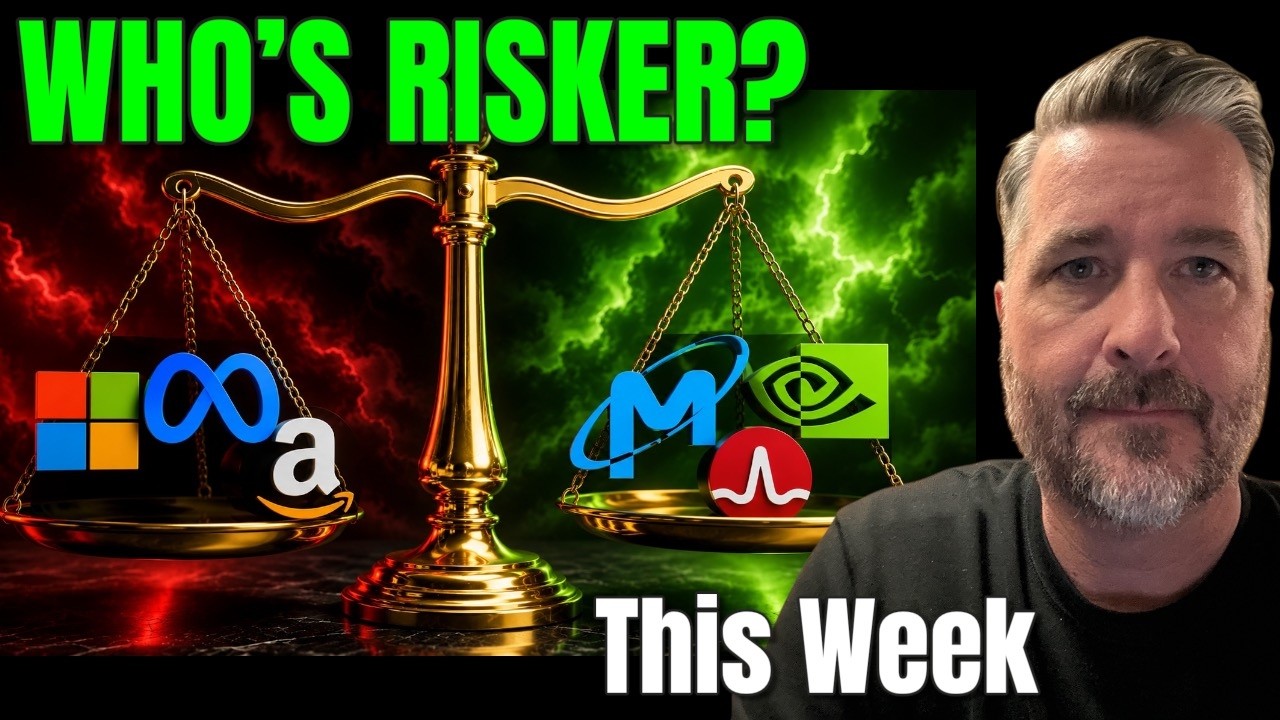
Guys, welcome back. We are heading into probably the most pivotal week of all of 2026 right now with regards to the AI infrastructure buildout. This week ahead of us will give will test so many different things. It'll give us so many different answers and provide us with so many signals of where we are going for the rest of 2026 in my opinion. And the reason I say that is because it's not just the hyperscalers. If I show you on the screen here all of the earnings that are happening this week, we have everything across the entire buildout. We have everything from key memory uh earnings with Seagate and SKH Heinix in the first half of the week. We have our hyperscalers of course in Meta, Microsoft, Apple and Amazon, but we also have a number of different players. We have our picks and our shovels with Vertive and Lamb Research. We have our we have compute players in ARM and Qualcomm and we have advanced packaging players in ASSE. We have Silicon Motion, Form Factor, Pterodine, Corning, an optical player as well as Modin. So many different companies that can give us so many signals about the AI infrastructure buildout, where the demand is right now. How how is demand continuing to outstrip supply with regards to the memory sector? What do the margins look like across these companies? What type of forward guidance will they give moving forward? What signals will this show us about the health of this sector, about the health of the AI infrastructure buildout? And it led me to a question that's really the fundamental question for this video is who has more risk this week. Is it the hyperscalers or is it the AR AI hardware stocks like memory sector that we that we follow very closely on this channel. So, that's the focus of this video. I want to dive into that and address that question. I want to hear from you as well. So, make sure you drop your comments down below. Let me know who you think has more risk. If you agree with my thesis or if you have a different point of view, I would love to hear it. But if you haven't done it already, make sure you hit like. Make sure you subscribe to the channel. Guys, let's keep growing together. Let's keep this channel moving and growing and continue to expand our reach across all of YouTube. So, thank you to each and every one of you for all you've done for the channel. so far all the level of engagement that's truly appreciated. All right, let's dive in. Let's dive in, excuse me, to the topic because guys, in my opinion, I think that the hyperscalers have more risk and let me show you why. I want to show you just the Google what Google did after their earnings. Tesla as well last week, but that was a different reason. Tesla missed on a few of their of their metrics, but Google's reaction to their earning, you can see on the graph here where they started on Monday the 20th, where they ended the week. It was all focused on their capex. It was all focused on the negative free cash flow for the company. The first time that they've seen that in the company's history. They increased their capex as you know from a from a target of 180 to 109 90 billion to ultimately saying they could hit 205 billion this year and signaling that they are going to be continue to be aggressive into 2027. So the market saw that and frankly got a bit anxious and look at the pullback that we saw with Google. Google entered the the week at about $356 a share and it exited the week at about $319 a share. So you see the drop here right around like post earnings how the stock just got hammered and dropped you know right where it closed on Wednesday at 342 to where it opened up at uh on Thursday at 322. So essentially a $20 drop per share overall. That was the impact of what was felt from their earnings even though they crushed their earnings. Like we know they had incredible earnings, but it was just that one signal that the market didn't like to see around capex. And that leads me to what I think we could see this week when Meta, when Microsoft, when Apple, when Amazon all report out, will we see a similar type of reaction? Because I think they're going to signal stronger capex as well. All of them. I just think they have to. I think they're in a race to build out right now. We're seeing many reports that capex targets for 2027 will exceed one trillion across the hyperscalers. So I don't think there's any slowdown because they have a fear of missing out. If they slow down, I think they're in a position where they feel like they're going to be at a competitive disadvantage compared to their peers. So that's my fe my belief. I think the hyperscalers are going to be a little more at immediate risk this week than the affiliated the hardware players that are affiliated with them such as memory, such as compute, such as the picks and the shovels overall. But we'll see how it plays out. But I do want to go through an article with you that I found very interesting. I think also kind of helps us understand this the buildout overall and why it's not overbuilt. So, let me uh pull that up. It's from investing.com. We'll walk through this article together because there were some really cool points in the article that I think I I just had to share with each and every one of you across the community. But you can see the title of the article, the AI buildout is not overbuilt. It's becoming an asset class. And they want to walk through the economies across three different layers. So of course the hardware layer, this is a generational transfer and free cash flow to the hardware players like the memory stocks, the hyperscalers. In here it's an interesting piece. They talk about how compute is ultimately becoming an asset class, not a sunken cost for these play. And then finally, we're going to walk through a case around how anthropic is going to be the first profitable frontier lab and it's about to repric the entire stack according to investing.com. So, let's walk through it. Overall, you can see here it said Alphabet uh printed its first negative free cash flow since it went public. Anthropic Anthropic signed its fourth chip deal in nine months and Meta all but confirmed it will rent out compute. Remember when that story hit and that was a worry that there was a supply glut of compute. The fact that they're renting them out now u and that drove a fear and anxiety over all the down it it hurt the stocks in the in the short term. There's a great case in here to talk about how this is becoming an asset class and it's not shouldn't be a concern at all. So let's walk through it. First piece is the hardware layer. It's a generational transfer of free CL free cash flow. You can see the combined 2026 hyperscaler capex. They're saying it's reached 725 billion. It's up 77% from 2025 where it was 410 billion. But as it as I mentioned earlier, their research points to the fact that it'll exceed 1 trillion in 2027. Here's the graph that shows Alphabets, you know, the last earnings that we just saw where free cash flow flipped to the negative to support the data center buildout. And they mentioned at all of the at the same time, this is landing as profitability one layer down. This is the impact we're seeing with memory with the other uh with the other comp companies involved around the buildout in the hardware AI layer. They're saying that pricing is up, memory pricing is up a cumulative 435%. Micron's gross margins is nearing 86%. And compute alone is 380 billion. This line, let me get that out of there. Sorry guys. Yeah, 380 billion this year, roughly double what it was in 2025. And it's expanding beyond just Nvidia. Intel's data center revenue grew by 59% the best it's been in 15 years. Texas Instruments their data center sales are set to double past three billion while custom silicon pulls a much wider ecosystem. So the impact here the generational flow of money from the hyperscalers into the AI hardware level. It's having an impact a positive impact on all of these companies related to memory CPUs networking packaging across the board. So we as I mentioned we continue to see hardware layer as the best riskreward in the entire sector. This is why we're bullish on the memory uh sector on this channel. It's why we have so much conviction as we move forward. We know all the reasons, but we continue to see the investment from the hyperscaler and how that transfer of money from the hyperscalers is essentially going right to the balance sheets of all of these companies that are supporting or building out the hardware or that are involved in the hardware layer and helping helping achieve the data center buildout like the memory companies. This next piece is a very interesting part of the article. It's around the compute resale opportunity because we know that the bear case was clear when Tesla and Meta said they were going to sell compute. There was so many kind of bearish themes around compute scarcity is over. There's a glut of it, but the deal economics say otherwise that they walk through. So on their math, a gigawatt costs roughly 30 billion to build out and it throws off 14.5 billion of net income a year at a conservative rental rate. It's a two-year payback for the hyperscalers. So, if you look at Meta, they sit on seven gigawatts and they're doubling to 14 gigawatts of compute. I and they're using an estimated 60 to 70% of that. So, if they monetize 5 gawatts of excess compute, it could add 70 billion of income to their balance sheets. So, this is not overbuilding in the author's author's opinion and in this article investing.com. It is compute becoming an asset class. Look at the economies of compute here. You can see one gigawatt in the numbers. What 30 billion of compute actually earns and how fast it comes back. So the investment 30 billion compute it's one gigawatt. It drives revenue of 20 billion operating margins of 85% operating income of 17 billion with a tax rate net income of 14.5 billion. will say 2.1 years you get payback on that overall. So this also there's another piece they also called out which was interesting in the market right now because we've heard around replacement cycles and a depreciation and they say that this fails the same test because fouryear-old GPUs right now still command rising rental rates so that the worth so the thought of it being worth zero in five years that assumption behind the bare case it doesn't survive contact with the resale market. doesn't survive contact with the real world data that's out there in the market. Demand and it says demand is contracted. So more than two trillion of backlog sits across the four big clouds. Alphabet is the cleanest expression. So cloud grew by 82% 25 billion margin of 36% with a backlog of 514 billion. still short of capacity even after guiding capex to 200 billion while turning on its own TPUs in a revenue stream with Anthropic and Meta. They mentioned Anthropic has contracted more than 11 gawatts of compute across the four deals that you can see on your screen with Amazon with Google Broadcom with AMD and obviously with Microsoft and Nvidia as well. So for hyperscalers renting compute to the labs isn't a sign of glut. a second monetization engine that is coming online. And then the last piece I want to go through with this article which they mentioned could flip the entire market. If we can show that a frontier lab like anthro Anthropic is becoming profitable, it changes the entire discussion. It changes the entire argument in their opinion. They mentioned that anthropics run rate has gone from 9 billion at the end of 2025 to more than 47 billion mid 20266. It's roughly an 80x uh uh uh growth in a year and it's all based on token e economics. So inference cost has fallen 40x since 2024 while revenue per token fell only 9x. So swinging quarterly gross profit from a negative 555 million to an estimated 1 billion plus by the third quarter of 2026 is going to be the first profitable frontier lab according to this article. If we scroll down the bottom line which I love to see it just says the hardware layer it offers the cleanest riskreward as free cash flow shifts from buyers to suppliers. And they go on to say the market keeps hunting for a peak with regards to AI hardware, the AI hardware layer. It keeps hunting for the peak, but the economy keeps the economies keep pointing to this to the fact that it's going to be higher for longer. So, I wanted to share that article with you. Just thought it was a great kind of walk through, particularly a bullish kind of sign for memory. I thought there was a lot of cool things in there just showing how the money is flowing into the memory sector overall. And it leads me to my next piece as we scale out for next week. What do we need to look look for? Put this quick graphic together for all of us to walk through. So, hyperscaler earnings this week. This is just a small set. You saw the full group that I showed at the beginning of the video, but we've got Microsoft, Meta, Apple, and Amazon. Key things to look for real quick. Microsoft, it's going to be Azure volume growth. We have to see if that sustained acceleration if it signals a strong AI cloud growth infrastructure spend of course data center revenue and kind of the inventory commentary so guidance on supply tightness or inventory normalization meta it's going to be their reality labs update the hardware roadmap and the memory content per device the AI compute spend you know investment in their AI trending clusters and infrastructure their ad revenue is going to be a big piece every earnings for Meta and the capex outlook. Apple's an interesting one. I think it's probably the most risky one for me for the memory sector all week. Not for the reasons I have here, but what do we watch for is obviously demand for their products. So, iPhones, what's the shipment looks like for iPhones? You know, what is the unit growth? Is it supporting DRAM nan demand services, revenue, you know, AI features roll out and the inventory levels? What I what I say when I say for apples because there's rumors that they're going to announce a partnership with Prism, a company that's been able at least to show that they can compress memory. There's other rumors that Apple's found a way to compress memory through AI and and be able to shrink memory in their devices. I think they may announce a partnership if the government lets them, but to buy memory from CXMT. So, this is probably the most pivotal one in my opinion this week for us to watch for. But again, any of those, all three of those I mentioned to me is not a long-term risk for the memory cycle. We've said many times, if we can find economies of scale and it lowers the cost, it just expands memory uh exponentially. It's all the Jebans paradox uh concept in my opinion. And then Amazon, we have to watch for revenue growth, AWS revenue growth, capex infrastructure as well, supply chain commentary insights and memory availability and lead times there. But the bullish and the bearish case for memory this week is clear from a bullish it's all around infrastructure accelerating AI infrastructure accelerating capex remaining elevated supply constraints continuing to persist and strong pricing environment overall can we ensure that the contract pricing stays firm across those we're going to see increases with DRAM nan hm will we hear anything more around long-term contracts in place from these hyperscalers with the memory companies the bearish cases is is pretty much the opposite. If capex slows down, if demand is softening, if inventory is building overall and if the pricing pressure feels like it's it's declining or HBM is is supply is improving faster than the demand, it'll have an impact on the memory sector for us. Few things I want to walk through because like I said, I think the hyperscalers are the biggest risk for me. So I just want to show you the four they're going to that are going to report this week because I do think if they face pressure guys we are going to have an excellent opportunity to maybe have a new entry point on some of these hyperscalers. These are outstanding companies that are fundamental to the US economy and if they get down low enough it creates an unbelievable entry opportunity for us where you know they're just going to be undervalued in the market from a price to the return that they have or the the impact or the value they have to the entire market. So that's something we should keep our eye on as well because if you look at where we sit right now with Microsoft, it's at a price of 381. The average analyst rating is 555. Here's what the stock looked like this week. But if we see a drop with Microsoft, it could be an excellent opportunity to enter in, particularly when you see analyst price ratings at 555 for this company. If we jump over to Meta, same thing. Meta's analyst rating is 822. The average analyst price point 71 ratings all rated as buy. The stock is kind of undervalued right now at 594. If it shrinks a bit more, we'll see what it did this week. It opened up at 644, kind of ended the week at 595. If it drops further, that could be an excellent entry point if you were looking to get into Meta. We look at Amazon's at 231. Average analyst rating right here. You can see on the left across 69 ratings is about 317 for the stock rated as a buy and we see it already had an impact from the other uh earnings from Google and Tesla last week. It is down right now already. So again could be a great opportunity to get into to Amazon if we see further kind of pressure and pullback in the stock. And finally Apple. Apple is the one outlier. It has had a positive week. It's kind of sitting right at its analyst rating. As you know, it's trading at 333. It's actually above the average analyst rating at 321.85. The uh stock actually outperformed the others. It had a little bit of a inverse relationship with the others. When the others felt pressure based on Google and Tesla, we saw Amazon I mean, excuse me, Apple continue to uh to move. So, keep your eyes on these hyperscalers. they get low this week, could be a great point for us to have entries into them. For me, I do like Google. I do like Microsoft. I'm long-term bull on both of those. I do like Apple as well. I think they're just critically important to the US. So, those are the stocks that I like, but I want to give you a bonus signal before we leave because we've heard a lot about the Chinese competition. Saw this article on Tom's Hardware. Thought it would be important to share. So Chinese CXMT DRAM doesn't look like a budget saver that many were expecting. New modules enter the market, but prices still track towards the big three of Samsung, SKH, and Micron. Show you real quick, but basically one common misconception in today's memory market is that once memory modules based on chips from CXMT enter the consumer market, the big they will be cheaper alternatives to the to the sticks running DRAM from the big three. It's not what we're seeing in reality right now. So if you look at a 64 gigabyte DDR5 RD dim based on Samsung and SKHX, the cost of that at JD.com is about 2700 27.45. CXMT is priced at 2,800 right now. So it is a 60. They say while the $60 difference seems significant, it's really just a two 2.2% which could be considered negligible at these high prices. But they did say many expected that CXMT's memory modules to be cheaper than those carrying chips from Micron, Samsung, SKHix. But it's not what we're seeing in the market. And what makes it even more problematic is what they call out that CXMT produces memory chips, an outdated fabrication technology. Its DRAMs consume more power than those made using by by made by the big three using the latest manufacturing process and they have lower performance potential and medio mediocre overclockability. So that's an article I just wanted to share. I know there was a lot of kind of thoughts that we are just going to see significant pressure from CXFT. They're going to flood the market with cheap memory. As of right now based on those prices we're seeing doesn't seem like it's going to be that way. They're pricing it pretty much closely to the big three in the market. We'll see how that evolves, but I wanted to give you that bonus signal overall. So guys, let's get ready for a wild week. It's going to be a volatile week. I think we need to be ready for that. There's so many earnings coming out, but I'm excited about it, honestly, because it'll give us such insights. It'll give us such learning into the AI buildout, into the demand that we see in the marketplace, into the guidance moving forward and where we will go from here. It's going to be exciting week, but it's probably going to be a volatile week. So, be ready for it. But I do think in the end that the hyperscalers are probably at a more of an immediate risk than the AI hardware players like the memory sector. But let me know your thoughts below. Let me know if you read it differently. Let me know if you feel the same way. Hope you had a great weekend, guys. I'll see you in the next one. Take

Comentários 0
Entre para participar da discussão.
EntrarAinda não há comentários. Seja o primeiro a compartilhar sua opinião!