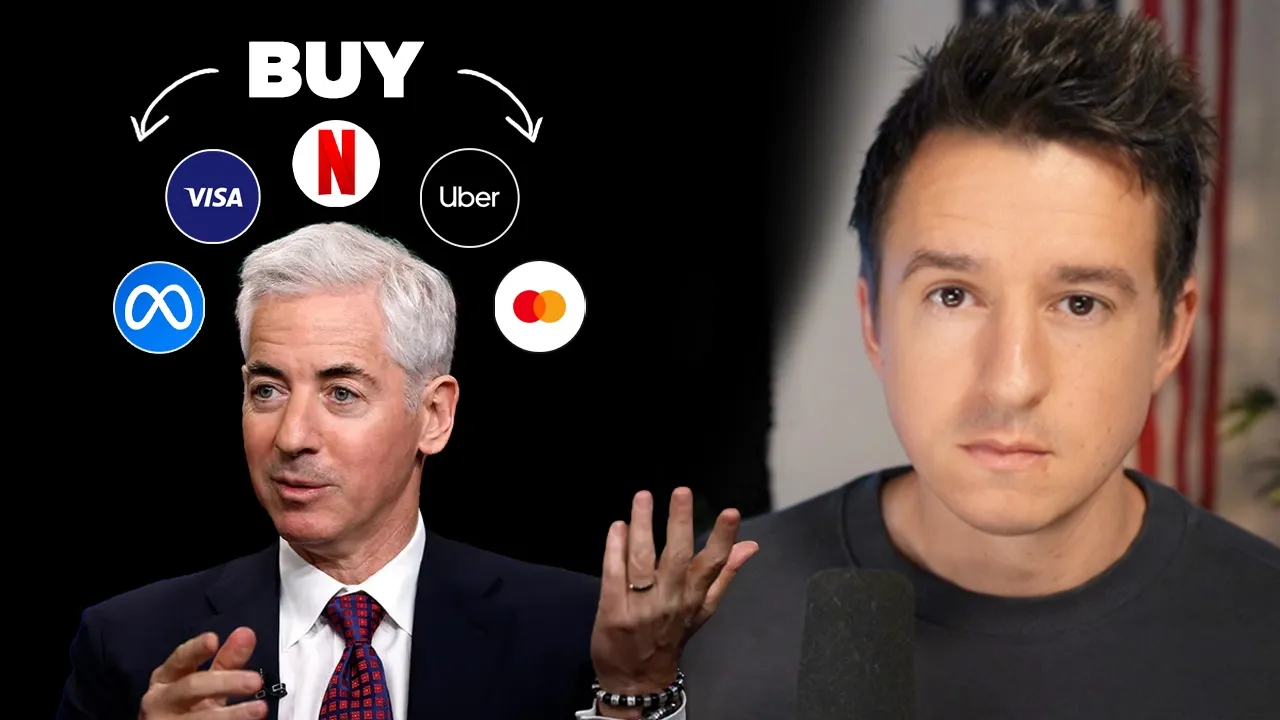
Earlier this year, we initiated positions in Visa, Mastercard, two businesses we have long admired, which provide a dominant global network for consumers and commercial payments.
Contexto
“He bought both Visa and Mastercard as a collective buy. He says, 'Earlier this year, we initiated positions in Visa, Mastercard...'”
I think this is a timely buy during a dip and another fantastic addition to the Persing Square portfolio and I continue to hold my position in Mastercard.
Contexto
“He bought both Visa and Mastercard as a collective buy... I think this is a timely buy during a dip...”
he continues to view Meta as one of the best stocks in the market today to own.
Transcrição Completa
Welcome back everyone. We just had breaking news that Bill Aman is once again a Netflix shareholder. That's right. After his brief stint of owning it for about three months in 2022, he finally decided to buy back in. So, what changed? Why is Bill Aman now buying Netflix when he used to own the company and he at one point called it too unpredictable? It seems like he's changed his mind on Netflix as well as a number of other companies. In fact, he didn't just buy Netflix as a new position, he bought six new holdings. That's a lot of buying. Bill Aman has been on a buying spree. But the interesting part about this is I already own three of these six new companies. Three of them were Netflix, Mastercard, and S&P Global. These are all big positions in my portfolio. So, obviously, I have a lot of thoughts about his analysis on these companies. And with his analysis on them, he released an entire in-depth update. This is a Persing Square Q2 report. It's very in-depth. He goes through his entire strategy, what he's trying to accomplish. He goes through every holding and the performance of it. He also goes through the valuation and the implied growth rates, how much he thinks all of these companies will grow in their earnings per share over the next 5 years. So, I compared all of his estimates against the market consensus to see which companies he believes will grow the most today compared to what investors think. So, this is going to be a very full episode. We have a lot to get into. Let's go ahead and get started. Now, the first thing I want to address is many of the holdings that I have now are an overlap with Bill Aman's portfolio. But I just want to point out in my defense, the majority of them I have bought before Bill Hackman. I've already been in a lot of these companies. I bought Meta before it was revealed that Bill Aman bought Meta. I had Google before he bought Google. I had Microsoft before he had Microsoft in his portfolio. I had Amazon before he bought Amazon. I had Netflix twice before he bought Netflix. And the same goes for now Mastercard and S&P Global. Now, there are some companies that I followed Bill Aman into. One of them was Chipotle, which was a successful investment, and the other one is Uber, which is a new position that I really like. But the reason I point this out is because between the two of us, there is a big overlap in holdings. But I'm not just copying his trades. The majority of these companies I've actually owned prior to Bill Aman buying into them. Now, out of the new companies that he just bought, the one that I first want to outline is Netflix. I find this particularly interesting because Bill Aman had previously owned Netflix and I've owned the company long ago. I owned it before Bill Aman both times. So, he's owned it twice now. This is his second time. I've owned it just once the entire time through. My position is a $12,000 position, $30,000 in the green. If we look through Netflix's stock price history, I'll give a short outline of Bill Aman's dealings with this company a couple years ago. in early 2022 or late 2021, he bought the company after it suffered a major fall. So right there, Netflix dropped like 25% in a single day because things were slowing down. We had a major slowdown in subscribers and management was they warned about it. They said it's a problem. We have a slowdown in subscribers. With Bill Aman having looked at the company and studied it, he thought that this might be just a minor dip and he can buy the company today and it will sail back up in the future. Well, what he didn't know is that is that Netflix would stay flat for the next 3 months and then things would get much much worse. Netflix management said that not only are they not going to grow subscribers, but they're going to lose 2 million subscribers. So, millions of customers being lost. Their churn has picked up. They're no longer a growth company. And literally everything flipped on top of its head. Netflix now was being viewed by Wall Street as a has been a company that was totally saturated. It couldn't grow at all. It had no pricing power and it had competitors crowding it out. The news was so insanely bad. I've never seen anything like it. YouTubers were making videos of the rise and fall of Netflix with big arrows and explosions showing it just crumbling. People were almost rejoicing in the fact that this big company came tumbling down. From the peak to the bottom, Netflix dropped by about 75%. And again, sentiment could have not been worse. Everybody was mocking anybody that owned the company. Uh it was a terrible time to be a Netflix shareholder and Bill Aman after 2 days after that report and the stock dropping he decided to move on. He called CNBC and he said that the stock has become too unpredictable and he wanted to move to a more predictable company. >> As he told me the reason why he exited his position after only 3 months at a $400 million loss was quote, "I'm 100% ready to admit when I'm wrong and 100% ready to admit when I'm wrong quickly." Um, so that sort of gives you an idea of where his thinking was. >> So he sold out of Netflix roughly at the bottom. Now, this isn't to criticize Bill Aman. We all have to make judgment calls. Uh, he had a different analysis on this company than I did at the time. And I would say that my analysis of Netflix at the time was uniquely bullish on the company. I I realized it was a bit of an outlier at the time. I had studied Netflix so much. I felt so confident in it. Maybe to some naivity. Maybe I was uh being overconfident, but I just I could not fathom that Netflix was done growing. It was just such a global company. They had so much content. They they in my opinion, they own the world and I thought that the market got it wrong. So while this was going on, I continued to add to my stake in Netflix. I bought more and more of the company. I continued to buy it and I talked about it incessantly. In fact, I even published and I I wrote things in depth about Netflix. This was December 1st, 2022. The stock price at the time of writing that was $30. So I wrote this December 1st, 2022. Netflix was trading at a price adjusted $30 per share. And I go through and I highlight a lot of different things that are going on with Netflix at the time. Netflix reported subscriber losses for two consecutive quarters. Netflix subscriber loss resulted in destroying investors confidence, causing the stock to drop by over 70%. Netflix had changed their mind on having no ads and has introduced a new $7 a month ad tear. Netflix has decided to monetize password sharing accounts. Netflix admitted they faced real competition in streaming. Netflix made a pivot into gaming. Netflix has done layoffs and budget cuts. So when you're looking at the situation here, this is illustrative of what goes on during a time period where a stock is in crisis, where it's just dropped 75%. Everything is interpreted negatively. All of these actions that Netflix took look desperate on the surface. Ah, they changed their mind and they're adding ads. They're going into video games. They're they're monetizing password crackdowns. All of these looked like desperation when in reality they are well calculated moves by management. I continued on saying the damage to Netflix's story over the past year is real. Investors confidence has been shaken. Even Bill Aman purchased into Netflix to buy the dip and quickly sold out three months later when Netflix had another disappointing quarter. He's now stated that the stock is quote too unpredictable for his concentrated portfolio. This is where I continue to strongly disagree with the market and with Bill Aman. I don't think things are so bad for Netflix. I don't think the company is unpredictable. In fact, I think Netflix is one of the most predictable companies in the market. I go on talking about how Netflix is making breakout shows. You had the Glass Onion, you had Dawnmer, we had Wednesday, we had all these shows that they're making that were actually quite good. When I consider the facts surrounding Netflix, I don't see a distressed or struggling company. I see a company that is still dominant and thriving. Netflix is the only streaming company at scale generating positive free cash flow with their streaming business. Netflix is still profitable and growing despite all their competitors spending tens of billions of dollars on streaming to chase Netflix. Now, since then, over the following years, Netflix's stock price quickly sailed upwards, going up around 600% from the lows. And while many other streamers like Paramount and Disney were throwing tens of billions of dollars at streaming, most of them gave up the fight. They pulled back on their budgets and conceded the battle to Netflix. And with Netflix soundly winning that streaming war, fighting that battle and completely dominating, the stock went up to around $135 per share. huge highs for Netflix, all-time highs. But then, as you can see, over the past one year, Netflix is down substantially. The stock has actually continued to go downward this year, almost around 40%. So, it's given up a lot of the gains from its all-time highs. And why is that happening? Well, the reason that's happening is because there's now a new fear baked into Netflix's stock price. They first tried to buy Warner Brothers Discovery, which a lot of investors didn't like. They they thought it signaled that Netflix is weak. Netflix looked at it as a content acquisition, but many investors thought it it means that engagement's going down and they need to do acquisitions. This narrative of an engagement problem has dropped the stock enough to become once again attractive to Bill Aman. And he's recently entered a new position at around $74 per share. So, right around where it trades today. He's now reinvested back into the company. So, that's Bill Aman's history with Netflix. And while it's easy to take shots from the peanut gallery and say, "Look, Bill Aman sold the company after just a short time last time, that's true." But he also bought back in. He bought back in during a big dip. And that shows a level of mental flexibility when you're able to have a company that you're a loser on, but you also now want to turn it back into a winner. You're buying back in later, and you're maintaining discipline. So, I actually view it as a strength that he was able to change his mind on Netflix and once again re-enter the position. And things have materially changed for the better for Netflix. But there's still that one problem which is the engagement issue. This is what he talks about with Netflix. He says with respect to engagement, investors have been intently focused on the watchtime metric without appropriately considering the quality of that watch time or the impact of geographic mix shifts. So he outlines two reasons that investors are being confused about Netflix's engagement problem. One of them is that engagement is not equal to watch time. The other is geographic mix shifts as he calls it. Now, I want to play just a short clip of a video that I did two days ago on Netflix. Here it is. The reason the stock is down 37% over the past year can largely be attributed to this entire narrative that there is an engagement issue with Netflix. That their watch time and their engagement per subscriber is going down. But the way that Netflix measures this is that engagement is different than just watch time. Watch time is important, but watch time from a social media app or you're scrolling YouTube shorts or Instagram res is different than watch time watching a movie. One of them can be more impactful to the enjoyment of someone. When you watch a really good TV series that you're really into, that's a higher quality of engagement and enjoyment than simply scrolling Instagram reels while you're on the toilet or enjoying lunch. So, right there, I outlined the exact same thing earlier this week, that engagement is not equal to watch time. And this is exactly what Bill Aman points out. He says live programming, for example, represents a small fraction of watch time, yet is instrumental in driving signups and retention. But we also have the other thing that he points out here, which is what he calls quote geographic mix shifts. This is another issue that investors are getting wrong. And of course, I also commented on the geographic mix shifts in this video earlier this week. The areas in the world where people watch the most TV are already largely saturated. that is the United States, Canada, and Europe. In other areas that they're growing fast into, those people don't watch as much TV. They don't spend as much time on it. So, even though they're growing in the number of subscribers, the amount of watch time per subscriber is lower for those new areas. But that's not a concern intrinsically about the company. So, of course, I agree 100% with Acman here. I've been arguing the same thing for months now that Netflix doesn't have an engagement problem and part of what's going on is being skewed by the geographic mix shift. Now, he continues on addressing another bare case for Netflix and that is short form video. He says, "In our view, time reallocated towards short form video is far more likely to come from share donors like linear TV and lower quality streaming services than from utility-like services such as Netflix. To that end, the ramp up in short form video consumption has been most acute over the past two years, yet has no discernable impact on the company's results. We've had short form video for a while. It's been growing rapidly, and so has Netflix. Netflix is continuing to grow rapidly. Look at the look at the revenue. Look at the subscribers. Whatever short form video is doing, it's not really damaging Netflix. We don't see any of that in the numbers itself. So, I think that's another good point to highlight. Combined with a robust buyback program, we estimate earnings should compound at close to 20% annually. We believe the company's current valuation represents a substantial discount for a business with such a strong growth profile and dominant market position. So that's his case with Netflix and obviously I agree with it. I've made many of these same points for months now and I am glad that Bill Aman once again has Netflix in the portfolio. Hopefully he has a better experience with it this time. Now next up we get to S&P Global. This is another new position to the Acman portfolio now. Of course, I have to show that this is also one that I've had in my portfolio for some time. I've owned S&P Global for a while. It's currently a $104,000 position. I'm up around 18%, $13,000 on it. I own this one in two places. I have another small position, $18,000 in the story fund with another $2,000 in gains. He says, "Our opportunity to invest in S&P Global arose amid concerns of AI disintermediation of the company's data offerings and workflow and analytic tools, including Capital IQ." Now, I remember this vividly. It It was like it was yesterday. What happened was on Twitter on X Claude released a financial analysis plug-in. So, they said, "Oh, you can plug it into financial dashboards. It can run through and do analysis on companies and it can do all of this stuff that a lot of it seems very similar to what S&P Global does and investors went crazy with it. Lots of likes, lots of retweets spread everywhere. Every investor is looking at it going, "Oh no, Claude has jumped from coding and now they're into finances. S&P Global and Moody's, those companies are no more." And the stocks dropped that day and they continued to drop. And Bill Aman watched this happen. He said in February of this year, the stock declined more than 25% from peak to trough following Anthropic's launch of Claude Co-work. That's the name of the plugin. Now, as a result, the stock's valuation declined from 25 times to 19 times earnings per share, the lowest valuation in the previous 5 years and a bargain level for a company that is often cited as one of the world's highest quality businesses. It is incredible that S&P Global today which is considered again one of the best companies in the world is trading at 21 times multiple. And an interesting thing about this that I'll just highlight now is even if Claude was to hypothetically completely disrupt market intelligence, the thing that it actually competes with, if it made that business line of S&P Global go to zero. So it totally eradicated that entire business line S&P Global's forward PE ratio would be 26. That's what we're talking about here. The concerns of Claude are real, but they are heavily overstated to a dramatic degree. Capital IQ, that's their desktop application, which has grown a disproportionate amount of investors attention this year, represents less than 7% of the total revenue and an even smaller percentage of the total profit. On the other hand, over 40% of market intelligence revenue is driven via the sale of proprietary and curated data that are typically deeply embedded in customer workflows. The actual part that's subject to being disrupted by Claude is a tiny fragment of the market intel business. He says, "We believe investors have become myopically focused on the potential threats to a singledigit portion of the company within market intelligence and have lost sight of the fact of future earnings growth. They will be almost exclusively determined by the company's benchmark business. These high growth franchises should enable the company to meet its multi-year target and high singledigit revenue growth." So in Bill Aman's mind, investors are focusing on all the wrong things. And I believe they are as well. Investors get easily scared. We see it again and again in all different great companies. They jump out of them as soon as Claude or Anthropic releases one feature without even knowing how it's going to affect the company. And they've done the same with S&P Global. When you listen to the calls and you listen to what's going on with the company, they are business as usual. They're in fact growing in many areas faster than anticipated. So this is another buy that I obviously like by Bill Aman. Now, the next company that Bill Aman bought that I already own is Mastercard. And this is an exciting one. It's literally one of my biggest positions. I own $188,000 worth. It's now up 89% money weighted returns. That's $40,000 in gains. And I really increased my position in Mastercard this year. He bought both Visa and Mastercard as a collective buy. He says, "Earlier this year, we initiated positions in Visa, Mastercard, two businesses we have long admired, which provide a dominant global network for consumers and commercial payments. We believe stable coins represent an opportunity for card networks rather than a threat. They are in fact most relevant where cards are not the incumbent. Crossber businessto business payments, high-cost remittance corridors, and dollar savings in countries with volatile currencies. adoption in these areas should grow in parallel with not at the expense of card volumes. So he's not only not worried about stablecoin but he believes that's a bullish part of the story here. He also says that in terms of agentic technology that agentic commerce is more likely to expand the payment ecosystem than erode the network's mode as agents remove friction, enable more frequent purchases and accelerate digital e-commerce. Agents should adopt not replace consumers existing payment preferences. So again, I believe this is a timely buy during a dip and another fantastic addition to the Persing Square portfolio and I continue to hold my position in Mastercard. I'm I'm every bit as bullish on it. So with Acme adding Netflix, Mastercard, and Sme Global, our portfolios are looking more similar. But then he also added companies that I don't own. So there's some additions here we'll go over. One of them is the Intercontinental Exchange. Most of ICE's exchange revenue comes from its future and options exchanges. These seem like a new type of business for the AMAN portfolio, but it does remind me of S&P Global. He says that we believe the favorable macro backdrop and powerful secular tailwinds should enable ICE to achieve a low to mean uh low to mid- teens growth. And that in summary, the business is a classic simple predictable free cash flow generative business that is sold off on concerns that we view as unwarranted. The other company that he bought that's not currently in my portfolio is called Alcon. And this is one that I wasn't familiar with. Elcon is the world's leading opthalmology company with a dominant position in surgical vision, strong positions in vision care and contact lenses. So this is a medical opalmology company that is a strong franchise benefits from a massive global install base, strong brand affinity, unrivaled commercial capabilities. The core of Alcon's business is the dominant surgical vision franchise supported by over 30,000 unit capital equipment install base. This install base anchors a highly attractive stream of high margin recurring consumable revenue. We anticipate Alcon generating meaningful compounded returns from the current levels as it grows its earnings in the mid- teens and its valuation multiple expands to a level more reflective of the underlying business quality. So there you have the six new companies to the Acman portfolio. Now outside of those six new holdings, Aman also gave small updates on his existing positions and what his ongoing thoughts are. For example, with Uber, he notes that the stock continues to trade down because of AVs, but he doesn't share the same AV risk as the market. Broad investor concern regarding the potential long-term impact of AVs continues to negatively weigh on Uber stock. Punctuated this quarter by the evidence of an increasingly fraught relationship with its partner, Whimo. But offsetting these concerns, the company continues to make significant progress with its many other strategic partners with AV launches planned in multiple new cities later this year. Against this backdrop, Uber continues to demonstrate very strong operating financial performance with earnings on pace to grow approximately 35% this year. Valuation is increasingly disconnected from the fundamentals and now trades at just 19 times earnings near its lowest valuation ever. Uber already has the critical demand that you need to have a successful ride sharing business. And a hybrid model where you have humans and AVs will always be superior to a purely AV model. Uber has many things working for it. And while I believe that Whimo will be successful in its own right, that has not detracted from Uber success. The company continues to grow even in the markets that Whimo's successful. I do own Uber. This is one of the positions that I bought after Acman was in it. I agree with him on the thesis. I think this company will do really well. Meta is another company that he talked about in this report. I also have a large holding in Meta. It's currently in the red by around 14%. And Meta is a position that I did buy into before it was disclosed that Aman owned the stock. He continues to view Meta as one of the best stocks in the market today to own. He says, quote, "We view Meta as one of the clearest beneficiaries of AI, which is driving higher engagement through better content recommendation, greater ad monetization through improved targeting, and meaningful product innovation in consumer and business agents. Though still early days, these benefits are already visible in greater revenue acceleration in Meta's core advertising business. Meta's compute investment also affords itself downside protection as capacity not consumed internally can be profitably monetized in a highly supply constrained compute market. Anytime that Meta has gotten down to the teens PE ratio, it's just been a great deal. Like look throughout history and look at any time it was in a 10 to 20 Ford PE ratio and those are times that you wanted to own the stock and that's exactly where Meta is today. So overall I like these updates. I think that he's right on Meta and Uber. I like his new buy into Netflix. I like the thesis into Mastercard and Visa as well as S&P Global. Great additions to the portfolio. Overall, it's very strong. And then finally, I think it's worth highlighting one part of his letter here that I thought was particularly interesting. We know that Bill Aman has invested in all of these companies, the hyperscalers, the capex vendor, these digital network companies, but he doesn't own any Micron or Nvidia. He doesn't own any SanDisk. He's not in these AI companies. and he believes the outperformance of this subset of companies is likely temporary. He says while the S&P 500 index has increased by approximately 10% through the first six months of the year, nearly the entirety of gains has come from two sectors that provide the picks and shovels for AI infrastructure. Just two of the S&P 500's 24 sectors, semiconductors and tech hardware and equipment, which comprise just 8% of the companies and 22% of the market capitalization of the index, have contributed nearly 85% of the S&P 500's year-to-ate gains. As a result, more than 90% of the companies in the S&P 500 have collectively contributed less than 2% of the overall return. That is a staggering statistic. 90% of companies contributing less than 2% of the total return. We are fortunate that in the current market backdrop, it has created highly attractive environments for Persing Square as it's allowed us to opportunistically deploy 5 billion worth of cash. So, we've used this as more of an opportunity than a problem. He's using these companies that are all being left behind as chances to buy in now. Now, that's going to be it for this episode. Hope you enjoyed. See you in the next one.

Comentários 0
Entre para participar da discussão.
EntrarAinda não há comentários. Seja o primeiro a compartilhar sua opinião!