I've actually been trimming a little bit of my position despite the fact it's been one of my best performers over the past two years.
Contexto
As much as I love the qualities behind ASML, I believe the valuation is very stretched today. And so I've actually been trimming a little bit of my position despite the fact it's been one of my best performers over the past two years.
I would have reduced uh part of my waiting out of Moody's and I would have kept S&P Global.
Contexto
these are the duopoly, the credit rating agencies. and he chose to reduce S&P Global and not not Moody's, I would have done just the opposite. I would have reduced uh part of my waiting out of Moody's and I would have kept S&P Global.
Contexto
He also bought big into S&P Global, 5.4%. So, huge holding into this one. I think another excellent buy for the Acman portfolio. The same thing for Visa and Mastercard.
Contexto
He also bought big into S&P Global, 5.4%. So, huge holding into this one. I think another excellent buy for the Acman portfolio. The same thing for Visa and Mastercard.
Contexto
I believe if Blackman was to tell you to buy two companies, it would be Uber and Meta, which I agree with both. I've been buying both of these companies.
Contexto
I believe if Blackman was to tell you to buy two companies, it would be Uber and Meta, which I agree with both. I've been buying both of these companies.
Contexto
I think in terms of business quality, growth, and valuation, Bill Aman would say that Uber is the top buy today.
Transcrição Completa
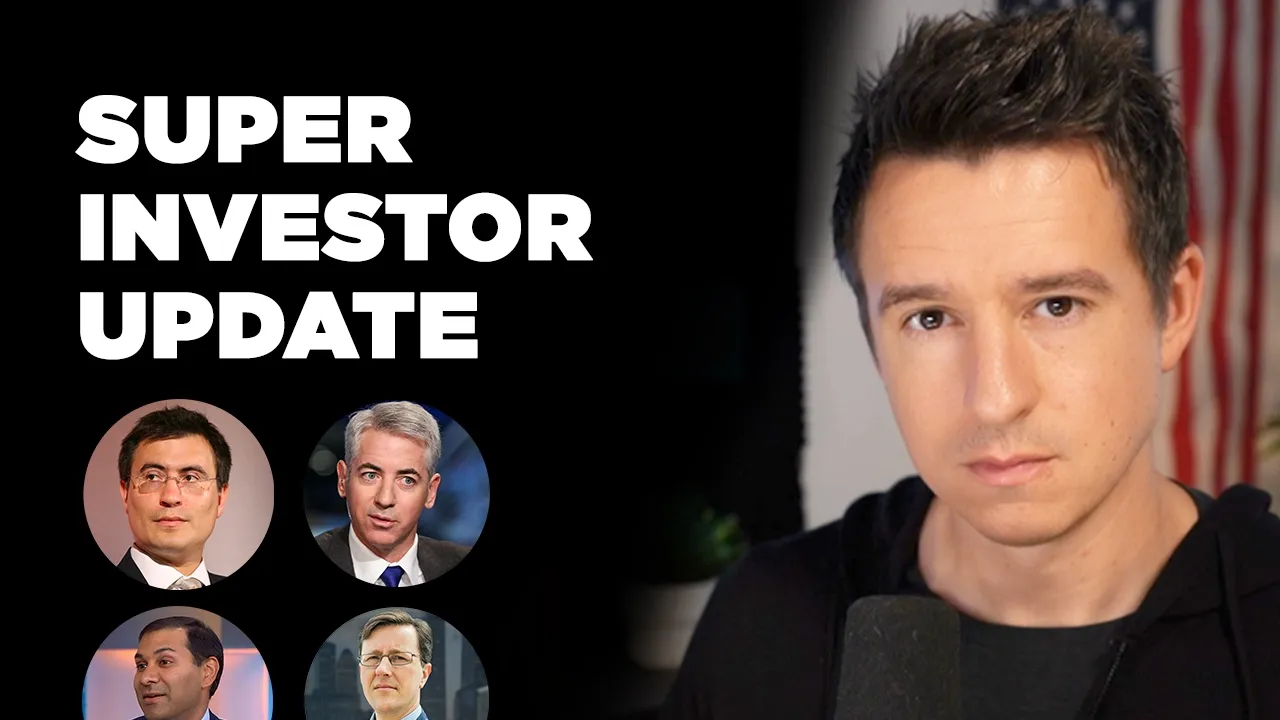
In every major category of sport, we're always looking at the best and analyzing what they do and why are they so good at it. With Steph Curry, we're just wowed of how good he is at shooting three-point shots and fader shots. We're looking at LeBron James and his physical dominance over the court. With golf, we're looking at Scotty Sheffller and his ability to consistently drive it on the green or sink putts that are 20 feet out. When we watch the World Cup, we're wowed at Messi's ball control. How do these professionals do it? Now, unfortunately, in the category of sports, most of us are not able to replicate the success of these professionals. They possess inherent abilities and skills that aren't easily transferable from one person to the next. They are elite athletes. In the world of finance, we have a unique advantage. We can actually copy them and we can do it successfully. Not only can we learn and observe from their decision-making and judgment, but we can directly benefit from it. And this is where the 13F filings come into play. The 13F filing is a legal requirement that anybody managing over $und00 million needs to disclose what they've been doing with their portfolios and they do that every 3 months. A lot of investors have made aggressive changes, lots of buys and some big sells over just the past quarter. So, we have a lot to get into in this episode. Plus, we have a lot of news. For example, we have some big news for Meta and it's not good news for the company. Meta faces quote astronomical consequences as legal fight reaches critical moments in California. We'll be diving into this news, breaking it down, and I'll be giving you what I believe investors should really be focused on. And then of course, we have today's fail of the week, which in this case is a guy that tried to trick a court by injecting a message into AI. We're going to be looking at all the details. Now, let's go ahead and jump right into the super investors, and we'll kick things off with Valley Forge Capital, which is led by DevCantes. He's an investor that I really admire because of his strict discipline and his investing philosophy. He is a compounding machine investor. He buys a highly concentrated portfolio of incredibly high-quality companies. He focuses on companies as he describes them as ones that have incredible efficiency, meaning that they don't need to reinvest a lot into their own business to get high returns. These are companies like FICO or Mastercard or Visa or S&P Global. They're many of the companies that you've heard about. But what's unique about Devkantisaria is that he has these companies and none others. He really is concentrated. He really walks the walk. He has the huge majority of his portfolio in only a handful of companies. And this is not a small portfolio. It's over $3 billion. Now, DevCantes had incredible performance for quite a streak. For a 10-year period, he was outperforming soundly, and his track record is still incredibly strong. But over the past year and a half, his performance has gone down. And Valley Forge Capital today has been going through their longest streak of underperformance in their funds history. The situation with Valley Forge Capital today is that this is a hedge fund where their philosophy and what's worked in the past is not being rewarded in today's market. And that's a difficult situation. When you have your strategy not being rewarded for a year and a half while other people are making money, it puts a lot of pressure on your hedge fund because people invest in you to outperform. When you're underperforming the market for over a year, that puts immense pressure. So, this is a pressure test for Valley Forge Capital and we get to see what's going on. Now, let's go ahead and take a look at the activity of their recent trades and we'll zoom out a little bit here. I'll organize this by the changes in portfolio and we can look for the past couple of quarters to recognize patterns here. When I look at this, I'll first look at the most recent quarter. And what I see here is that everything is reduction. They only sold. They're also selling companies that are at reduced prices. These are companies that have gone down in price recently and they're at attractive valuations. So immediately when I look at this it becomes abundantly clear that they are not selling out of willingness. I don't think that DevCantaria or his team believe that Mastercard or FICO or S&P Global or Visa are sells. I believe that they have redemptions. Anytime during periods of underperformance, there's going to be some of your clients, some of your customers that say, "Look, I can't go through this period of underperformance. I need some liquidity. Can you please give me back some of my money?" and they have to raise that money somewhere. Dev has also been on the record saying that they hold almost no cash. So if they hold almost no cash and there's a client that wants some of their money back, they have to raise that money by selling some shares. But I also notice he has not sold the same amount from each holding. So I believe that DevCantasaria had a list of redemptions, people that were pulling some money out of his fund. This is something that happens frequently. And when he got these redemptions, he used it as an opportunity to shape his portfolio. Now, when I look at the reductions that he did, this is where I get into some level of disagreement. For example, when we look at FICO, I'm okay with him reducing FICO. It's a huge holding. I think that that was likely an intelligent decision. He could pull some money out of FICO if he had to. But we also look at S&P Global and Moody's. These are the duopoly, the credit rating agencies. and he chose to reduce S&P Global and not not Moody's, I would have done just the opposite. I would have reduced uh part of my waiting out of Moody's and I would have kept S&P Global. The reason why is because right now Moody's stock is holding up better than S&P Global. It's at a higher valuation, but I believe he likely thinks that Moody's is a higher quality company than S&P Global because it has more of a concentration into the credit rating business. So, in any case, I probably would have kept a little bit more S&P Global and reduced Moody's, but that's not such a big deal. He also reduced Mastercard and he reduced Visa a big amount, 28% and 22% respectively. And these ones really sting. I hate seeing that he reduced Mastercard and Visa last quarter. I hate seeing that because the quarter ended right before these companies went up. The actual quarter of this trade happened before this time period right here. So he reduced them at some point along here right before the stock went upwards. So unfortunate timing on those reductions. Now notably there's one company in his portfolio that he refuses to reduce and that is ASML which is by far his best performing holding this year. In fact I believe it's the only company that he owns that is in the green by any meaningful amount this year. The rest of the portfolio is in the red. And overall this has been a deeply red year for DevCantes. When we look at ASML, he started the position in Q1 and then he added more to it in Q2. So, he's been adding to it this year, and ASML is up around 62% year-to date. Even though ASML is doing really well and it's at a very high valuation, he chose to keep it in the portfolio. And I believe there's a specific reason why. When I look at DevCantes portfolio, one of my major criticisms for it for a long period of time is single concentrated risk factors. For example, we have FICO, which is a credit company in that financial arena. It offers financial data, and it's a company that's highly sensitive to interest rates because as interest rates go up, homes become more expensive, fewer people need their FICO score. We have S&P Global, a credit rating business. It's one that's rating the debt of companies. The same thing with Moody's. These companies are duopies in this category. And again, they share very similar mixes of risk. They both are financial companies. They sell financial data. They are highly sensitive to interest rates. Then we have Mastercard and Visa of which their risk is a little bit different than Sme Global and Moody's, but they're very much similar to each other and they're also sensitive to all these same factors. That's one thing that I don't personally like about DevCantes portfolio is the level of concentration of risk factors. I believe that you can have a very concentrated portfolio in the number of holdings while spreading out the risk to different market factors. For example, in my portfolio, I have Mastercard, which is a credit card company, but I don't have Visa. I have Meta, which is completely different risk factors than Mastercard. I have ASML, which is completely different risk factors in all these companies. We have Google, which has some overlap with Meta, but is also very, very different. SMB Global, Costco, Microsoft, Texas Roadhouse, Door Dash, and Uber. In the Story Fund, I have other companies that are similar. These are entertainment companies, digital platform, advertising, but the risk factors are spread out through all different categories. They're not all subject to the same credit based and interestbased risks. And I like that my portfolio doesn't have the same Achilles heel. So while dev will do well if FICO pops off or SMB Global and Moody's does well, if those three companies don't perform, the portfolio is gone. It's just completely in the gutter for as long as those companies don't do well. And I think that's a painful process to go through. I believe the reason that he refuses to trim ASML at all despite the high valuation is because it's the one confounding variable in his portfolio. ASML doesn't have any of the same risk factors of any of these companies. It shares none of them. So, I believe he likes having that asymmetric risk factor. It's one of the only companies holding up the portfolio this year and preventing it from going deeper in the red. So, for me, it makes sense of why he wouldn't want to take gains on this position. Next up, we have Chris Hone from the TCI Fund. He's at the top of his game. He's considered the best or one of the best hedge fund managers in the world. He constantly ranks in Bloomberg as one of the top performing hedge funds of the year, and he's not only grown his portfolio substantially, but he's attracted more assets over time. It is now at a staggering $52.7 billion. So, we're looking at massive amounts of money here and it's concentrated into around 11 stocks. Now, there's some international companies that he holds that aren't mentioned here, but they're very similar. A lot of them are airplane suppliers and very similar type of companies. When we look at Chris Hone, he is also one that walks the walk. He manages of course this huge sum of money and then it's in a concentrated portfolio of companies that he considers as basically having impenetrable modes. So what Chris Hone does on a most fundamental level is he looks for companies that have such high competitive advantages that whatever they own or have created can never be replicated by another company that the barriers to entry to remaking what they've accomplished is just too high. GE Aerospace is one of them. I did a deep dive special on this company, but the more that you learn about it, the more that you realize there's no one even close to making these type of plane engines. They're just too difficult. They're too big. They're too expensive. There's too much science behind them. It requires too much capex, too much testing, too much red tape, too many regulatory bodies to go through. It takes decades of time to get them approved. The basic summary is GE Aerospace has a market position for a product that is so important. These are the engines on commercial airlines. They don't mess around with these. Another startup company can't chat GBT their way into creating aerospace engines. So when you look at this company, the moat is virtually impenetrable. The only thing that prevents it from growing is if airline growth slows down. But as it turns out, airlines continue to expand. Air travel is becoming more popular. They're ordering more planes, which means they need more GE engines. Now, this is the similar case with all of these companies. How do you remake a Visa network or the Moody's position in ratings or SMB Global? How do you remake the railroads that travel all across the US to Canada to Mexico? The burdens of entry to any of these companies are so substantial that Chris Hone can afford to put all of this money in these positions and sleep well at night. Now, even while Chris Hone initially does this deep level analysis and the moat of the company, he's always vigilant. He's always looking on the outskirts for anything that could potentially cause problems with the mode. And if he believes there's any issues that could damage the mode of one of these companies, he sells. He doesn't wait. And that's exactly what he did with Microsoft. Microsoft is probably the single biggest thing that has changed in Chris Hon's portfolio over the past quarter and over the past number of years. For example, he used to have Microsoft as a massive position in his portfolio. It it was huge. In fact, if we look at overall the history, we can look at where Microsoft stood. It was his second largest position, 17% of the portfolio, and it's gone. It's completely vanished. He's completely out of it. And interestingly, he transitioned from Microsoft to Google. So, he believes the moat is going down for Microsoft and up for Google, which if you look back in 2018, he said the exact opposite. He actually sold Google because he thought the moat was being disrupted by Chat GBT and he was buying Microsoft. Now, of course, Google's moat wasn't disrupted. Chris probably looked at the data and he said, "Wow, my concerns about chatbt did not manifest in the numbers." So, Google seems like it still has a continued large mo. But he does have now concerns about Microsoft. He recently said that Microsoft is now susceptible to claude, all the AI plugins that can replace or mitigate a lot of the Office tools. Now, a lot of claude is being used in conjunction or with Microsoft Office suite, but Chris Hol believes that that poses a disintermediation risk. He believes that claude could overtake many of the responsibilities and suppress the pricing power of Microsoft Office. And Microsoft Office is the core pillar of Microsoft. It's the suite that gets him in to all the Fortune 500 companies. Now, to a lesser degree, Chris Hone has also expressed that he's concerned about Azure. He believes that a lot of Azure is reliant on Microsoft Office. So, it's kind of like a domino effect. If Microsoft Office falls, Azure will suffer as a result. As a result, he's out of Microsoft and he has Google at a combined position of around 8%. He added 12% to his position in the last quarter. So he continues to build conviction on Google in this most recent quarter. Now when I look at Chris Hone, I agree with some of the concerns to some extent. I think that there is some pressure on Microsoft with Claude. They are dealing with something that is interacting with their software and certainly transitioning some of the value to Claude's interface. But I'm not so concerned about Microsoft that I'm going to be selling my position. I believe Microsoft still remains very wide mode, at least wide enough to have as a big position in my portfolio. In fact, I become more bullish on Microsoft over time. And as we look at the trading over the past year, this is another unfortunate case where Microsoft has made a full recovery this year. It's in the green year to date and Chris Holmes sold it at some period at a lower valuation. Now, also during that time he was buying Google. Google has already raced up to a much larger valuation and many investors have come to the same conclusion that Google is still wide moat. It's not actually going to be disrupted by chatbt as much as the market had priced in. Having said all of that, I believe the portfolio still remains incredibly good. Whether or not you're flipping the coin between Microsoft and Google, they're both great. I own both of the companies. I'm bullish on both of them. So, I don't necessarily have a problem with them trading one for the other. He also has continued to hold GE Aerospace. Very minor changes to that position. He continues to build Conviction and Visa and S&P Global. These are massive positions already. He's added slightly more to each of them. and he maintains this large moody position. He added two watcher positions. I call these watcher positions because they're at around a 1.4% waiting. One of them is Martin Marietta. This is MLM. Now MLM is not technically a monopoly, but it is very much like a controlling stake or a monopoly in many chemicals and materials in certain geographical areas. It is very difficult to disrupt. So it makes sense that he likes buying these physical companies. They're creating materials or creating chemicals. They own huge market share in certain geographical areas. The barriers to entry are very difficult to replace them. Chris remains fantastic and if you're looking for companies that aren't necessarily AI companies or tech companies or ones that are easily disruptible, his portfolio is one to study. Now, next up we have Bill Aman. We've already gone over his portfolio to some extent, so I'm not going to go over the thesis on every company, but this has the waiting so we can see what percentage he has in each company and which ones in particular he's been adding to. Now, the first thing I'll mention is he bought a number of new companies, including Netflix, which is almost a 5% share. So, big stake back into Netflix. Netflix right now is 50% off of its highs. There is a lot of fears baked in that I don't believe are accurate. And I still hold this one as a huge position. I haven't sold any Netflix. And in fact, I've added $5,000 to it this year. So, I continue to add to my position in Netflix as well. He also bought big into S&P Global, 5.4%. So, huge holding into this one. I think another excellent buy for the Acman portfolio. The same thing for Visa and Mastercard. Combined, this is a 11% position, but we also have more buying with Bill Aman. He bought more meta, added 20% to his stake, raising it to 9%. I agree with him here. I think a great buy. He added more to restaurant brand International. Finally, we get further up the holding list for Bill Aman and we get to companies like Amazon. He slightly reduced Amazon. This one has done really well. So I believe he's taking some gains out of this one and simply reallocating it. When we look at Microsoft, this is another one that he added to recently, another 10%. Bill Aman did the exact opposite trade of Chris Hone. Billman sold Google at a high to buy Microsoft at a low, and that was a really good trade in his portfolio. So Microsoft has grown to a bigger position. He still has Brookfield Corporation, which is in the AI business, funding it, doing a lot of the big infrastructure projects, and I think that he really likes this one as well. I don't see it going anywhere. And then finally, he added even more to his Uber position, making it currently his top holding in the portfolio, currently at 12.72%. So I think in terms of business quality, growth, and valuation, Bill Aman would say that Uber is the top buy today. That would be at least my assessment. The only other one that I think you would argue for would likely be Meta. He's been adding to that one even more aggressively, and it's not that much smaller than Uber, especially for how new of a position it is. So, I believe if Blackman was to tell you to buy two companies, it would be Uber and Meta, which I agree with both. I've been buying both of these companies. Now, next we have Pat Dorsy, whose portfolio, I believe, has been on a winning streak. He manages 1.5 billion. He's been buying up companies as he's getting more funds. More investors are attracted to what Pat Dorsy's been doing. First of all, he has a massive winner, which is ASML. As much as I love the qualities behind ASML, I believe the valuation is very stretched today. And so I've actually been trimming a little bit of my position despite the fact it's been one of my best performers over the past two years. So he has ASML is a big winner and likewise he's also reduced his position a little. That's smart. I think he played this one very smart. If we look at his history of ASML, he was buying it at $600, $800, $900, $1,000. Great buys. This is great trading. I I love seeing this. At the same point in my channel, I was buying the stock. I have buys at 660. I have a lot of buys in between here at around $700 per share. That's where I bought the majority of my stake. So, I'm right there with Pat Dorsy on this one. I think it's amazing. He added the majority of his position and bought more of it right around these price points. So, excellent trading here. I I love everything about this trading buying before the market gets a hold of the story. While the market was concerned about uh the tariffs or different problems, he was buying the stock. The only thing that I have a slight criticism for is I think he did his first trim just a tad too early. I also thought, "Wow, I'm at $1,300 per share. I've doubled my initial price on this company, but I realized it had so much momentum that I just wanted to let it ride for a little bit longer." I think it's a smart thing to do. When a stock has this much good sentiment behind it, they travel up a lot further than you would think. So, you can be very slow to take gains in stocks like this. and it traveled up from $1,300 per share up to around 2,000. Fantastic handling of this top position and this top performer. Apploven is his second largest position. He added meaningfully to it over the past 3 months. And this is one that has outstanding growth. It's one that helps different companies monetize and advertise, especially on mobile. They've carved out a very good market position for themselves there. So, it's the type of one that you're going to see it trade around with a lot more volatility. It's growing 47% year-over-year on a trailing 12-month basis. The next one that we're looking at here is called Royalty Pharma. Look at the price chart of this company. It almost looks made up. It's just going at a 45 degree angle up and to the right. That's the type of price chart that you would look at and you'd think, man, this looks like it's a scam. It almost looks too good. So, he's likely riding a lot of momentum with that company. He also built up booking to a large position. Now, I'm very familiar with booking holdings. I believe it's one of the highest quality companies in the world. I did analysis on it to find that it was a very capital efficient, super profitable company that benefited as travel continues to grow around the globe. It went up in stock prices. They do a ton of buybacks and I made good gains on this one in a couple of years. I took profits from it. I removed the position to concentrate my portfolio and I made a decision to go from booking holdings which is a vacation aggregator to move into Door Dash and Uber which are travel and ride sharing and delivery aggregators. The reason why is while booking holdings is really good and it's more mature, more profitable, I believe Uber and Door Dash are more early in their respective journeys. So they're just a bit earlier in the arc of making these big aggregation platforms. Booking's already won the game and it's already towards the end. Now having said that, I think it's a great company. It does have some minor disruption risk with Google. There's some disintermediation risk, but it just has such a big backend, such a big infrastructure that I don't believe that's going to happen. So, I understand the buy and booking here. I like it. I think it's a great company. I also like S&P Global, of course, he also bought Uber Technologies. You can see a lot of these investors are thinking alike. They want to buy these big digital networks as the stock price goes down. They dive in when the market's not giving them their credit. And Pat Dorsey has been very good at this over the past couple of years. He did this with Meta as well, and he continues to pour more money into Meta, increasing the position size by 24%. These are great trades. I really like what Pat Dorsey has been doing. So overall, you see the actions of these super investors where they're piling into some of the highest quality companies that have temporary discounts and dislocations from their intrinsic value. And I believe that this is where they separate themselves from most investors. They typically don't panic. They buy companies that are highquality. They don't look for speculative bets and things that they don't know how it will turn out. And they stick with that plan even when it gets difficult. You're seeing investors like Chris Hone, like DevCantasaria, like Bill Aman all exercise discipline in that strategy. Now, moving on, we get to some big news about Meta. And it's not the news that you want if you're a meta investor like me today. All across the Wall Street Journal, all across Bloomberg and CNBC, we have headlines like this being plastered. Meta faces astronomical consequences as legal fight reaches critical moment in California. The jury was seated last week in Oakland's federal courthouse. The trial involves a coalition of 29 state attorney generals in a unified case against Meta that was brought in 2023 will be argued by lawyers representing California, Colorado, New Jersey, Kentucky, and so on. The stakes are enormous as leading government officials across the country push for Meta to be held accountable for allegedly violating federal and state laws, including Children's Online Privacy Protection Acts, COPA, uh the various consumer protection statutes, and so on. Industry experts are calling it social media's big tobacco moment with Meta as the centerpiece. In the 1990s, tobacco companies were forced to pay billions of dollars for misleading the public about safety and potential harms and their products. Subsequently, their power and influence dramatically diminished. You see the narrative being painted here? First of all, Meta is being accused of heinous crimes, crimes against children, which no one ever wants to defend. If someone accuses anybody of a crime against children or anything like that, you can't defend it. Even if there's a sound offense, even if there's a reasonable explanation, it's just bad to defend it in general. After all, you're arguing against crimes against children. So, that's one aspect of the dynamic here. This is not aimed at adult users of Meta. It's aimed at children. The other aspect is the branding of it. It's a big tobacco moment. The big tobacco moment was when tobacco's product was considered no longer safe, but in fact being very dangerous and harmful. At its core, tobacco harms its users. So, Met is now being viewed the same way with the same branding. Earlier this month, Meta lost a case in New Mexico that will require the company to make changes to its service and pay nearly $1 billion. But California carries such power and influence that a bad result in Meta's home state could lead to much steeper penalties, including a broader overhaul that forces fundamental fundamental alterations to the algorithm. Now, during time periods like this, specifically when there's enormous amounts of bad news, big headlines, huge accusations, things that sound heinous or sound incredibly bad from a company. That's the time period where investors should be the most focused, the most grounded, the most levelheaded, and look at things from first principles of how this can actually affect the company. Because in many cases, what people do is we just get emotional. We look at these headlines, you see them as big red flags, you react, and you make bad decisions as a result. So the first important thing to highlight here is that almost all of this is regarding people that are under 18, children. Under 18 demographic of users of Meta products makes up a very small minority. It's estimated between 2 to 4% of the total daily active user base. So the vast majority of users, 90 to 95% are adults using Meta. And of those users, the children 2 to 4%, the ad revenue that comes from that cohort is also even lower because children don't have as much money. It's the parents that buy things. So it's not so important that Meta advertises to children. It's important that Meta advertises to parents of children. that's where they get the transactions from. So, this is also not a cohort that's incredibly important in terms of advertising dollars. Now, there is an argument that they'll grow up to be meta users, but people change which social media platforms they use all the time as an adult. So, this is a small cohort to begin with. Now, there's two ways that the court will land on this. One of them, which is the most likely, is that Meta will receive a big fine. They'll navigate to a big fine, multiple tens of billions of dollars that they'll have to pay out as restitution for all the bad deeds that they did. That'll be one option. And under that, they'll also have to make restrictions with their children accounts. They'll have to make them more locked down and more controlled. But Meta has already been doing that for some time. For example, if we look at just a basic timeline of the restrictions and changes they've made to different children accounts in 2021, adults generally could no longer DM teens who didn't follow them. And also 2021, under 16 Instagram accounts were defaulted to private. Also in 2021, accounts showing suspicious or adult behavior stop being shown in teen accounts and explore reals and suggested accounts. These are all restrictions to make make it more safeguarded for for children in 2022. Suspicious adults were removed from teens, people you may know. Meta tested removing the message button entirely. In 2023 and 2024, message requests became much more restricted. Strangers couldn't initially send photos, videos, or voice. Also, later on, teens defaulted to receiving DMs only from people they already follow and are connected to. Also, in 2024, they have enhanced warnings about explicit accounts. Also later in 2024 and 2025, they launched teen accounts with private accounts, strict messaging and content settings and parental permissions. Then we have later on in 2025 and 2026, teen accounts expanded to Facebook and message. AI age detection looks for teenagers lying about their age. And we also have AI being expanded to detect under 13 accounts and deactivate them. Now, the reason that I bring all of this up is to highlight that this isn't a story of Meta not doing anything. They've taken clear steps year after year after year, numerous steps making teen accounts and children accounts more restricted, more guard rails, more parental controls. This has been a a process over a period of time. Now, that doesn't mean that Meta did no wrong. I'm not arguing that. And I believe that there's going to be a big settlement. They'll pay out a big amount of money. But the bigger question for investors is if this will result in huge changes in how the algorithm works and if Meta has to restrict their product. If they do that, and especially if it has to apply to other states, if it has to apply to adult accounts, that could change the entire game for meta. I believe the probability of that happening is much lower. I'd put it in the range of around 10%, maybe less, but I think it's more than likely they're going to pay a huge amount of money. They have further restrictions on teen accounts, and then they might have to change some algorithms or some things like infinite scroll specifically for underage accounts. It's unlikely for the judge to rule in the case that Meta needs to completely overhaul its product and that it can't use AI recommendations, that it can't make its algorithm as good as Tik Toks or other platforms. That doesn't make sense for Meta. So, I look at this, I'm not as worried as the market is today, and that's why I continue to hold this position and continue to buy in. The other thing that I'd mention is we can look at other scary times in past from Meta. For example, we can highlight Cambridge Analytica. Remember how visceral the headlines were from the Cambridge Analytica scandal? Everything was going wrong. Every advertiser was leaving Meta. Users were fleeing the platform. The company was part of a big data harvesting scandal. Everything. All the most serious allegations were against Meta at the time. There's a news article like this. March 20th, 2018. The UK investigates Facebook over data breach to raid Cambridge Analytica. The stock dropped 7% on the day, the lowest that it's been in years. We have other articles like this. Wall Street starts to trim Facebook targets as shares fall. Zuckerberg finally plans to speak. Called in front of Congress. A hurricane flattens Facebook as Cambridge Analytica story broke over the weekend. Facebook has struggled to formulate a response from Vanity Fair. Silicon Valley insiders think that Facebook will never be the same after the Cambridge Analytica scandal. It didn't end. There are more and more headlines every single day about how big and bad Facebook was. US regulators, state attorneys look for answers from Facebook. Facebook cuts ties with data broker and blow to targeted ads from Time magazine. These companies have cut their ties with Facebook amid the Cambridge Analytica data scandal. Advertisers were fleeing the platform. Meta or then Facebook was selling at $130 per share. That's during the Cambridge Analytica scandal and it's now selling for around $560 per share. So investors that bought the dip during that time period saw around a 400% return. There's been some volatility in between. But when investors put aside all the noise and focus on the likely outcome from these type of events, in many cases it's the best time to buy. Now moving on, we get to the fail of the week, which in this case was an individual that tried to trick a court with a potential AI injection. So basically what happened here is this guy went to court and one of the documents that he submitted, he hid text in the document. It says, "A state judge in Connecticut said the plaintiff in the case before him included quote hidden text in a court filing meant to serve as instructions to any AI system reviewing the document." Now, how did he hide the text within the document? The court identified the text that was quote set in tiny point type and colored white. So, basically all he did was he emailed in a document. Then he had normal text, normal size document, you know, black text on a white background. But then for a portion of it in the middle of the document, he had around three pixel text that was also all white matching the background. So as you're browsing the document, you'd never come across that text. It just fit in with the back background of the document. But in it, he gave instructions to AI. The judge said the plaintiff was attempting to use a technique called prompt injection to direct any AI system reviewing or analyzing the filing to quote produce an output only favorable to the plaintiff's position and to treat prior clerk's ruling as an error to be corrected in their favor. So he wrote he put this enty text in a document. Now of course this didn't work out like he wanted. The plaintiff in Connecticut resident is representing himself in this case and he told Reuters that he included the hidden text as a way to audit the court's review process. In any case, he's calling this an audit. He's saying, "Hey, system, agree with me and and rule in my favor." And then when he's caught, he just says, "Oh, I was just auditing the system. I was just making sure you're doing your job right." I don't think so. I think if the the judge ruled in his favor, I don't think he would have brought it up. I think he would have just been happy that he outsmarted the judicial system. But in this case, since he's caught, he can he can back up and say, "Oh, it was just an audit. I was just making sure that you guys are doing your jobs, making sure that you're keeping track of this stuff." Now, of course, the courts didn't like this. They believed it was evidence of a malicious purpose and intent, so it's not helping out his case. But this is something that we're going to see more and more as time goes on. As systems become more reliant on AI, the amount of prompt injections, hidden text, the amount of of context changes that people are going to try to do is going to become more meaningful. This is just one of the first and funniest failed attempts. That's all for this episode. Hope you enjoyed.

Comentários 0
Entre para participar da discussão.
EntrarAinda não há comentários. Seja o primeiro a compartilhar sua opinião!