… software and some of the other names, they're almost trading like the AI revolution is not happening. And it's the exact opposite. the trillions that are going to be spent. Capback's going to peak probably you know 1 two years earlier but this will be a golden buying opportunity for especially on the hyperscalers in terms of compute what we see on some of the selloffs like meta alphabet that in our opinion is this will be a gut check moment but I view it as you know these are the opportunities >> yeah no the the AI revolution to your point a lot of the capex commitments are already out there so it's just a matter of how the market prices them what the political environment entails and uh we'll see how the market trades from here…
this will be a golden buying opportunity for especially on the hyperscalers in terms of compute what we see on some of the selloffs like meta alphabet that in our opinion is this will be a gut check moment but I view it as you know these are the opportunities
Contexto extraído por IA
I mean, I think this is just irrational selling when it comes to tech because the reality is that these stocks specifically like a lot of the semis, hyperscalers that go to the software and some of the other names, they're almost trading like the AI revolution is not happening. And it's the exact opposite. the trillions that are going to be spent. Capback's going to peak probably you know 1 two years earlier but this will be a golden buying opportunity for especially on the hyperscalers in terms of compute what we see on some of the selloffs like meta alphabet that in our opinion is this will be a gut check moment but I view it as you know these are the opportunities >> yeah no the the AI revolution to your point a lot of the capex commitments are already out there so it's just a matter of how the market prices them what the political environment entails and uh we'll see how the market trades from here.
… software and some of the other names, they're almost trading like the AI revolution is not happening. And it's the exact opposite. the trillions that are going to be spent. Capback's going to peak probably you know 1 two years earlier but this will be a golden buying opportunity for especially on the hyperscalers in terms of compute what we see on some of the selloffs like meta alphabet that in our opinion is this will be a gut check moment but I view it as you know these are the opportunities >> yeah no the the AI revolution to your point a lot of the capex commitments are already out there so it's just a matter of how the market prices them what the political environment entails and uh we'll see how the market trades from here…
this will be a golden buying opportunity for especially on the hyperscalers in terms of compute what we see on some of the selloffs like meta alphabet that in our opinion is this will be a gut check moment but I view it as you know these are the opportunities
Contexto extraído por IA
I mean, I think this is just irrational selling when it comes to tech because the reality is that these stocks specifically like a lot of the semis, hyperscalers that go to the software and some of the other names, they're almost trading like the AI revolution is not happening. And it's the exact opposite. the trillions that are going to be spent. Capback's going to peak probably you know 1 two years earlier but this will be a golden buying opportunity for especially on the hyperscalers in terms of compute what we see on some of the selloffs like meta alphabet that in our opinion is this will be a gut check moment but I view it as you know these are the opportunities >> yeah no the the AI revolution to your point a lot of the capex commitments are already out there so it's just a matter of how the market prices them what the political environment entails and uh we'll see how the market trades from here.
Transcrição Completa
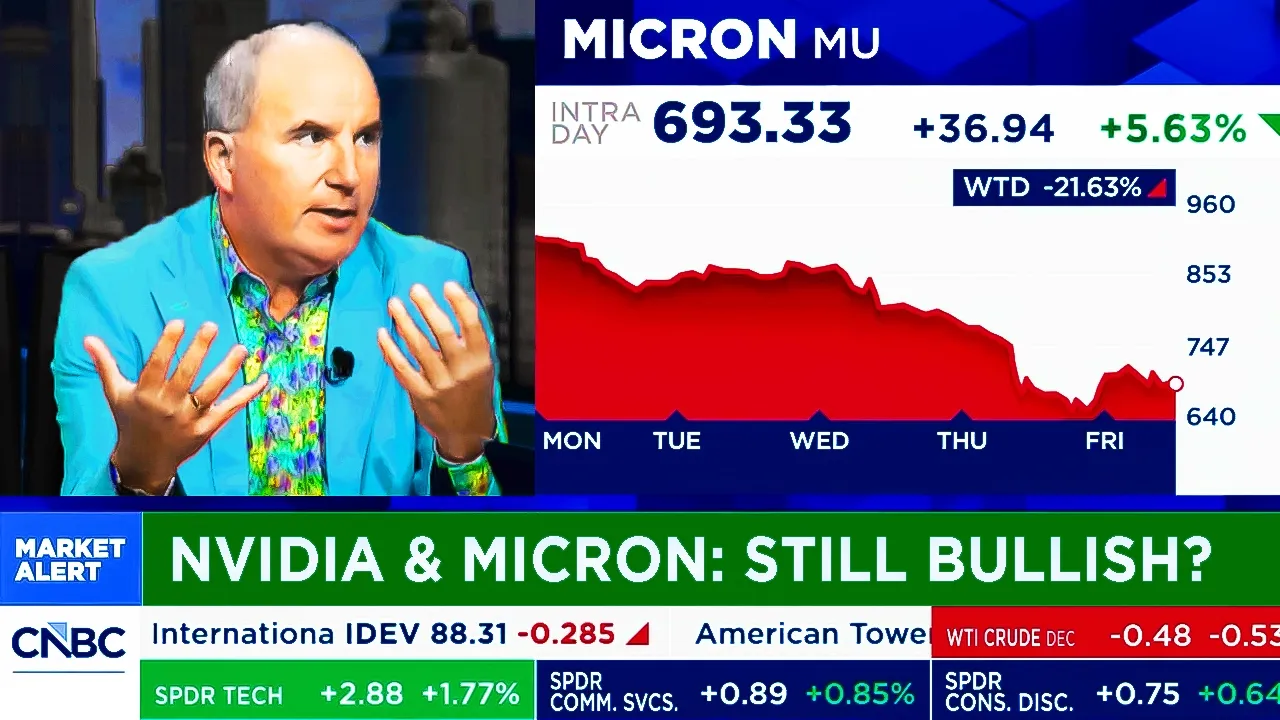
Dan, I want to start with you because we were talking before the show just in the green room here about how yesterday's market activity was once you've seen maybe five situations like that in your entire career. What about yesterday struck you as so unique and what do you think it says about just the durability of the selloff? Yeah, I I put it in the March 2020 COVID selloff, the April 2025 liberation day, even some of the times during financial crisis, it felt just like a panic almost mini crash from a tech perspective to me and we've talked about it. Does the blue wave ultimately really next year is where you know capex peaks out at instead of 28 or 29? Yeah. Are there neo clouds and other names that should have been down 100%. But tech stocks were trading like the AI revolution's done. Like the blue wave is going to basically blockade this. And I think that is way the wrong move. I mean to me I view it as sort of almost a generational buying opportunity for the tech winners because we as we've said demand is 4 to one relative to capacity. So, I think that's where as as calmer heads sort of prevail, we're going to look back at this and being this was just a magnitude of a sell-off that that I'd put in a top five that I've seen in the last 25 years. >> So, what I'm hearing from you is it's more technical in nature. Maybe there was a bit of a short squeeze coming out of the midterms on Wednesday and then everything reversed. What what I'm trying to wrap my head around is kind of where the market sits with regard to AI sentiment right now because it's massive swings on a day-to-day basis. >> Yeah, I think some of it is that you saw a lot of comments from politicians, you know, on social media and others saying we're going to end AI, we got to shut it down. But the reality is that the permits are already there. Even in Texas, I mean 75% of those data centers for 27 28 are already approved. So I think that's where when you start to go into and you've seen the governor from Texas has talked about it. I think that there's a calming that needs to happen where data centers need to be built in in the right way. But the reality is is that when you think about the call it 3540 gawatt that's going to come on into next year. Even if 10 to 15 of that doesn't happen demand the supply is 4 to one and that's bullish for chips. the hyperscalers to compute the capacity that they own is so much more valuable than it was 48 hours ago. And I think that's where we view this for the winners that you need to own these. When I look at Nvidia, AMD, the way it sold off, but Neo clouds and some others, those should be done. The power companies, you know, Genova and others, that made a little sense. >> No, you bring up a good point. this idea that if there are additional moratoriums that get imposed as a result of the midterm elections, those who do already have the compute have this benefit of scarcity and could therefore maybe command even higher prices if you're lucky enough to currently be sitting on the compute as many of the hyperscalers are. Dan, how do you think the setup is for today? We obviously we're not done with news yet. We get the jobs report in about two and a half hours. I mean, does it feel like positioning has kind of flushed out to the point where the market can can resume its normal fundamental focus? >> I mean, I think this is just irrational selling when it comes to tech because the reality is that these stocks specifically like a lot of the semis, hyperscalers that go to the software and some of the other names, they're almost trading like the AI revolution is not happening. And it's the exact opposite. the trillions that are going to be spent. Capback's going to peak probably you know 1 two years earlier but this will be a golden buying opportunity for especially on the hyperscalers in terms of compute what we see on some of the selloffs like meta alphabet that in our opinion is this will be a gut check moment but I view it as you know these are the opportunities >> yeah no the the AI revolution to your point a lot of the capex commitments are already out there so it's just a matter of how the market prices them what the political environment entails and uh we'll see how the market trades from here. >> Chip stocks getting crushed in this week's selloff. Joining us now, Chris Castle, Wolf Research senior analyst. Um when did you first start seeing some some cracks in in uh in chips, Chris, cuz that just that could have been the culmination yesterday, not the beginning. >> Yeah. And you know, we had obviously from a from a separate from a stock standpoint and a fundamental standpoint, from a fundamental standpoint, there haven't been any cracks. uh we just got through earning season and uh all of the commentary has been that that demand is is well ahead of the industry's ability as supply. So, so lots of data there. With respect for the stocks, of course, we saw uh a a big run, you know, from from April into the summer and and then they started to sell off. And of course, the sell-off is really a function of investors, you know, not having the confidence that the big numbers that these chip companies are seeing for 27 and 28 are are going to come through. And and so that's really the question. And and I I think you know the underlying question is is really one of you know can the semiconductor customers get the financing to be able to to to uh to provide this? Certainly the demand seems like it's there. >> If it's demand okay then it it is still a a supply constraint. So what why would if if would you sell these stocks and we're showing today's move instead of the big moves yesterday. Uh but would would would you um sell would you ever sell anything based on uh supply being constrained? I mean that's like a a great problem to have. >> It is a great problem to have. And you know, as long as I've been covering semiconductors, as long as demand is ahead of the industry's ability to supply, it's favorable for the the the chip companies. Uh because you know, obviously you you have you know, you're taking price uh as in has been the case with memory. uh where where the the chip companies have historically had a problem is when you oversh and that's one of the fundamental differences with semis now is you just don't have enough capacity as an analyst I mean you're dealing with things like for we show we had AMD we have it right there at 404 is down 17% uh yesterday the low just in a year is 188 the high is 658 how do you possibly advise clients on on what whether they should buy or or sell these names, Chris? >> Yeah. Well, you know, you have to you have to take take a a little bit of a long-term view and and and take a look out here. And uh uh again, what what we're focused on now, >> we shouldn't be I'm sorry, but we we shouldn't be surprised when something that ran from 200 to to 650 pulls back. I mean, should that tell us some that there's, you know, that there's the Houston we have a problem or does that tell us that this is just all natural and and to be expected? >> Yeah. And and I'd say, you know, before yesterday, you'd say, you know, these stocks have still had a a tremendous run through the year. So, uh, you know, that in that case, it's natural, right? After you've had, you know, some of these stocks up, you know, doubling year, you know, year-to- date, a pullback is is is is natural. But now, what you're seeing after uh and again, it's not just yesterday. Yesterday was was sort of the culmination of that. uh you know stocks like Nvidia Nvidia is not really up on the year anymore. Uh so uh I I I I do think you know certainly what happened yesterday was was was a bit overdone given what we heard in earnings season and given you know what appears to be very strong ROI for the AI investments the semi customers are making. All right, Chris. So, so in closing, we're closer to the lows than we are to uh to the beginning of something really horrible in your view. >> I think so. And and I'll leave you on this. I I I don't think the catalyst is necessarily going to be what the semiconductors companies say because they've already said very good things. What you what you'll want to see is confidence that the semicustomers are actually going to spend what they said they spent and and that they're going to get the financing to do so. I think that's the catalyst with semiconductor group. >> We begin with tech on track to recoup some losses from the selloff yesterday. Some on the street expressing concerns though about the AI trade going forward. Goldman has a note this morning saying quote continued semis pressure as a result of the view that by 28 we won't have enough data center shells that is land power shell and therefore we'll likely have too many semiconductors and not enough data center shells for them to go into. Here's a look at how rough a week it's been for the chips, including Marll Sandis down 30 to 30 respectively. The socks in June, Mike, was a double for the year. Now 27%. Yes. Um up 27% and I think that's part of the tricky thing here because it's down almost 40% from the highs. It's completely following the trajectory of past bubbles. And so you've done enough damage in the short term, but you still I think the action this week and yes, that was the concerns about are we going to get into an over supply situation with chips because we can't uh finish data centers. That's been a rolling issue for months and now it's a crescendo. Um it's why Micron trades at under four times forward earnings. The market is saying those earnings aren't going to be there or they're going to be an anomaly because we're going to go into a loss situation at some point in this cycle. Um, so but what was fascinating is the the the velocity of the declines. It got a little bit disorderly. It showed me that the AI trade was more crowded and there was more complacency than I would have expected. I really seemed like you had cleaned it out to a fair degree coming into this year this week and it was poised to to rebound. The weird action after the election, it made some sense. Okay, we're going to buy the hypers skills. We're going to buy non AI tech. the market is kind of handicapping a rebalancing of the economy away from AI growth. Uh but then it turned out that just the uh the trip wires in semis tripped everything else too because the rest of the market got overdone to the upside, right? So I hate the whole broadening issue and these these pullbacks that are halted because we suddenly buy healthcare and staples just because semis are down and we buy Apple because Nvidia is all that stuff broke down yesterday. So I think one of the um kind of excesses of this market or one of the strange elements of it for months has been this implausible mechanical rotation that protected the indexes. So now maybe we can have the makings of a real wash out and part of the wash out is you know getting sentiment uh you know to be very depressed having reports of hedge fund liquidations and losses retail selling actually hit yesterday by various measures. So, I think that's where we sit. Market's oversold enough to bounce. Sometimes you don't want to just see a tentative bounce like this. Uh, but without a doubt, the bare case is having its day. And so now you can make a decision as to whether we've just hit a more stable equilibrium of price, valuation, and and sober expectations. >> Can you share some thoughts about yesterday? >> Yeah, I mean, I I think that yesterday was two parts. I think some of it is about Iran having good quarter last night. It's about the the neo clouds. I mean, you're a county official and you've seen the vote. You're doing a deal with Nebius and you say, "Oh, who's Nebius?" That's changed. That's something to worry about those three companies. Jensen, of course, Jensen backing those. And then I talk about what really happened yesterday because I would think that why did these stocks that have nothing to do with tech go down? And that I think is yes, there could be capital gains coming that's going to make it so that we're uh we have less money in the market and of course corporate tax go up. Now that's 2028, but in a in a couple months that's what we're going to be thinking about is 2028. I wish I had more positives because I think price can be a positive. I do think that if if maybe I'm too bullish on this, but if anthropic can just get done >> Yeah. >> then I think I'd feel better. Well, I'm glad you brought it up because it's still, you know, of course uh a key for this market, frankly, is anthropic and the potential initial public offering of that uh leading AI lab. Many of us expect perhaps it would get priced as soon as a couple of weeks from now. So, not next week, but the week after, but we'll see. Uh given this market action, Jim, I mean, you know, you got to figure out what what can clear at what price and what size. And that certainly seems to be coming in. Yes. So any ideas around 2 trillion maybe even around 1.5 trillion may be overdone. What is also key is filling in that blank in that S1 which we still don't know. There are numbers around now being reported of annual uh revenue run rate for the company. Is it more than 80 billion? Could it even be approaching? We don't know the number. I don't feel comfortable going with the number at this point. I know others are sort of reporting things around. We'll see. But it it's a key it's still a key as we used to talk about to this market what that number will be because it undergurs so much >> even if you do have a slowdown in data center. >> Exactly right. I know Michael you had some good comments. We the semis there's no we don't really have a bounce level. >> Yeah. >> Doesn't that concern you that there's no no place we can just say AMD it's this price? >> Yeah. I mean we're still like I said up 20%. And I think you need about a 20% rally from here in like the socks to get back to the 20-day moving average. Like that's the definition of is it a dead cap bounce or not. Um but I do kind of agree. I don't know if you think the valuation of Anthropica is a little bit less important than getting it out and getting the cash in the door and then you know right I mean if it's a down round versus the last private valuation even at 1.3 trillion if you sell a h 100red billion you're still selling a relatively small percentage of the overall company. You want to set yourself up as well though for being able to hit the market again at some point because their capital needs are never ending >> and getting you know access to the credit markets with the cash you have on the market. >> Now there is some question as to whether they would be anywhere near investment grade but you know just to remind people from the amended S1 we got on Monday. It's been a long week. Um total committed spend is $895.4 billion 447.5 billion expected before the end of 2030. It's a lot of money. Now they do have 30 plus billion on the balance sheet or something around that and cash and marketable securities. They could raise another hundred billion in a in a deal if they get it done. So that gives them some cushion for a while. But you want to price it, Mike, so you can also get back to the market at some point. >> I assume so. >> But I do think Carl, one of the problems we have again is is that there was a mandate. Now we talked about a clearing event the election. We didn't think it would be a clearing event that would attack us. Exactly. But I do think that if I am uh an analyst who's trying to get ahead of this, I might just say I want to take numbers down XYZ and if we take numbers down, let's say for SanDisk, we suddenly cut sand, we for we had some people cutting Qualcomm, but that's really about it. We take numbers down for dare I say Micron, what would happen is we could have another leg down and that maybe takes us to some level of support. But AMD was at 200 just a couple of months ago. >> Yeah. >> I mean, real quick, Jim, forgot the opening bill. Nvidia is what, 12, 13? >> Nvidia is actually at support level. That's the only one that's in support level. >> So, where does Nvidia fit in the story? I actually had a friend asking me about Nvidia worried because it's now been in a downtrend for a longer period of time. one year for example it's down 4% while the averages and some of the other te tech stocks are higher but many of the guests I have on still pick Nvidia as a clear leader in the group because that demand is there um what say you of Nvidia at 187 tell me what you think happens next for Nvidia >> yeah well look it's it's over 20% off of its high it's down just about 14% in the in the last week the Nvidia trade is synonymous with AI. AI cannot continue to expand at the rate it is without Nvidia. Now, the thing about it is is a huge company and you've got to remember they had outsized returns for investors for a long period of time. So, it's not uncommon that the stock needs to be able to digest that. But when you look at the valuations of the company, it's trading cheaper than the S&P 500 about 16 times forward versus about 19 times forward earnings on the S&P 500. So, I believe at this point some of the de-risking has been done for you. With that being said, obviously they're going to be reporting earnings soon. So if you're looking to take a position, maybe you put half of it on now, half of it on later. But if you believe in the AI trade, I think for most people, Nicole, Nvidia has to be one of the core holdings there. >> Can we talk about Nvidia's upcoming earnings and some of the guidance has been a little weaker in tech, right? So we I I keep hearing I've noticed lately a lot of great quarter, but the outlook seems a little bit, you know, tepid. Um, what do you think is important in the Nvidia upcoming earnings and what will decide the next major move in AI when you listen to Nvidia's earnings report? >> Yeah, well, I mean, it's definitely going to be how good they're able to sell the future earnings. And that's what we're always buying as stock investors is not last quarter's earnings, but what's going to happen in the future for this company. And so, look, we're looking at about $108 billion, um, which is huge year-over-year growth. The big thing I think that also people are concerned about is the gross margins. we were at 75%. I think people are calling for about 74. If you see that creep down anything, I would say less than 72. And if you don't have great forward-looking guidance um from the team over there, I think you could see the stock go down another 10 to 20%. So, you're definitely going to have to be prepared for that. But, I don't really think that's going to happen. I think they more than likely had a great quarter. We see all these companies Meta and Microsoft that are now taking on debt to be able to continue to pour money into this which Nvidia is a direct benefactor from that. I don't think it's anytime soon. The question is though, what does next year look like? What is 2 years from now look like? Because we all know I just talked about I'm going to kind of contradict myself. Nvidia looking cheap. Well, I could tell you in 2006, 2007, housing prices looked really cheap. Housing stocks looked really cheap also until they crashed. Why? Because the expectations were continue people continue to buy one or two homes a year. If the expectations for the AI trade is that this goes on for many many years and Nvidia is still able to have those topline earnings. If anything derails that story, you're going to have to have a big correction in the name and across the sector in general. >> I mean, you're making it really clear that for the long term, you're definitely bullish. In five or 10 years, the names that uh that we're talking about, you believe will be going higher. Nvidia I, you know, you mentioned semiconductor stocks. So Nvidia is the top of the Dow Jones Industrials heat map at the moment. And also when you look at it year-to date, it's kind of disappointing for anybody who bought just a few months after that because you see at the moment we do have Nvidia up three and a half%. But year to date, it's just flat to only slightly higher. So it's almost just vaporized all of those gains. That brings me to this question about all of the chip stocks as we look at them. You said pick carefully and judiciously. What do you look for then specifically? >> So, Nvidia is is a perfect example because it has never been cheaper. I mean, it's trading at 13 a.5 or so forward earnings and this is a company that's basically gone nowhere this year because of what's happened over the past month or so. and it's growing parts of its business at 50 to 100% year-over-year and there's clear demand visibility into what they're doing. So that's a name that I think makes a lot of sense. And then I also think investors within the semiconductor space really should be focusing on the backlogs that exist within NAND and DRAM because those are areas that as we use more agents, people are using more muse, more Grockbot. as we start to adopt those, that's going to require a lot more memory. And we know there's backlogs through at least 2028. So whether or not data centers slow down, these chips are being produced. They're going to be used and I think the degree to which data centers are expected to slow down after Tuesday are nowhere near what the market decided to price in yesterday. >> All right, I hope you're all doing well today and staying calm in this market. Friday was a mixed day in the market and a positive day for many of the AI infrastructure stocks that were hit hard in Thursday's sell-off. Friday morning, we got a stronger than expected non-farm payrolls number which strengthened expectations for future Fed rate hikes. The information published a story saying that TSMC is considering expanding into advanced memory production and charting plans for manufacturing 3D RAM at the request of Nvidia. I need to provide a disclaimer and say that this has been an unreliable source on some Nvidia rumors in the past and I don't know if this story is true or not. I'm just mentioning it so that you're aware of it. If TSMC were to successfully commercialize 3D RAM, it could eventually find itself in competition with incumbent DRAM manufacturers. That said, if the report is true, we don't know what products the 3D RAM would be for. It's important to mention that 3D RAM is essentially a way of manufacturing memory, not a specific type of memory product like HBM. That said, 3DD RAM could be used to increase the capacity of individual DRAM dies within an HBM stack, potentially allowing more memory per GPU. Importantly, TSMC's commercial production of 3D RAM is unconfirmed at this point, and we don't know important details about things like manufacturing cost, yield, and timing. And again, even if the story is true, we don't know which products Nvidia wants TSMC to produce 3D RAM for. It could be used in many different products. So, we'll have to see what happens in the days ahead. We have an update to a story I mentioned in Thursday night's video. Bloomberg published a story saying that Micron paused work on a $4.5 billion memory plan in Taiwan due to a labor dispute. That story added fuel to the tech selloff on Thursday as some market participants incorrectly perceive a news as being an indication of Micron pulling back on production in response to fears of a slower AI buildout after what happened with the midterm elections in the US. As I said Thursday, that does not appear to be what's actually happening with this story, but that's what some market participants knee-jerk reaction to the story was. And then Friday, we got an update to that story with Micron saying its Taiwan operations are continuing as normal. Micron did not directly address the Bloomberg story, but said in a statement that its Taiwan operations were continuing as normal and that it was confident it could maintain stable operations without disrupting service to customers. In other news, it's being reported that SKH Highix HBM4 cumulative yield has reached the mid60% range. HBM4 is expected to surpass HBM 3E in both shipments and revenue during Q4 2026. That's of course good news for SKH Heinix and it's also good news for Nvidia as SKH Highix is Nvidia's largest supplier of HBM even though Samsung got an early lead on HBM4 compared to both SKH and Micron. As a reminder, Nvidia's Rubin uses HBM4. Another story that got a lot of attention on Friday was a story from Bloomberg saying that Microsoft is unwinding its AI computing agreement with Oracle after deciding not to renew the contract. The original deal was announced in 2023 and involves Nvidia at 100 GPUs. as a reminder that GPU launched six years ago. According to the report, the older GPUs no longer meet Microsoft's evolving technical requirements and Microsoft has been shutting off the rented capacity over the past several months. This story caused market participants to question the useful life of Nvidia GPUs. Importantly, these specific GPUs were used to help power the AI enhanced version of Bing. Interestingly, Microsoft's SEC filings show that the company's estimated useful life for servers and network equipment is 2 to 6 years. So this appears to be a situation of Microsoft opting for newer equipment as that newer equipment is more attractive both from a technological and economic standpoint. That appears to be what's happening here rather than a degradation in compute demand. An Oracle spokesperson reportedly said demand for the company's AI infrastructure remains strong, including for earlier generation GPUs. As a reminder, Oracle leadership told us on the company's last earnings call that GPU capacity that came up for renewal during the quarter was renewed or resold at a 20% premium to prior contracts. The majority of those GPUs were four years or older. So even if Microsoft doesn't need six-year-old GPUs for the workloads in question, that doesn't mean that Oracle is unable to find another customer willing to rent that capacity. If the world is compute constrained, developers will use whatever viable capacity they can get their hands on. Friday, Bloomberg reported that OpenAI has closed on new funding of roughly 11 billion, which is the initial part of a round that values the company at $1.25 trillion. The remainder of the round could increase the total to as much as $20 billion and is expected to be completed in the coming weeks. OpenAI initially set out to raise $30 billion or more at a $ 1.4 trillion valuation. If you're invested in AI infrastructure stocks, you want to see the Frontier Model Companies continue to demonstrate their ability to raise capital. On that note, The Information published a story Friday saying that Anthropic plans to proceed with its IPO road show next week ahead of a potential IPO during the week of November 16th. In the short term, this is probably the most important event for AI stocks. I do wonder if we may see some selling in AI stocks ahead of the IPO, similar to what we saw ahead of SpaceX's IPO. That said, perhaps some of that selling has already happened in recent weeks given the recent downturn in many AI stocks. Anthropic's ability to raise capital and meet its spending commitments is important for the entire AI supply chain. And so, when it comes to market sentiment regarding AI infrastructure stocks in the short term, investors want to see this IPO succeed given all the recent concerns about both the cost and availability of capital. In case you missed Thursday night's video, let me recap Iron earnings because I know many of you found out about Iron from this channel and we learned a lot of important details Thursday evening. Iron is a relatively small company, but Iron's better than expected results and commentary helped calm market participants nerves, not just for Iron stock, but for AI infrastructure stocks more broadly. I'm just going to rapid fire important points both from the earnings report and earnings call. Iron reported quarterly revenue of $228 million versus roughly $221.7 million expected. Quarterly AI cloud revenue was $200 million. I was expecting somewhere in the range of $160 to $185 million. So that's better than what I was expecting. Bitcoin mining revenue was only $28 million for the quarter as iron decommissions mining hardware. 28 million is lower than what I was expecting. Overall, that's a positive from my perspective because iron exceeded my expectation for topline revenue even though Bitcoin mining revenue was lower than what I was expecting for the quarter. Bitcoin mining revenue declining is overall positive because we want iron to transition from mining to AI cloud quickly. So that's a positive. AI cloud ran at an 86% gross margin for the quarter. Quarterly net loss was $263 million driven by $148 million of depreciation and amortization, including charges on newly commissioned data center and GPU assets, $16 million of non-cash, stockbased compensation, and $22 million of net finance costs. Iron's more than $4 billion ARR target is fully contracted, which is a change from last quarter, and it is fully funded. Iron expanded its contract with the unnamed Frontier Model Company after the quarter end. That's likely anthropic, but we don't know for certain yet. Iron also said contracted pricing continues to rise, up 11% on three-year deals and up 12% on 5year deals. And this next point is big. Iron signed a short-term contract for $40 million per IT Megawatt of revenue. That's very strong. Importantly, that's for it megawatt of revenue, but we don't know which site that contract pertains to, and so we don't know the pee. But the important takeaway is that contract pricing is moving higher. As a brief side note, if data center capacity is truly going to become more scarce following the midterm elections, that's positive for the prices that companies like Iron can charge customers to rank capacity. Iron says that the more than $4 billion ARR target for year end 2026 is now targeted for January 2027 following a customer requested change in supplier timing and it may even extend to February 2027. On the earnings call, leadership confirmed the rumors. Microsoft made a request to reconfigure some of the network infrastructure after Iron delivered Horizon 1. Iron said yes to the requested change and that is the reason for Iron pushing its year-end 4 billion dollar ARR target back to January 2027 possibly to February depending on supplier timing. So the rumors are true. Importantly, Iron built Horizon 1 to spec and Microsoft accepted delivery, meaning Iron delivered the data center to spec. So it's not like Iron made a mistake on Horizon 1. Microsoft requested the change after they accepted delivery. Iron also mentioned signing a contract after quarter end at approximately $22 million per IT megawatt per year on a 5-year contract including customer prepayment covering 90% of associated GPU capex. Iron also mentioned that they have $20.6 billion of total assets including $6 billion of data center assets with 20-year useful lives and their assets and revenue are underpinned by customer contracts with 15 customers. Twothirds of revenue backlog is with investment grade counterparties. Iron also said they have $5.8 8 billion of cash, including $2.3 billion of restricted cash reserved primarily to finance GPU deployment. On the earnings call, we learned that Iron expects $250 million of AI cloud revenue to be recognized on the company's next earnings report. That number would have been higher if there were no delay related to customer requested changes. By June next year, Iron expects to have $25 billion of GPU and data center assets. Iron CEO was asked about modular data centers and said they're talking with Nvidia about that. As a reminder, Jensen Hong recently announced NVIDIA DSX Pods at GTC Berlin, which is essentially a ready to go AI factory assembled in the supply chain and housed in a transportable container which serves as a shell of the data center. It removes the need to construct a large building to house the AI factory. As I've said before, I think Nvidia's DSX pods will likely be a major success and an important accelerant to growth. That said, it will take time for the industry to get fully on board. Iron recently recontracted H100 capacity at double its original pricing. Iron spent about $5 billion on capex during the quarter and their expectation for capex through the remainder of the fiscal year is about $15 billion which is down from their prior forecast. Iron was asked why expected capex was lowered and leadership said it's not because of a lack of demand. It's purely because of the current state of capital markets. Iron wants to strike the balance between expanding to meet strong customer demand while at the same time not raising money at all costs. They want to strike the right balance. Market participants like that. That said, leadership made clear that the demand signals are there. They recently signed a short-term contract at $40 million per megawatt and iron recently recontracted H100 capacity at double the original pricing. Leadership indicated that Nvidia liquid cooled Vera Rubins are expected to start arriving late next year and the supply of Vera Rubins next year is incredibly scarce. Iron is excited about the economics in light of that scarcity. Also, Sweetwater 1 and 2 are both under construction and included as base load in the batching process, meaning that the 2 gawatts across those two sites in Texas are secured. As a reminder, the incoming Texas governor has indicated that sites that are already under construction will be allowed to continue. Sweetwater 1 and two are both under construction. Overall, I would say this earnings call was much better than the last one. Iron appears to be exercising some restraint on raising capital and capex in light of current market conditions. And at the same time, they're seeing stronger contract pricing and demand from customers. As I said, quarterly AI cloud revenue was higher than I was expecting and topline revenue was higher than I expected, even though Bitcoin mining was less than I was expecting. That's all positive. Previously, I shared an expected price range of $100 to $150 per share for the first half of calendar 2027, and I said I would adjust that range over time as needed. The reason the range was so wide was because of Iron's large $6 billion ATM program. $6 billion is a lot for Iron. And then after the last earnings report, I narrowed the expected price range to $90 to $120 per share. And I told you that I expected to narrow that range even further as Iron issues more shares. I also said repeatedly that the expected price range was not guaranteed. It was simply a general range of what I thought was reasonable. I also said repeatedly that there were multiple assumptions baked into the expected price range. Those assumptions were one that there's not a market downturn, two that iron reaches their ARR target on time, three that the world remains computed, and four that there is no significant dilution beyond the $6 billion ATM. I said repeatedly that if any of those assumptions do not hold true, then the expected price range should not be expected within the relevant time frame. Now, two of those assumptions have not held true. Of course, we've seen the recent market sell-off in tech stocks primarily concentrated in AI infrastructure stocks and especially concentrated in the Neocloud stocks. So, that's the first assumption that didn't hold. They've been a notable market downer. The second assumption that has not held true is that iron will not meet its ARR target by year end. Again, that's due to Microsoft requesting a change after Iron delivered Horizon 1 according to spec. So, it's technically not Iron's fault. Still, the assumption did not hold true. Therefore, the expected price range should not be expected within the relevant time frame. If I account for the dilution that occurred during the quarter and the fact that the $4 billion ARR target was pushed out to early calendar 2027, that gets me to a price range closer to 70 to $95 per share in the first half of calendar 2027. But there are a couple problems with that range. First, Iron indicated that there's already been more dilution after quarter end. If I account for that additional dilution, that gets me to a price range of 67 to $91 per share in the first half of calendar 2027. We also have to consider that iron will likely issue more shares under the ATM in the days ahead and that would bring the range even lower. Additionally, we have to acknowledge that capital market conditions have changed notably in recent weeks and there's been a notable selloff in AI infrastructure stocks. So, put simply, two of the assumptions baked into the original expected price range have not held true. One being a market down and the other being Iron not reaching its year-end ARR target on time. And so, the expected price range should not be expected within the relevant time frame. The range of 67 to $91 per share in the first half of calendar 2027 is what I think is reasonable, but that range does not account for additional dilution that will happen in the future. I expect to narrow the range further in the future as iron issues more shares under its ATM program. Something else that I said previously was that if Iron delivers on its ARR target by year end, then the earnings report released in May 2027 could potentially be the first earnings report that really grabs the market's attention in a positive way. With the ARR target being pushed back to early 2027, I now think the earnings report released in August 2027 is likely to be the first one that really grabs market participants attention in a positive way. Now, I continue to be bullish on Iron and I expect that I will likely be bullish at least through the first half of calendar 2028, depending on what happens. The ARR target being pushed back is simply a timing issue, so I'm not worried about that. And hopefully in the future, Iron will be able to lean more heavily on asset back financing and larger customer prepayments as well as ramping revenues. So, yes, I'm still bullish overall, even though I reduced my expected price range for H1207. As I alluded earlier, I do think the selling in some of the AI infrastructure names is overdone and misses important context regarding the AI buildout. That said, I don't know where the bottom is for stocks, and I don't know how long this will last. If you need help with your situation, consider reaching out to a certified financial professional who can help you with your unique circumstance. As I often say, remember to stay calm in this market. Remember to maintain a long-term perspective and to not make any hasty or irrational decisions. Looking ahead, we have Nvidia earnings on November 17th. Now, in case you're new to the channel, I want to make sure that you have at least a basic understanding of the underlying long-term thesis. So, let's cover that. Now, I don't know what's going to happen in the short term, but from a long-term perspective, I am very confident that Nvidia will be worth much more in future years than it is today. When Jensen was on the Lex Freedman podcast not that long ago, he was very seriously raising the possibility of Nvidia becoming a $3 trillion revenue company in the near future. If that happens in the coming years, then it is very plausible that Nvidia could one day be worth tens of trillions of dollars in market cap. That might sound crazy, but that's what Jensen is implying when he raises the possibility of Nvidia becoming a $3 trillion revenue company. I guess the question at that point is what multiple the street will be willing to give Nvidia. I don't know the answer to that question, but I truly do think that Nvidia will be worth much more in future years than it is today based purely on the fundamental growth of the business. Based on everything I'm seeing, the world is still computed and I expect that to continue at least through calendar 2028. In a computed environment, developers will use whatever viable compute they can get their hands on. Today, there are no GPUs that are sitting dark due to a lack of demand. Like, there was fiber sitting dark due to a lack of demand at the height of the dot bubble. Back then, companies were laying fiber in the hopes that use cases and demand would eventually show up. Today, we are seeing the complete opposite. As I've said many times, when market participants compare this AI revolution to the dotcom bubble, they ignore the fact that the internet is already here this time. This means that mass adoption of the technology and new use case development at scale are immediately possible. We don't have to wait years for it to show up. It's already here. The world is compute constrained, which means there is not enough supply to satisfy demand. New capacity is utilized as soon as it comes online. The hyperscalers are monetizing capacity as soon as it comes online. Each of the hyperscalers spoke about being supply constrained on their most recent earnings calls. Additionally, many of the clouds are building out into contracted demand. They're not blindly building in the hopes that demand will eventually show up. No, they're building out because they have signed contracts and in some cases significant prepayments from their paying customers. This AI revolution is fundamentally different from the do-com bubble. And 2026 will be a pivotal year for the AI industry thanks to the rapid adoption of agentic AI and the proliferation of agentic systems in the world's leading enterprises. The leading AI labs revenues are surging right now. Agentic coding and the implementation of agentic systems in large enterprises are new use cases that are increasing inference demand significantly. That subsequently is increasing compute demand. The rapid adoption of Agentic AI is why we're seeing an inflection in inference demand. It's why we're seeing the leading AI labs revenue surge. I wish both anthropic and open AAI were public so the public could see the ramp in their revenues. I think the leading labs surging revenues may be the initial proof point that grabs market participants attention and causes them to realize that there will be a clear ROI on AI infrastructure. I think the leading labs surging revenues will also help assure investors of the longevity of Nvidia's growth since these labs revenues are directly tied to compute. If they had more compute, they would have greater revenues. It really is that simple. Demand is not the problem. The problem is a lack of supply to meet the demand. As I've said previously, I expect the world to be compute constrained at least through calendar 2028, possibly longer. And so regardless of what happens in the short term, it's important for long-term investors to remain focused on the fundamentals, maintain a long-term perspective, and remember that we are only in the early stages of aenic systems being adopted at scale. This will increase compute demand significantly. And after that, the next surge in compute demand will likely be fueled by physical AI. We're no longer talking about digital agents performing digital tasks. With physical AI, we're talking about physical AI agents performing physical tasks in the real world. NVIDIA CFO has called physical AI, quote, a multi- trillion dollar opportunity. and the next leg of growth for Nvidia. This industry will fundamentally transform society and Nvidia has positioned themselves to benefit massively. NVIDIA sells the hardware for the data centers where the models are trained. They offer omniverse where the models are taught and tested. And Nvidia also sells the hardware that allows ondevice real-time inference through NVIDIA AGX allowing robots to have intelligent interactions with the real world even when they are not connected to a data center. Notice that Nvidia is taking a holistic platform approach to physical AI and they're embedding themselves as the underlying foundation supporting all of it. Over 3 million developers are already building on the Nvidia robotic stack and this is not getting enough attention. As for production ramps, Blackwell Ultra has ramped and remains in high demand. Vera Rubin is rolling out to customers. Nvidia Gro 3 LPX is in full production. Later on, we're expecting the launch of Reuben Ultra in 2027 and Fineman after that in 2028. We have a clear data center product roadmap stretching into 2028. And Jensen believes that AI infrastructure spending will reach 3 to4 trillion annually by the end of the decade. That means Jensen is expecting growing AI demand and an expanding total addressable market underpinning all of this. I don't think we are anywhere near any type of bubble bursting type of event. With all of this in mind, I seriously think that Nvidia still has plenty of runway ahead of it. And I think this company will be worth substantially more in future years than it is today. At least that's my view of the situation. Quick note before I wrap up. All of the compilations on this channel are edited by Finn Vid with original structure and commentary. Occasionally the same edits appear elsewhere on YouTube. If you're looking for the original version, it's always here on this channel. Thanks for watching, Finnvid. I appreciate your support. Remember to stay calm in this market. Remember to maintain a long-term perspective and do not make any hasty or irrational decisions. With all of that being said, I hope you all have a great rest of the day and I'm curious to hear your thoughts about Nvidia in the comments below. Please leave a like on this video so more people will see it. And while you're down there, please consider subscribing. It's free and you can always change your mind. Thanks for watching and hopefully I'll see you in the next

Comentários 0
Entre para participar da discussão.
EntrarAinda não há comentários. Seja o primeiro a compartilhar sua opinião!