5 Growth ETFs That Make Millionaires (2 Are NEW)

- Video return
- —
- Calls
- 2
- Buy / Sell
- 2 0
- Published
Recommendations
Entry is the asset's closing price on the publication date. Current is the last close on record.
-
Entry $582.70 09 Aug 2026Current $582.70 07 Aug 2026Result +$0.00
That's why it's my highest conviction growth holding here.
Context That's why it's my highest conviction growth holding here. And here's the gap that I told you to hang on to.
-
Entry $153.46 09 Aug 2026Current $153.46 07 Aug 2026Result +$0.00
I'm going to put this one in my IRA
Context And given the quantum space is very up and down, I think it goes without saying I'm going to put this one in my IRA and the chart that I'm about to show you is going to list exactly why.
Full Transcript
[01:00:00:04 - 01:00:20:03]
I often hear people say that they have the worst luck possible when it comes to investing.
You finally decide to buy a stock and the next day it crashes. Or you sell something that you've
been holding onto for years and the next week it skyrockets. And that feeling is why I get the
same question over and over. Is today a bad day to invest in when the market is this high?
[01:00:20:03 - 01:04:58:14]
Imagine that you had the worst timing of any
investor alive, where every single time that you put money into the S&P 500, you managed
to do it on the exact day that it topped out. And that was right before it crashed. And then
from there you did nothing about it. You never sold. You just held on. You bought in October of
2007, right before the worst crash since the Great Depression. Also the exact same time that I bought
my first house. Not a great time. And from there, you watched as 55% of your money just completely
disappeared. Even then, you're only 1.8% a year, which is better than the market's own long-term
average. And when you look at the rest of them up here on the screen, every single one of them
says the same thing. They all wound up with a decent return over time. The reality is, some of
those were negative for years before they finally turned a profit. So the timing really isn't the
hard part. Leaving it alone is the hard part. Because with ETFs, somebody else runs it for
you. Somebody else rebalances when it drifts. And you can genuinely just set it and forget
it. And of course, I need to state up front that I'm not a financial advisor and I do this for
educational purposes. Now right out of the gate, not all ETFs are the same. Some of them are built
to be left alone for 40 years. And others happen to be cyclical or more violent with their ups and
their downs. So today, I'm going to walk through the five high-growth ETFs that I would actually
recommend But not only am I covering the ETFs for growth, I'm also going to explain which account I
would prefer to hold each one in. Like a taxable account. Or an IRA, which is tax-advantaged.
And before anybody heads down to the comments, there are going to be a couple of funds on this
list that you possibly don't agree with. And there's probably one that you expected to see that
isn't there at all. And the reason has nothing to do with performance. It's because of the overlap
within their holdings. The point of this video is for me picking five ETFs that complement one
another without being duplicates of each other. And that's exactly what I'm going to show you
by the end of this video. So let's jump in with Vanguard S&P 500 ETF, symbol VOO, where it holds
the 500 largest public companies in America and weighs every one of them by how big that company
is. And that weighting is worth 20 seconds because it isn't what most people picture. You're not
buying 500 companies equally. So if you put $1,000 into this fund, about $76 of it goes into
Nvidia. While about $6 goes into Costco, a company that most of us go to every other week. The Giants
obviously get the biggest slices. And everybody else is just along for the ride. And when a
business shrinks, its slice shrinks right along with it. But the best part is, nobody has to make
a decision. Nobody has to hold a meeting. That is the entire reason this thing can sit untouched
for 40 years. For my money, its job is to just be the floor. It's what lets everything else I own
be a little violent. And by violent, I mean that it's got big growth, which comes with big highs
and a lot of big lows. And of course, something underneath all of that has to be a little boring.
And this is the definition of boring in my mind. And for all intents and purposes, it has been a
very good floor. Over the last 10 years, this fund has returned 15.5% a year, which turned $10,000
into $42,000. To me, that is a fantastic outcome and it's why this is the base of everything that I
own. But like I said, it's just the base. It's not the ceiling. So hang onto that $42,000 because
I'm going to put it up against the next couple of funds and the gap is bigger than most people
expect. And since I'm going to let this one sit for decades, this is a must-have ETF in my cash
account, meaning a regular taxable brokerage account. Because you have to remember, if you want
to retire early, then you're going to need money that you can actually reach. And money inside of
an IRA is meant to sit there until you hit the right age. Now of course there's a few ways around
it, like the 72T, but those are hoops and I would much rather just have an account that I can pull
from without asking anybody's permission. And the reason that I put riskier ETFs in a tax advantage
account like an IRA is because if you need to buy or sell the ETF to minimize your risk or improve
your returns, you can take action without an immediate tax hit. And please stick around to the
end because I'm going to put all five of these funds side by side with their expense ratios,
their dividends, and their performance. This way you can see exactly how they stack up against
one another and how I'm choosing to invest in them based on my age and my risk tolerance.
[01:04:58:14 - 01:06:38:26]
Most every high-growth ETF tends to have at least
one thing in common. Nearly the entire growth story of the market comes down to at least one
word, AI. But some of you may think that you've missed your chance to invest in these assets.
But there's one investment that may be even more valuable, and that's in yourself. Because
when it comes to careers and business and income, those are going to people who actually know how
to use AI. Because at the end of the day, owning the stock is exposure. But knowing the tool, well,
that happens to be leverage. That's exactly why I want you to join the Clod Mastery Sprint. It's a
full deep dive into Clod, and it's real use cases and 10-plus other AI tools. It's happening
this weekend, 10am to 7pm Eastern Standard, and this is brought to you by today's sponsor,
Outskill, where they've made it completely free for my audience. Just register through the
link down in the bio, where over 10 million people around the world have already gone through
this. If you're even a little serious about Clod, this isn't one to skip. In two days, you'll
run deep research with Clod. You'll build your own artifacts and dashboards, put together full
presentations, and set up connectors that automate the boring stuff, even your job search. You'll
get hands-on with Clod code, build custom agents, generate AI visuals and videos, and walk out
with your entire week running on autopilot. Sign up now, and you'll also unlock three bonuses. 50
secret Clod codes that turn it into God-tier tool, a complete AI prompt library, and a personalized
AI toolkit builder. And you're mentored by actual leaders from Microsoft, Google, Amazon, and
Nvidia. Two days can change the next two years. Sign up before the seats sell out. Link is down in
the description. You can also scan the QR and join the WhatsApp community before it closes.
[01:06:38:26 - 01:16:32:06]
Let's go ahead and jump into the opposite end
of the risk scale with the Roundhill Memory ETF, simple D-R-A-M, where it only holds 12
companies that make their money from memory chips. And it does not spread that money
out because Micron, Samsung, and SK-Hynix carry roughly three quarters of the whole fund just
between them. Now here's why you'd want it. The AI build out ran straight into a memory wall
in 2026 because every AI chip needs memory stacked right next to it and there isn't enough of it
being made. That specific kind of memory is forecast to compound at 25% a year through the
end of this decade, which is the fastest growth attached to anything in this video. And this fund
is the cleanest way to buy it. It's also the only fund here that gets you direct access to Korean
memory makers like Samsung. So I want that growth, but I only want a small piece of it. And it lives
in my IRA because this is one that I'm pretty sure that I'm going to have to touch at some point.
Memory has consistently worked in cycles. And while the demand looks like it runs for several
more years, eventually supply is probably going to catch up and prices will come back down. And
if I think that's starting to happen, then I want to be able to sell some of this and move it
into something else. That's why an IRA is the only place that I can do that without taking an
immediate tax bill. Now let's move on to the Vanax Semiconductor ETF, symbol SMH, which owns the 25
largest semiconductor companies and nothing else. So no software, no banks, just businesses that
design and manufacture those chips. It weights them by size the way that the SMP fund does, but
with one rule that changes everything because it caps how big any single company is allowed to get.
And right now that's about 20%. And of course, here's why that rule matters to you. It means that
the fund cleans itself. Whenever a company gets too big inside it, the fund is forced to sell
some of it down and push that money right back into everything else. And you can watch it working
because in the first half of 2026, almost none of this fund's gains came from its largest holding.
In fact, they came from Micron, Intel and AMD, which are much further down on the list, and
they're doing all the heavy lifting instead. That's why it's my highest conviction growth
holding here. And here's the gap that I told you to hang on to. Over the last 10 years, this fund
has returned 34% a year. So that same $10,000, it became roughly $186,000, where the SMP fund
turned it only into 42,000. That is the entire reason that I don't just own the SMP fund and just
call it a day. But it does come at a little bit of a cost and that is your ability to stomach all of
the ups and downs. This fund took 45% from peak to trough in 2022. And that's one of four drops
of 27% or worse since 2018. You took nearly twice the pain the SMP fund took that year. And you were
paid roughly three times over the following year for just sitting still. And of course, sitting
still is a very easy thing to say and a very hard thing to do while you're watching half your
money just disappear. But like the SMP fund, this is one that I plan to hold for decades, so it sits
in my taxable account right alongside with it. Now before moving on, if you're getting any value
from my videos, then hey, I'd really appreciate it if you'd consider pressing the like button
and also consider subscribing to the channel. And if you want to see any of my deep dive
analysis or have Q&A sessions directly with me, feel free to join the community on Patreon. Next
up is the TEMA Space Innovators ETF, symbol NASA, holding 38 companies across the commercial space
economy. So launch providers, satellite operators, and the companies that own the spectrum those
satellites run on. And there's really no index underneath it at all because a team at TEMA picks
every one of those names by hand. This is the only fund on my list that overlaps essentially with
nothing else that I hold. Everything else here is some version of a chip bet that's wearing just
a different hat. And this one is a $600 billion a year industry that most portfolios don't even
touch it at all. Now the biggest concern with a NASA ETF is that most of the companies in
here don't really make any money yet. And the fund is down more than 40% from where it peaked
in late May. So this is obviously a very small position for me and it sits in my IRA where I can
resize it whenever I want. But I will say this, if you were considering to start a position
in this space economy, this is a far better entry than it was back in May. Now we can move
on to the Defiance Quantum ETF, symbol QTUM, holding 89 companies where every single position
lands right at around 1%. And in some ways that's the whole appeal. Because nothing in here can
completely sink you and nothing here can also carry every bit of you. Now the interesting thing
about this fund is that only about 12% of it is actually tied to quantum computing. And a bit of a
bonus with this one is that 20% of its holdings is with foreign listed companies that your S&P
fund probably doesn't carry, like MediaTek, which is a Taiwanese chip designer with no real
US listing. So for most of you, this is the only practical way to own those businesses. And given
the quantum space is very up and down, I think it goes without saying I'm going to put this one in
my IRA and the chart that I'm about to show you is going to list exactly why. So just like I promised
at the beginning, let's go ahead and take a minute and look at the overlap of all the holdings of
these funds. For me, two things really jump off the chart. The Semiconductor Fund and the Quantum
Fund are the pair to think the hardest about. And the Space Fund touches nothing else at all, which
is the whole reason that it made the list. So if you already own an S&P fund and a chip fund, those
are the lines that I'd be looking at before you add anything else. But that top number does not
mean those two funds are duplicates. They own most of the same companies, but one of them puts 20%
of your money into Nvidia and the other one just puts 1%. Because remember, one is a concentrated
bet on the winners. The other is insurance against being wrong about who the winners are. And this
is also where I begin to answer the question that I know some of you have already started to type
out in the comments, which is why QQQ isn't on the list or it's cheaper twin Now I honestly have
nothing against it, and it genuinely beat the S&P fund over the last 10 years. But look at where it
lands on this chart. It's 49% of the same fund as VOO and 32% of the same fund as the Semiconductor
Fund. And those two are the backbone of this entire list. So in my mind, it isn't a sixth idea
for me. It's a remix of the two positions that I already lean on the hardest, and it gets squeezed
out from both sides. And that is exactly the same type of test that I want you to run on your own
funds. Now let's double click into the companies themselves, because this is where it gets a
little bit away from you. Nvidia sits inside three of these five funds. So if you bought all of
them in equal amounts, Nvidia would end up at 5.9% of everything that you own. And of course, most
of you probably already saw that coming. However, your biggest position is Micron. It sits inside
four of the five funds, and it's a quarter of the memory fund all by itself. So buying all five in
equal amounts turns one memory chip company into 7% of your entire portfolio, sitting ahead of
Nvidia. And of course, you never picked that. It happened because four fund managers each
made a perfectly reasonable decision inside their own fund, and nobody really added them up
for you. So let's go ahead and take a step back, and here's how I'd put $100 to work across these.
And I want to be clear upfront that this is based on my age and my own tolerance for risk, and
really nothing else. I guarantee you that you're sitting in a very different position than me.
So take this as a starting point, and this is not a prescribed way of approaching it. So for me,
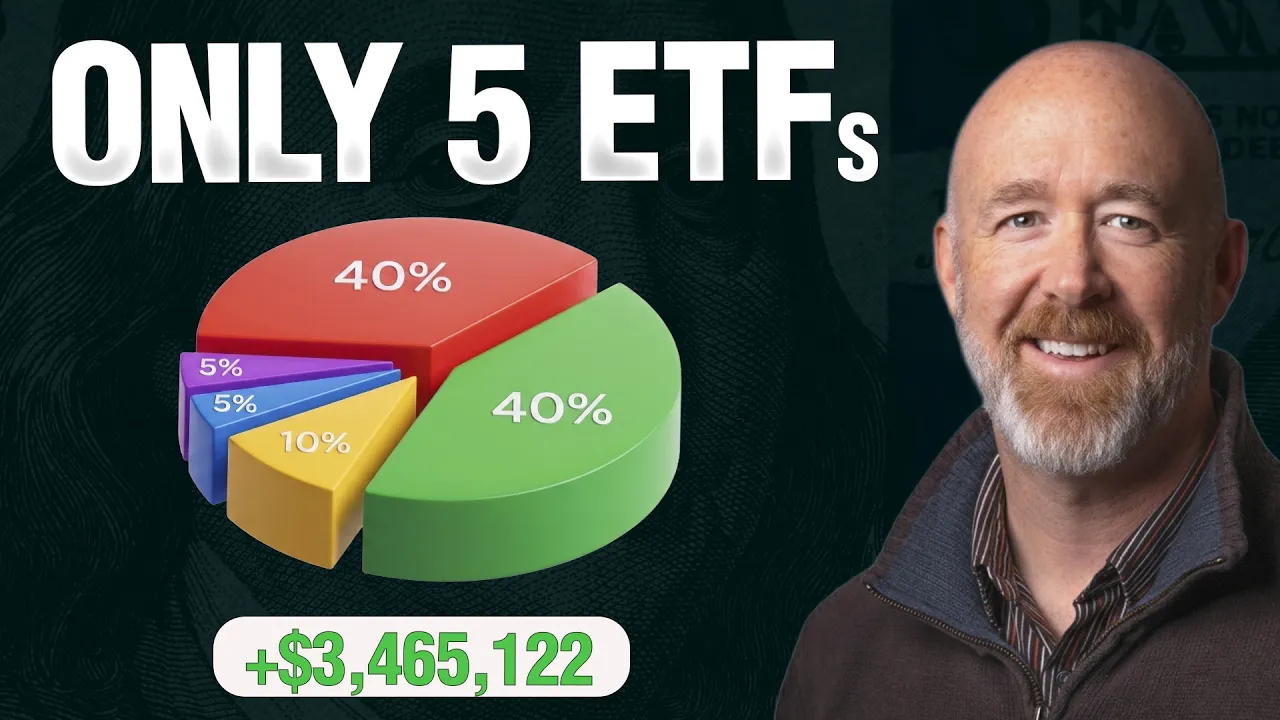
I'm putting 40% into the S&P fund and another 40% into the semiconductor fund. And both of these as
a minimum are in my taxable account. The last 20% splits across the other three, with 10% going to
the memory fund, 5% each to the quantum fund and the space fund. So as I mentioned earlier, I make
it a point to hold those three only in my IRA, so I can reallocate them without a tax bill kind
of holding me back. So 80% of my money is going to be sitting in the two funds that I never have
to touch. And that is exactly what earns the other three the right to be as strange as they are. So
here's how the top 10 holdings break out based on the allocation for myself. We have Nvidia at
11.4% and that's the one that I chose. And then there's Micron sitting second at 5.6% and that's
the one that chose me. And it's still there even after I kept the memory fund small. And that's the
difference between a position and pure accident. And here's the comparison that I promised you
at the very start. All five of them side by side. Now there are two things that I'm going to
point out on that chart. The two cheapest funds are also the two that I never have to touch.
And I'm going to point out right now that is not a coincidence. And the two most expensive
ones are the two with barely any track record, which is exactly why they're the smallest
positions that I hold. And I'm also keeping them in my IRA so I can change them as I like. So
that's my entire setup of five funds that actually grow that don't turn out to be the same bet once
you open them up. And the three that I might actually act on are sitting where acting is free.
So a key takeaway is open up the holdings before you buy and add up what you already own. So if you
would go ahead and tell me down in the comments which of these five you would argue with because
I guarantee you that some of you have a much better sixth fund that I should have included.
And as always, thanks so much for watching.
Comments 0
Sign in to join the discussion.
Sign inNo comments yet. Be the first to share your thoughts!