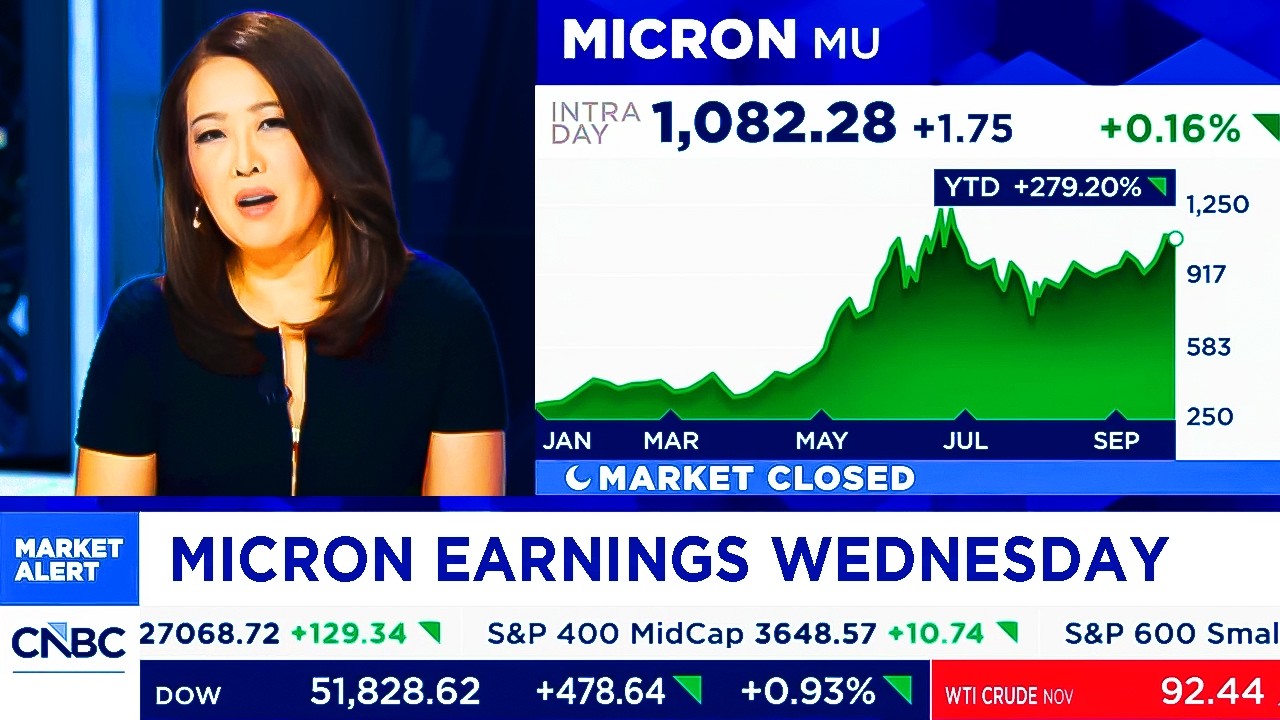
The News Today On NVIDIA Stock, Micron Stock Ahead of Micron Earnings - NVDA Update

- Rendement de la vidéo
- —
- Appels
- 1
- Achat / Vente
- 1 0
- Publié
Recommandations
L'entrée est le cours de clôture de l'actif à la date de publication. Le cours actuel est la dernière clôture enregistrée.
-
Entrée $1 082,28 26 sept 2026Actuel $1 082,28 25 sept 2026Résultat +$0,00vs. indice +0,0% SPY +0,0% sur la même période
Citer cette recommandation Voir le segment source (332s) *
Contexte de la transcription source
…bly bullish only because his orders are backlogged. He is coming in with so many orders that he can't even fill for years out. And there, of course, is a shortage of memory chips. So, isn't that a good enough sign for an investor thinking, should I buy the stock here, even though the stock has had a pretty good runup? >> Yes. Fundamentally speaking, this is the same type of narrative we had with internet of things. Micron is still trading off of NAN prices and it's a commodity stock which it got back in the 1990s. What we need is the market and Wall Street to s…
should I buy the stock here, even though the stock has had a pretty good runup? >> Yes.
Contexte extrait par IA isn't that a good enough sign for an investor thinking, should I buy the stock here, even though the stock has had a pretty good runup? >> Yes. Fundamentally speaking, this is the same type of narrative we had with internet of things.
Transcription Complète
They say the alternative which is there is no way to contain our experiments. There's just no way. When we test our AI models, uh it will get out and it will damage the world. Then I think the answer is we have to shut the labs down because the the cost to humanity the the the damage is too great. the shareholder the liabilities it could be civil liabilities could be criminal liabilities I mean the liabilities incredible video Jensen Wong on that Ezra Klein podcast this week while he doesn't believe that AI poses an existential threat to humanity he does say if the people working at places like anthropic or open AI really are on the verge of destroying the world they should shut it down uh interesting example of him not exactly talking his book >> shares of Nvidia hired today as Elon Musk races to scale up XAI's computing power. Musk says its Colossus 2 cluster in Memphis now has 550,000 Nvidia GB200 and GB300 chips with hundreds of thousands more expected online in the coming months. Now, if all goes according to plan, the cluster could more than double its current chip count by the end of the year. And I know you've got Micron as one of the names that you're buying and and with their earnings sort of kicking off the season for us next Wednesday. I'd love to know how you're looking at them because I mean last earnings we saw them uh beat heavily on top and bottom line. I think they even went beyond the whisper numbers and we still saw a negative reaction. Now different technical setup for Micron coming into this earnings report. So, what's giving you optimism here, Eddie, that we're going to get a different market reaction to what are expected to be again positive numbers and a top and bottom line beat? >> So, I think we have an opposite setup as we did last earning season. And I think when we go into this earnings number next week, I think you have pessimism much worse, positioning much worse because the July selloff, I mean, names like Micron lost 30 to 50% of their value in a very short period of time. uh we did start buying in July and we recently added as they broke out uh even more to those positions. So we think positioning going into this earnings next week is actually more bearish than where we were last time. So we're expecting earnings uh to stay strong, but more importantly we are cautiously optimistic that the opposite will happen that they'll be rewarded for good numbers versus being punished for good numbers like they were last time. And anyway, I we've talked about where the yields are. I mean, I'm looking right now. We're we're at 521. I mean, just very high. How are you looking at that and its potential to affect this runup in semis? I mean, at what point are these higher rates going to weigh on capex spending? Are we far enough removed from that still that you are near-term optimistic? >> Yeah, this is a short-term call for us, you know, for the rest of this year. Uh I think in this market things move so fast to try to predict 12 months out is going to be really challenging. But look, we don't sugarcoat this with our clients. If the cost of capital continues to increase, it's going to be a real problem for capex spending numbers for 2027. Uh so we do need to see yields level out and peak. We do think we'll see peak yields probably next month when we get our our last most hawkish inflation data. But, you know, at the end of the day, the other thing that makes this market very tricky is oil. We're one announcement away from oil going down into the 60s or oil going to 118 to 120. Um, if we get positive news on energy, it's going to bring yields down because future expectation for inflation will come down. So oil is driving the bus right now on yields as well as the Fed. So if we remove that risk, I think uh we're going to surprise many to the upside, much higher than most expect. >> Micron Technology set to report fiscal fourth quarter earnings on Wednesday. This could set the market on fire or dump cold water on it depending on how the numbers come in for the memory chip maker, but it is projecting revenue to come in at $50 billion and diluted non-GAAP EPS of $31. The stock has just been on a tear. It's rallied 588% over the past year and Bank of America says Micron's gross margin and capital spending guidance could fire it up further. Joining me now, Wellington Alta's chief market strategist, Jim Thorne, who has more than a an AUM of more than $ 35 billion. Jim, how important is it to watch the Micron earnings next week? >> Well, the mar the margins are going to be the most important thing because for investors that are looking at it right now, it's the rerating. Micron is still trading at a massive discount to the market. And if you can get this thing trading at a market multiple, you have another leg up that's going to provide investors handsome returns. Okay, handsome returns. When I speak to Sanjay Moro, the CEO of Micron, he is so incredibly bullish only because his orders are backlogged. He is coming in with so many orders that he can't even fill for years out. And there, of course, is a shortage of memory chips. So, isn't that a good enough sign for an investor thinking, should I buy the stock here, even though the stock has had a pretty good runup? >> Yes. Fundamentally speaking, this is the same type of narrative we had with internet of things. Micron is still trading off of NAN prices and it's a commodity stock which it got back in the 1990s. What we need is the market and Wall Street to sit there and say this should have a market multiple and if it had a market multiple with the margins that it has, it's another substantial leg higher. But that's a psychological question because it should be there right now. There's no reason why Micron is trading at such a discount to the market. >> Okay, >> Micron earnings are on deck next week. Despite a strong beaten raise last quarter, the stock hasn't moved much since then, up just 3% with a big drop and then some partial recovery. Although we should note it is up more than 280% for the year. So, will the company deliver? With us now to discuss is Harsh Kumar, Beimo Capital Market semiconductor analyst. He raised estimates just this morning. has an outperform rating on the stock with a price target of $1,300. Harsh, good to see you. Uh I imagine the the big question among investors that you talk to is u you know, how long can we expect this extraordinary demand situation uh to to last for for memory products and the pricing power uh for Micron. >> Yeah, thanks Mike for having me on your show. Uh so we're in the middle of basically simply put a super cycle for memory and this cycle looks like it's going to have legs. Um you know memory is extremely short. We talked to a distributor who characterized demand as roughly three times stronger than supply. But even if we look beyond that there just seems to be insatiable demand for memory. And I think um while the industry is desperately trying to catch up, I don't think we'll be at par anywhere close to the middle of next year. And so that's the that's the last data point that I have, but it's very conceivable and very likely that we may not be in par for all of 2027 calendar and even some part of 2028 for that matter. So I think we we still have legs to go on the cycle. I found it interesting harsh that you found that all categories of memory DRAM HPM as well as NAN showed an average selling price uptick um for the August quarter. You're also expecting the same for the quarter afterwards. Uh how what are your forecasts now? Did the were these upticks greater than what you had expected? Are they in your forecasts? >> So they were a little bit better than what I had expected which is why we ended up raising our numbers. So if you recall last quarter the prices rose up what I would only describe astronomically. DM was up 60% NAND was up greater than that. This time around the big surprise came from server DRAM or DDR5. uh and I think what's happening is a agentic AI things such as metam muse things such as uh you know other agentic applications are really driving the server super cycle and that is causing uh memory for DM to go up also HPM is on a contractual basis so it's not possible to raise prices quite as aggressively in the middle of a contract however DM as you know floats a lot better to the market and the spot price so that's what happened we're thinking that for probably next year. Flash might be the choke point and that might be the one that rises or nan flash might be the one that rises the most next year. >> It's remarkable when you just sort of look at the at the stock price of Micron and go back a year and you just see how it it released higher in such a dramatic way that was like it dawned on everybody not just that there was a shortage but that the next phase of the AI buildout and AI usage was going to require that much more memory. I mean what's the next turn of the dial on this? I mean, if we couldn't see that coming a year ago, what might not we see coming right now? >> So, Mike, it's the same turn of the dial. So, remember in 2023, Micron had negative 10% gross margin. Just let that sink in for a second. We're not talking that far ago, you know, a couple years ago, three years ago. And so with since then AI came comes along and the demand for HBM and the trade ratio of 3:1 which is for every HBM die you make you take away three times the surface area from DRAM. And so when that came into play and the aggressiveness of the AI that came in it has all led to basically lack of supply and prices rising astronomically. Now these factories or these fabs take two 2 and 1/2 3 years to make and they cost 8 to10 billion. So you cannot just turn on the capacity and that's part of the problem here. So the first branch of capacity actually comes on in middle of next year and we'll see how that plays out but I suspect we'll still be short. >> Yeah. Uh peak of Micron's share price was 1255 exactly 3 months ago today. Hey, uh you got a $1,300 price target on a very modest valuation if those earnings come through. We'll see how it goes next week. Harsh, thank you so much for the time today. >> Look, we've got some big news coming up because we've got uh as you alluded to, we've got Micron coming in uh next week. And I don't expect any news to be disappointing in the near term in that space. And like I was saying before, you know, the multiple is such that if you're looking at something like a micron, which is trading at, call it seven times, actually less uh next year's earnings, you know, it's kind of hard if you think that they're going to maintain that for any length of time to understand why it would go materially lower from here. So I I think you can still stick with this trade. Nvidia also um AMD like I alluded to before is probably the name that to me at least uh looks like the multiple is still uh anticipating a lot of good news rather than pricing in the good news that's already here. >> Money shares a micron on a tear this year nearly quadrupling in 2026 as a growing AI data center buildout fuels demand for memory chips. So with results on deck next week and with both Mike and Carter joining us tonight, we thought it'd be perfect opportunity to lay out some old school options action. Let's kick it off with the technical take as we always do. Carter, >> here we go. Well, not for the faint of heart. You're talking about a stock that went from 300 to,200, then lost about 45% of its value and is sitting right here. Let's put some lines on it. So, second iteration, one way to depict the current circumstances is this, which is converging trend lines. We're working into the apex of the formation and what resolves it is fundamentals. You get something like earnings and that's what's coming. uh another iteration just to make uh clear how precise this is the upward sloping uh trend line we have bounced off it to the penny to the penny to the penny and here we are the downward sloping and we rallied to the penny and have been backing and filling in stock something has to give last chart this is a judgment of course mine meaning I think it's up and out I'd play for around 1,200 and from there over to Mike Mike. >> Yeah. So, let's talk about those fundamentals very quickly. First of all, they're expected to do about 73 and a half bucks in adjusted EPS for the fiscal year that just ended. That's what they're going to be reporting. And that would put the stock at about 14.7 times trailing earnings. It's trading at less than seven times forward anticipated earnings. So, I think if the market gets what they're hoping for, there is reason to believe that the stock can hold in here or even go higher. And as we look at the options market right now, it's implying a move of about 6%. That's below average. Maybe not surprising given we're talking about a $1.2 trillion company. I think you take advantage of that slightly discounted options premium and look out to November. I was looking at the 1100 1350 call spread buying those 1100s. Those were going to cost about 97 bucks and then selling the 1350s for around 31 and a quarter. So you're risking about 6% of the current stock price and you get some upside participation and you also give yourself some time in fact all the way through the midterms in addition to just earnings. So this I think is a way that you can define the risk, don't have to worry about those kind of 40% draw downs that Carter was just talking about. >> Bonwin, do you like this trade? >> I do. If you look at what your max loss is versus your max gain, you're in there between two and a half to three times, which is a pretty good riskreward. I like situations where you can risk one to win three. I think it's well laid out by Mike. Uh Tim, I just spoke to an analyst in the last hour and he was raising his estimates because he found that ASPs in the August quarter and he's expecting the November quarter are actually still rising. >> Well, first of all, it's a privilege to be in the middle of an options action episode and and I I tend to agree. I think part of longerterm visibility for Micron is has been part of the story on the rebound. Uh I would also just point to a couple other charts, but notably Korea. I mean the Cosby has slowly been itching higher is now back above the 50 has been not has been very under control and along with semis I mean that that's your support for for Micron on some level as well. >> All right I hope you're all doing well today and staying calm in this market. Friday was a slightly positive day throughout much of the market although we did see some red action in many software names. We saw oil move lower around midday after reports claimed that talks between the US and Iran have entered a technical stage that caused oil to move lower and stocks to move higher around midday. And then not long after that, additional reports claimed that the earlier reporting was false. I'm just mentioning this because it had an effect on a market Friday. Late Thursday night, we got an important Nvidia update from Elon Musk. As a reminder, Elon recently announced that SpaceX will be building exclusively on Nvidia's platform moving forward. And Thursday night, Elon posted on X saying, quote, Colossus 1 is 150,000H100, 50,000H230,000GB 200. Colossus 2 is 110,000GB 2440,000GB 300. Another 220,000GB 300 will be fully operational next week and another 220,000 in November. If we get lucky, yet another 220,000GB 300 by late December. If all of those additions happen, then we're looking at more than 1.2 million Nvidia Grace Blackwell GPUs at Colossus 2. That is massive. SpaceX has demonstrated their ability to bring large amounts of capacity online quickly. And with their recent commitment to build exclusively on Nvidia's platform, I don't think the market is giving enough credit to Nvidia. Elon said on SpaceX's recent earnings call that their understanding with Nvidia is that they will receive a very significant percentage of Nvidia's GPUs next year. In other news, Inscale announced a $3.36 billion financing round. The structure includes $2.36 billion at closing, plus a separate $1 billion commitment from Nvidia with funding expected in mid- November. Nvidia's notes would convert into non- voting inscale shares upon Inscales IPO. As a reminder, Inscale recently announced that they filed to go public in the US. Nvidia and Inscale are deeply tied together in engineering collaboration and Nvidia has meaningful exposure to Inscale in the form of equity financing and guarantees. Nvidia works closely with Inscale and Nvidia making a very clear bet on Inscale success. This should be an interesting IPO to watch. Jensen Hong attended the Trump State dinner on Thursday and then USDR Greer indicated in a CNBC interview Friday morning that AI chip export controls were not meaningfully discussed. So, there's no news on that front. We got some important news for Microsoft on Friday, including a major redesign of Microsoft Copilot. With autopilot being the main feature, autopilot is essentially an always on AI agent. You give it an ongoing responsibility, and it can keep working when you're offline, monitoring conversations and projects, following up, gathering information, and coordinating work across Microsoft 365. It has persistent context memory in its own workspace. Microsoft says Autopilot is expanding to private preview at the end of this month. I noticed Peter Steinberger posted on X saying that they worked with Microsoft since March to make the codebase ready for large-scale deployments. I'm sure many of you have heard about the recent success of MetaMuse by now. The app reached number one in the app store and user reviews have been overwhelmingly positive. In simple terms, you could think of MetaMuse as essentially being OpenClaw for consumers. And now you could think of Microsoft's autopilot as potentially being like OpenClaw for enterprise employees. Microsoft is also making C-pilot an app building platform. So a nontechnical employee could say, "Build me a dashboard that tracks X." and copilot can create the app or automation using technology related to GitHub copilot. With home, copilot becomes more of a central hub where chat co-work and powerpoint are pulled into the same copilot interface. So copilot can actually create or edit live office files instead of merely giving you text to copy into them. And Microsoft also announced that these more compute intensive features will use usage based billing. That's a notable change that many software companies are going to have to make as they introduce AI powered features that could potentially change longer term as token costs come down. But for now, many software companies will need to use a usage-based billing system or at least a hybrid system similar to what Microsoft's doing. Now, as I alluded to a moment ago, in simple terms, you could think of Microsoft Autopilot as being kind of like Meta's Muse for knowledge workers. I want to make an important point here. Meta, Microsoft, and other companies like them have such large user bases and distribution capabilities that it's only a matter of time before they monetize those user bases with AI powered tools, features, and experiences. Building a large user base is the hard part. After you've built a very large user base and have extensive distribution, monetization is the easier part. Now, as I've said repeatedly about OpenAI in the past, when we're talking about their ability to meet spending commitments, OpenAI already has over 1 billion users. They will monetize that user base to a greater extent in the future than they currently are today. It's simply a matter of time. And as I explained earlier this week, I think the Frontier model companies will likely be able to fund their compute purchases for at least the next 2 to 3 years. Of course, we've seen them raise capital in the private markets, but you also have to consider the $500 billion in thirdparty independent capital Jensen announced alongside six of the world's top finance years back in August. That capital is mainly for the frontier model companies as Nvidia leadership alluded to on the recent earnings call. Plus, OpenAI and Anthropic will likely go public at some point in the not too distant future. So, I expect them to be able to fund their compute purchases for at least the next two to 3 years. And again, building a large user base is the hard part as we've seen over the past couple weeks with Meta and now with Microsoft. If you have a large user base, you have distribution. If you have distribution, then all it takes is the right product market fit to really catalyze the monetization of that user base. Now, before moving on, I want to mention one more thing about Microsoft as they announced these new computensive features will use usage based billing. I want you to notice the first part of that statement because it's directly relevant to Nvidia. These are compute inensive features. Microsoft told us on their recent earnings call that they now have more than 30 million paid co-pilot seats. In addition to those 30 million paid co-pilot seats, Microsoft also has over 400 million Microsoft 365 commercial paid seats and nearly 100 million Microsoft 365 consumer subscribers. Again, Microsoft has a large entrenched user base and they have massive distribution capabilities. I just want you to think about the long-term implications of millions and eventually hundreds of millions of people using agentic AI and computensive features in their work and daily lives. The amount of compute that will be needed to serve that demand is massive. It's kind of mindboggling to think about. I don't think we're even close to peak capex yet. We also have some memory news. According to DG Times, Samsung and SKH Highix are in the running to supply 24 GB GDDR7 for Sony's next generation console. The report notes that tight memory supply is complicating Sony's planning for the PS6. That's another reminder of the shortage and the impact that it's having on consumer products. In other news, consensus expectations for Samsung and SKH's revenue and operating profit have come down slightly. The change in consensus reflects a currency effect that reduced one value of dollar denominated sales rather than a downturn in memory pricing or demand. In other words, the slight decline in consensus expectations is due to changes in currency values rather than changes in the memory market itself. I didn't see any updates on a Micron Taiwan labor union situation. But in case you've missed recent videos, one of the unions is expected to hold a strike authorization vote October 1st through October 3rd. And then voting is scheduled to happen at a second location from October 4th through October 6th. so we could get the results of that vote sometime around October 6th or 7th. In order for a strike to be authorized, more than half of union members must vote in favor of it. The other Taiwan labor union is scheduled to meet with Micron again on October 22nd and mediation is ongoing. Taiwan is Micron's main manufacturing hub and so we do need to keep an eye on the situation just in case. If a strike is announced, that would most likely have a short-term negative impact on the stock. So be prepared just in case. That said, even if a strike happens, I expect the situation will eventually be resolved. Looking ahead, we have Micron earnings on September 30th after market close and then Jensen is scheduled to speak again at GTC Berlin on October 21st. Now, in case you're new to the channel, I want to make sure that you have at least a basic understanding of the underlying long-term thesis. So, let's cover that. Now, I don't know what's going to happen in the short term, but from a long-term perspective, I am very confident that Nvidia will be worth much more in future years than it is today. When Jensen was on the Lex Freedman podcast not that long ago, he was very seriously raising the possibility of Nvidia becoming a $3 trillion revenue company in the near future. If that happens in the coming years, then it is very plausible that Nvidia could one day be worth tens of trillions of dollars in market cap. That might sound crazy, but that's what Jensen is implying when he raises the possibility of Nvidia becoming a $3 trillion revenue company. I guess the question at that point is what multiple the street will be willing to give Nvidia. I don't know the answer to that question, but I truly do think that Nvidia will be worth much more in future years than it is today based purely on the fundamental growth of the business. Based on everything I'm seeing, the world is still compute constrained and I expect that to continue at least through calendar 2028. In a computed environment, developers will use whatever viable compute they can get their hands on. Today, there are no GPUs that are sitting dark due to a lack of demand. Like, there was fiber sitting dark due to a lack of demand at the height of the dot bubble. Back then, companies were laying fiber in the hopes that use cases and demand would eventually show up. Today, we are seeing the complete opposite. As I've said many times, when market participants compare this AI revolution to the dotcom bubble, they ignore the fact that the internet is already here this time. This means that mass adoption of the technology and new use case development at scale are immediately possible. We don't have to wait years for it to show up. It's already here. The world is compute constrained, which means there is not enough supply to satisfy demand. New capacity is utilized as soon as it comes online. The hyperscalers are monetizing capacity as soon as it comes online. Each of the hyperscalers spoke about being supply constrained on their most recent earnings calls. Additionally, many of the clouds are building out into contracted demand. They're not blindly building in the hopes that demand will eventually show up. No, they're building out because they have signed contracts and in some cases significant prepayments from their paying customers. This AI revolution is fundamentally different from the do-com bubble. And 2026 will be a pivotal year for the AI industry thanks to the rapid adoption of agentic AI and the proliferation of agentic systems in the world's leading enterprises. The leading AI labs revenues are surging right now. Agentic coding and the implementation of agentic systems in large enterprises are new use cases that are increasing inference demand significantly. That subsequently is increasing compute demand. The rapid adoption of Agenic AI is why we're seeing an inflection in inference demand. It's why we're seeing the leading AI labs revenues surge. I wish both anthropic and open AI were public so the public could see the ramp in their revenues. I think the leading labs surging revenues may be the initial proof point that grabs market participants attention and causes them to realize that there will be a clear ROI on AI infrastructure. I think the leading labs surging revenues will also help assure investors of the longevity of Nvidia's growth since these labs revenues are directly tied to compute. If they had more compute, they would have greater revenues. It really is that simple. Demand is not the problem. The problem is a lack of supply to meet the demand. As I've said previously, I expect the world to be compute constrained at least through calendar 2028, possibly longer. And so regardless of what happens in the short term, it's important for long-term investors to remain focused on the fundamentals, maintain a long-term perspective, and remember that we are only in the early stages of aic systems being adopted at scale. This will increase compute demand significantly, and after that, the next surge in compute demand will likely be fueled by physical AI. We're no longer talking about digital agents performing digital tasks. With physical AI, we're talking about physical AI agents performing physical tasks in the real world. NVIDIA CFO has called physical AI quote a multi- trillion dollar opportunity and the next leg of growth for NVIDIA. This industry will fundamentally transform society and Nvidia has positioned themselves to benefit massively. NVIDIA sells the hardware for the data centers where the models are trained. They offer omniverse where the models are taught and tested. And Nvidia also sells the hardware that allows ondevice real-time inference through NVIDIA AGX, allowing robots to have intelligent interactions with the real world, even when they are not connected to a data center. Notice that NVIDIA is taking a holistic platform approach to physical AI and they're embedding themselves as the underlying foundation supporting all of it. Over 3 million developers are already building on the NVIDIA robotic stack, and this is not getting enough attention. As for production ramps, Blackwell Ultra has ramped and remains in high demand. Vera Rubin is rolling out to customers. Nvidia Gro 3 LPX is in full production. Later on, we're expecting the launch of Reuben Ultra in 2027 and Fineman after that in 2028. We have a clear data center product roadmap stretching into 2028. And Jensen believes that AI infrastructure spending will reach three to 4 trillion annually by the end of the decade. That means Jensen is expecting growing AI demand and an expanding total addressable market underpinning all of this. I don't think we are anywhere near any type of bubble bursting type of event. With all of this in mind, I seriously think that Nvidia still has plenty of runway ahead of it. And I think this company will be worth substantially more in future years than it is today. At least that's my view of the situation. Quick note before I wrap up. All of the compilations on this channel are edited by Finn Vid with original structure and commentary. Occasionally the same edits appear elsewhere on YouTube. If you're looking for the original version, it's always here on this channel. Thanks for watching Finnvid. I appreciate your support. Remember to stay calm in this market. Remember to maintain a long-term perspective and do not make any hasty or irrational decisions. With all of that being said, I hope you all have a great rest of the day and I'm curious to hear your thoughts about Nvidia in the comments below. Please leave a like on this video so more people will see it. And while you're down there, please consider subscribing. It's free and you can always change your mind. Thanks for watching and hopefully I'll see you in the next
Commentaires 0
Connectez-vous pour rejoindre la discussion.
Se connecterAucun commentaire pour l'instant. Soyez le premier à partager votre avis !