…g 2,141. That is, in fact, 45% implied upside from today's price. So, ASML is close to my fair value in my base case, while the downside case still matters. Monopoly like quality, it reduces the risk. It doesn't remove valuation risk. Now, ASML, I would in fact be comfortable accumulating gradually, but I don't see enough of a margin of safety for an A tier. ASML is the first one going in the B tier group. We then move on to Qualcomm. This one is pretty much flat year to date over the last 5 years. Pretty much the same. So, it hasn't…
ASML, I would in fact be comfortable accumulating gradually
Contexte extrait par IA
Now, ASML, I would in fact be comfortable accumulating gradually, but I don't see enough of a margin of safety for an A tier. ASML is the first one going in the B tier group.
…h for an A tier because handset exposure, licensing risk, and the need to prove meaningful diversification that still caps my conviction. For Qualcomm, this goes into the B tier. Is a reasonable value entry rather than a screaming bargain. I'd consider a measured buy rather than going all aggressive. Now we reach Nvidia. The stock will probably create the most disagreement. The shares well they fallen hard yet analyst ratings and profitability they still remain exceptionally strong and as we highlighted earlier the markets remove roug…
I'd consider a measured buy rather than going all aggressive
Contexte extrait par IA
For Qualcomm, this goes into the B tier. Is a reasonable value entry rather than a screaming bargain. I'd consider a measured buy rather than going all aggressive.
…personally not size Micron like a defensive compounder and I would not anchor to the most optimistic output here, but the risk ward is too compelling for a tier. Micron today it enters into the S tier, but remember this is cycle sensitive. It means buyable at this valuation but only with a position size that can survive a brutal memory downturn. We then move on to SK highix which is down around 14% in just the last 30 days trading around 52- week lows where alltime highs sitting around $200. Wall Street will they give this a strong buy for which on a forward gap basis it's tradin…
It means buyable at this valuation but only with a position size that can survive a brutal memory downturn
Contexte extrait par IA
Micron today it enters into the S tier, but remember this is cycle sensitive. It means buyable at this valuation but only with a position size that can survive a brutal memory downturn. We then move on to SK highix which is down around 14% in just the last 30 days trading around 52- week lows where alltime highs sitting around $200.
…rting cash flow they can collapse in a memory downturn. Brocom as I said that ranks first because it's lower growth case still clears the market price while the base case offers more than 50% upside from a diversified cash flow machine. So if I were deploying fresh capital today I would start with brocom and lamb use a position for TSM and the cickle S tier names. I would not put equal money into every S tier stock. Broco means high conviction. The memory names mean high opportunity with high volatility. And Nvidia, it remains a measured accumulati…
if I were deploying fresh capital today I would start with brocom and lamb
Contexte extrait par IA
So if I were deploying fresh capital today I would start with brocom and lamb use a position for TSM and the cickle S tier names. I would not put equal money into every S tier stock. Broco means high conviction. The memory names mean high opportunity with high volatility.
…rting cash flow they can collapse in a memory downturn. Brocom as I said that ranks first because it's lower growth case still clears the market price while the base case offers more than 50% upside from a diversified cash flow machine. So if I were deploying fresh capital today I would start with brocom and lamb use a position for TSM and the cickle S tier names. I would not put equal money into every S tier stock. Broco means high conviction. The memory names mean high opportunity with high volatility. And Nvidia, it remains a measured accumulati…
if I were deploying fresh capital today I would start with brocom and lamb
Contexte extrait par IA
So if I were deploying fresh capital today I would start with brocom and lamb use a position for TSM and the cickle S tier names. I would not put equal money into every S tier stock. Broco means high conviction. The memory names mean high opportunity with high volatility.
…t is credible. But the base case is only offering us around 10% MOS. So Nvidia is not a selling the framework and I'm not betting against the business. it simply doesn't yet offer enough valuation protection to go straight into the A tier. So for fresh money, I would buy it in measured amounts rather than chase it aggressively. Nvidia, it goes into the upper half of a B tier. We then move on to Marvel, which on the surface, it looks far cheaper than Nvidia with strong growth and a share price well below our fair value. We've also got Consensus EPS rising sharply…
So for fresh money, I would buy it in measured amounts rather than chase it aggressively
Contexte extrait par IA
So Nvidia is not a selling the framework and I'm not betting against the business. it simply doesn't yet offer enough valuation protection to go straight into the A tier. So for fresh money, I would buy it in measured amounts rather than chase it aggressively. Nvidia, it goes into the upper half of a B tier.
…ng into the A tier. Now the obvious risk is geopolitical and no valuation model can reduce that to a neat percentage. Position size matters more here than it does for a normal industrial company. on business quality, growth, and valuation. While TSM it earns a tier, I would buy it, but I would still cap the position because the tail risk is real. We then move on to Lamb Research. The market, well, it raised profitability at an A+ while the share price is pulled back enough to create a meaningful valuation gap. All-time highs not long ago sitting around $440. It's now sitting near …
While TSM it earns a tier, I would buy it, but I would still cap the position because the tail risk is real
Contexte extrait par IA
Now, my DCF, it comes to $492. That indicates a 20% margin of safety, implying upside from today's price of around 25%. Low growth case, that one at 15% does imply downside. We're talking around 9% more aggressive 675 71% upside. This is what I like when we look at TSM. The low case of 15% whilst it is lower in fact than today's price is not materially away is the downside protection that I want from a company that I'm considering putting into the A tier. Now the obvious risk is geopolitical and no valuation model can reduce that to a neat percentage. Position size matters more here than it does for a normal industrial company. on business quality, growth, and valuation. While TSM it earns a tier, I would buy it, but I would still cap the position because the tail risk is real.
Transcription Complète
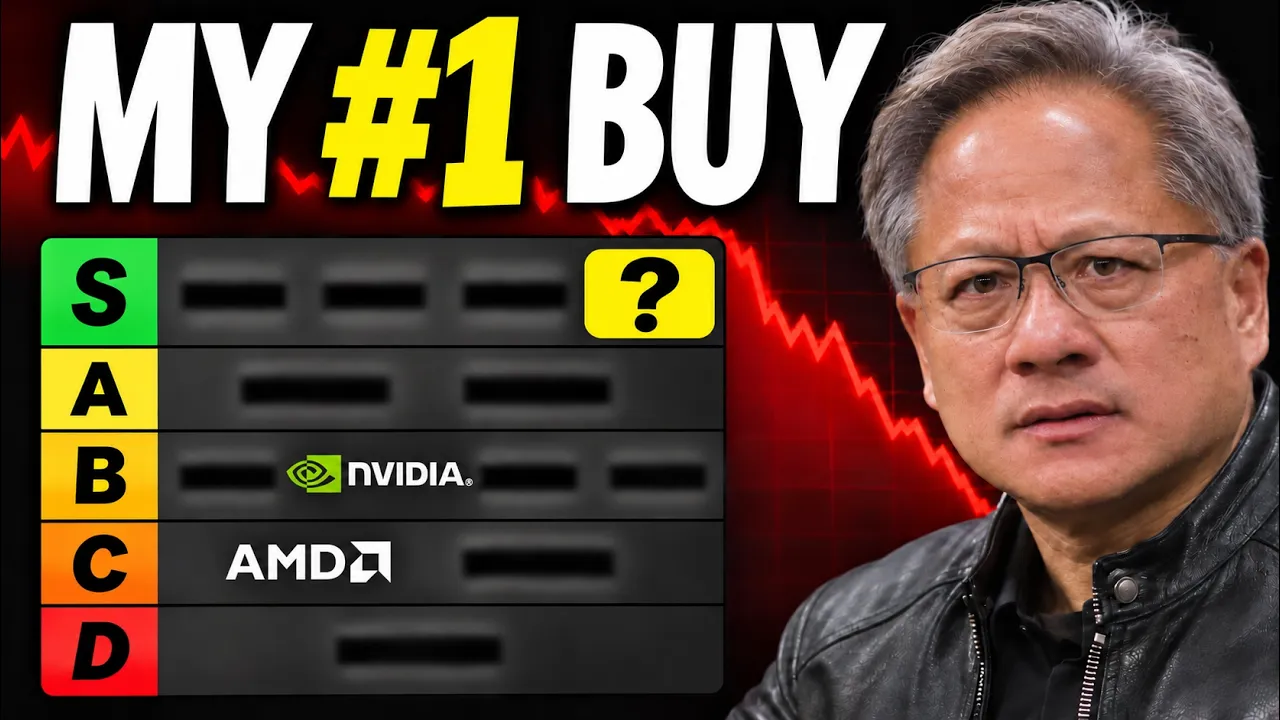
the semiconductor sell-off. It suddenly created some of the biggest valuation gaps that I've seen all year, but it's also created some very obvious traps. Broadcom that fell around 5% on Friday. AMD dropped almost 9% and Nvidia, Micro, Marvel, and the equipment names, they were all hit together. But if we zoom out to the full week, the picture is completely different. Most of the sectors are green, while Nvidia, that's down almost 13%. I mean, in less than one week, Nvidia alone has lost roughly 660 billion in market value. That's not a normal move in a normal market. And at the same time, we've got one AI stock in our ranking today. It appears to be trading at almost half of my calculated intrinsic price with a margin of safety close to 50%. Yet another worldclass semiconductor company, it still looks about 16% overvalued even after the recent weakness. Remember, falling prices, they don't automatically mean cheap shares. So today, I've rebuilt the valuations using the same 9% discount rate throughout. And I've ranked 13 semiconductor stocks from Dtier all the way to S tier. We've also got two extremely sickle names where the spreadsheet prints enormous upside. I'm going to show you why those numbers cannot simply be accepted at face value. And then we've got the number one stock is not the one with the biggest headline upside. It's the one where the downside case, the base case, and the business quality, they fit together best. So today's ranking is about where I put fresh money today. A brilliant company, it can still rank poorly when the price already assumes brilliant execution. And the wider market is important today. information technology. It traded around 18 times Ford earnings below both the 5-year average of 25 and the 10year of 23. Where the S&P 500 forward multiple is also fallen sharply from the recent peak and it now sits below the longerterm average lines. Valuation pressures they've already arrived. And before we get into the individual valuations, this is the bigger question hanging over the entire ranking. how much of Nvidia's value belongs to the company and how much belongs to Jensen himself. We're gonna listen to Bill Aman's thoughts. >> You allay fears of the AI trade and I know you also tweeted about um Jensen. >> Well, I think Jensen's amazing CEO. Sad to see uh him leave, but you know, Nvidia will survive. Uh and you know, I'm sure the company will do great. >> What do you think of Nvidia? >> And I think I think Jensen will do something else great. and Nvidia being the central bank of AI. What do you make of the key manner of risk and how one company is at the heart of all the AI trade on >> there a lot of iconic CEOs and and you know Apple had an iconic CEO and company did pretty well after >> that's the optimistic version the founder matters enormously but the platform can outlive him. I'm going to test that view against the cash flows rather than simply choosing a side. It's also important to note that earnings expectations, they've not collapsed. Bottom up S&P 500 earnings, they're still projected to rise from roughly 275 to 365, then 425. Where information technology is also producing some of the strongest earnings growth within the index. That is why I don't want to treat every red semiconductor stock today as being completely broken. I also want to make it clear that for every DCF that we use today, we're using a 9% discount rate, 3% perpetual growth rate, then stress the operating growth assumptions across a low, medium, and high case. Now, all companies, they're going to start in the D tier and then move them up to the relevant allocation or in fact keep them at D. But make it clear D in fact, it means I would avoid adding fresh money at this price. C tier, it means the risk to reward is still unattractive. B is going to be the watch list or measured buying territory. And A tier means I see an attractive entry with a real margin of safety. S tier today is reserved for the strongest opportunities. But I want to make it clear, some S tier names, they carry serious cycle risk. Most importantly, I'm not ranking the companies by quality alone. I'm ranking the shares by what today's price asks us to believe about the future cash flow is why the reverse DCF is also handy. And if we kick off with Apply Materials, this is a highly profitable business and they remain positive and the forward earnings multiple is sitting just below 20. If we look at a trailing non-GAAP earnings while Apply Materials, it tra around 28.7 times. We can see that's around 32% richer than the sector median and also 23% above their own 5-year average. Now their revenues moved from roughly $7 billion in 2005 to an estimated 34 billion in 2026. The longerterm execution for AMAT has been excellent. And then if we look at the estimates they do become much more aggressive rising towards 47 billion 56 and then 61. The future growth is exactly what buyers are paying for today. Now my DCF it produces a price of $311 compared with today's price. Well, there's actually no margin of safety. you're looking at a premium of 16%. Now the low case in our model it assumes 10% growth the value that falls to $213. Medium case as we said 311 while the higher case that reaches 453. It means the base case it still shows roughly 14% downside and the reverse DCF well that requires around 17% growth merely to justify today's price. Now apply materials I like it as a company. I simply don't like the amount of execution all you required for fresh money today apply materials it's staying right in the D tier we then move on to advanced micro devices the share price has been incredibly volatile and the session we saw on Friday it wiped almost 9% from the stock trailing non-GAAP earnings well they're valued at more than 80 times we're talking 270% richer than the sector and 63% above their own 5-year average now consensus This EPS we can see here it does rise steeply through the next several years. It gives AMD huge operating leverage if the estimates arrive but it also raises the cost of disappointment. My DCF it arrives at $525 against the market value pretty much seeing it at fair price. Therefore there's no margin of safety just around 1% which is fairly trivial. At 10% growth the value falls to $439 around 16% downside. And at the upper trend the high case where we can see 628 that indicates 21% upside the reward it does exist but the base case it gives almost no protection today. Now AMD it could absolutely outperform if AI accelerated share in margin surprise upwards. At this exact price though have to be honest the valuation it gives me no margin for error. AMD today it goes in the C tier. We then move on to KLA. We can see it's got an A+ on profitability and a remarkably durable position in process control. But the valuation grade it speaks for itself. It's sitting at an F. I mean the 5-year average forward P it sits at 23.5 currently sitting around 25. It means KLA it sits around the normal valuation which is why when we look at the blue tunnel from simply safe dividends which highlights intrinsic fair price is sitting within that but right at the upper end indicating potentially an overvaluation signal but this one last time it showed us severe undervaluation signals. I mean you'd have to go back all the way to around 2019. There were some points where it slightly undervalued. More often than not though this is a premium stock. Now the business is also earned that respect. Revenues compounded at 17% annually over the decade rising from $3 billion to around 14 billion for FY26. And my DCF it comes to $142. Compared to market price, there's actually no margin of safety, a 6% premium. If we look at the lower-end growth, 10%, models around $100, that's $ 33% downside. If we take a look more aggressive case at 20% around $200 33% upside and the reverse DCF it is asking around 15.8% growth. Now that is achievable for KA but it's also close to the company's excellent decadel long revenue compound rate as well as free cash flow rate. KLA for me this is a quality compounder at a quality price not a distress bargain. I would happily revisit it after a deeper pullback. For now, KLA, it remains in the C tier. Now we move on to ASML. The company's competitive position that's exceptional and the stock is held up better than most of the semiconductor group. The forward P it sits at 23 significantly lower than the 5 average of 32. That does indicate a potential severe undervaluation signal which is also confirmed when we look at the blue tunnel. There is quite a disconnect between the point today and the lower end of the fair value. again over the last 5 10 years. This one, not all the time, but there were some points in time where you could get this in a severely undervalued level. Most recent 2025 and their service and field option revenue that reach around 3.3 billion. It shows the value of the installed base. This recurring element, it makes ASML more durable than just a pure equipment cycle story. Now, my headline DCF, it comes around $1,540. There is a margin of safety, although fairly trivial around 4%. If we look at the lower case at 10% growth, it falls down to around $1,100, indicating 25% downside. If you want to go more aggressive at 20, we're talking 2,141. That is, in fact, 45% implied upside from today's price. So, ASML is close to my fair value in my base case, while the downside case still matters. Monopoly like quality, it reduces the risk. It doesn't remove valuation risk. Now, ASML, I would in fact be comfortable accumulating gradually, but I don't see enough of a margin of safety for an A tier. ASML is the first one going in the B tier group. We then move on to Qualcomm. This one is pretty much flat year to date over the last 5 years. Pretty much the same. So, it hasn't had the greatest short to medium-term in terms of where it sits around the lower end of the 52- week range where we only get one buy rating. very weak at that from seeking Alpha. Now interesting as well the yield while it is in line with their 5year average the forward valuation it does sit higher than historical 18 against 14 for which when we look at the blue tunnel we notice here a signal of potential overvaluation this one in fact qualcom you can see the underlying fundamentals they have been very volatile likewise so is the price now we're seeing it overvalued the opposite of what we saw in 2022 and 2023 also one thing to point out when we do look at the DCF in quite some detail. Well, historical free cash flow has been uneven, but also substantial, rising from 4.8 billion in 2015 to around 12.8 billion in 2025. Now, we've only used 2% growth because when we look at the fundamentals, both historical and expected moving forwards, they're not as fast growing as some of the other companies that we're discussing today. And with that value, we get $187 implied 10% upside, margin of safety coming around 9%. Now, if you wanted to look at the lower case today, that hits $137, downside of 19%, more aggressive at 7 coming to 64% upside. But some people may look at this and say this is a lot more conservative than what we've used for other companies. Which is why I'd say today for Qualcomm, the base case, while offering around 10% upside, the reverse DCF very important, is only highlighting here less than 1% growth expectations for Qualcomm. They already look fairly modest. So overall attractive. Not enough for an A tier because handset exposure, licensing risk, and the need to prove meaningful diversification that still caps my conviction. For Qualcomm, this goes into the B tier. Is a reasonable value entry rather than a screaming bargain. I'd consider a measured buy rather than going all aggressive. Now we reach Nvidia. The stock will probably create the most disagreement. The shares well they fallen hard yet analyst ratings and profitability they still remain exceptionally strong and as we highlighted earlier the markets remove roughly 660 billion in just under a week. The move it creates opportunity but the size of the fall is not a valuation by itself. First though the bull case Jim Leventhal explains why the collapse in the share price is not changed what he's personally doing with fresh money. The bulls like myself are going to point to the strong order book, the growth that's projected. We'll get an update on that with next week's earnings. I'm not expecting a major change. Um, we're going to talk about things like free cash flow over 300 billion, the forward multiple of 10. Uh, and say, "Wait a second, how can we be selling this here?" And I'm not. I'm not selling it here. And new money that comes into account, I am putting into Nvidia. >> That is the cleanest bullish argument. The order book and cash generation may be stronger than the fear. But there's also another side to this trade. The estimates they support the bullc case. Consensus EPS it keeps rising to 2031. Although the investment still depends on sustained demand and exceptional execution. Stephanie Link takes the opposite view. Her question is whether investors can earn a better return elsewhere while the leadership overhang remains. But this stock is not going to trade on fundamentals, I don't think, for a while because you have the overhang of the investigations, of leadership changes, of potential departures. And so I think it's really for me as as an investor, I'm thinking the opportunity cost here because I do think it's going to be kind of in a trading range for the next 6 to 12 months in my opinion. Um, I will not have a problem buying the stock back if we get a a really uh amazing leader and we can get past this, but I think we have time. >> An excellent company. It can still become dead money. That opportunity cost, it keeps Nvidia out of my top two tiers. And this final clip, it puts a number on the keyman risk. And even it's without Jensen estimate, it remains above my model price. >> The valuation without Jensen 225 per share. With him, it's 300. So, it's a different story, but that's why I just continue to believe like they will the 3 to four trillion of spend. They're going to get a significant piece. >> But the tech is the tech. These chips are the best chips in the world. >> My own DCF, well, it's more conservative than both of these figures. And Wall Street, well, they've continued to hit the company with downgrades. While most of them still reaffirming as a buy, we can see the average target now was above $300. It's come down to around $280, but still implying significant upside around 72%. It's useful context, but it's not what my valuation is telling me. Now, my model, and I will say as they're reporting their earnings in the coming days, it will change depending on how they perform. So, before that, we have $179 against today's price at $162. That's a 9 to 10% margin of safety. If we use the lower growth rate at 10%, we get $145 indicating downside of 10. If we use the more aggressive 20%, 220 indicating 36% upside with a reverse DCF. We can see here it requires 12.7% growth for Nvidia. That is credible. But the base case is only offering us around 10% MOS. So Nvidia is not a selling the framework and I'm not betting against the business. it simply doesn't yet offer enough valuation protection to go straight into the A tier. So for fresh money, I would buy it in measured amounts rather than chase it aggressively. Nvidia, it goes into the upper half of a B tier. We then move on to Marvel, which on the surface, it looks far cheaper than Nvidia with strong growth and a share price well below our fair value. We've also got Consensus EPS rising sharply all the way to 2031. Now after that point we can in fact see analyst count it does collapse to one. So I'm not going to treat any of these distant estimates as reliable evidence where they're currently trading at a forward P of 28 times slightly below the 5year that sits around 30. It supports the idea for Marvel that the recent selloff is compressed expectations rather than destroyed the story for which when we look on the blue tunnel we do get a slight undervaluation signal sitting right there towards the bottom end. I mean, this one we can see was trading at such a massive premium earlier in the year, and we do tend from time to time release videos considering stocks to trim or sell. Marvel, well, it's always been one when we see such a massive disconnect. And we've also got their revenue chart. It combines Marvel with momentum and shows enormous estimated growth all the way through 2029 is also the exact reason the current standalone numbers that do require a bit of caution. Now, the headline DCF, it gives us a valuation of $210 compared to today's price of $152. That's a 28% margin of safety. If we look at the cases, well, on the low end at 15% growth, $150, pretty much saying fair value, more aggressive 293, nearly a double with 93% upside. But bear in mind, this model uses $877 million shares. the planned all stock momentum transaction. It changes the future earnings base cash flows and the share count materially. The deal it could also create substantial data center scale and synergy value but it also means the old DCF it can't be treated as a clean 38% upside signal. Now I like the strategic logic and Marvel could eventually move higher into the ranking until we have a proper proformer model. This one it enters into the B tier is exactly why I don't rank stocks by the largest number in just one spreadsheet cell. Model quality matters just as much as model output. We then move on to Taiwan Semiconductor, the manufacturing backbone behind much of the AI ecosystem and the operating momentum where it remains exceptional. their recently released October detail. Well, revenue, it reached 587 billion Taiwan dollars, up 60% year-over-year. January through October revenue that was up 46%. And consensus EPS, well, it continues climbing, supported by leading edge demand. The forward P, it also sits below the 5year average 18 versus 21, an undervaluation signal for which also confirmed when we look at the blue tunnel. Again, most of these companies that we're talking about very rarely stay for long in the severely undervalued level. We saw it once in 2025 and then the end of 2022. If you want to go back even further, well, you'd have to look at data pre206. Now, my DCF, it comes to $492. That indicates a 20% margin of safety, implying upside from today's price of around 25%. Low growth case, that one at 15% does imply downside. We're talking around 9% more aggressive 675 71% upside. This is what I like when we look at TSM. The low case of 15% whilst it is lower in fact than today's price is not materially away is the downside protection that I want from a company that I'm considering putting into the A tier. Now the obvious risk is geopolitical and no valuation model can reduce that to a neat percentage. Position size matters more here than it does for a normal industrial company. on business quality, growth, and valuation. While TSM it earns a tier, I would buy it, but I would still cap the position because the tail risk is real. We then move on to Lamb Research. The market, well, it raised profitability at an A+ while the share price is pulled back enough to create a meaningful valuation gap. All-time highs not long ago sitting around $440. It's now sitting near half of that point. We've also got consensus EPS rising from $965 in 2027 to more than $19 by 2031. Now look, the first three forecasts always important to see. They do carry more weight than the final two where their forward valuation is only marginally lower than history. 22 versus 23 is not distressed but it is reasonable for this quality of a company for which when we look at the blue tunnel we can see it's heading towards the lower end of that reasonable entry in terms of the last 5 years or this one we can see was trading at a premium from mid 2025 very rarely again important to highlight this isn't a company that typically trades undervalued and share repurchase they've reduced diluted shares by roughly 14% since fiscal 21 that's supported by $17 billion of buybacks over the years. And obviously capital return, it matters here because each remaining share owns a larger portion of the company. I still obviously want repurchase made at sensible prices, not simply at just any price. Now my DCF for LRC, it comes to $317 indicating a 30% margin of safety. This implies upside of around 42%. The low case 10% pretty much coming to fair value today's price more aggressive 20% pretty much a double at $441. This is an excellent setup very limited downside in the low case 42% upside in the base case and reverse DCF requiring only 9.7% growth. I mean look at the 5year keer much higher at 18. Even the 10-year sitting a few percentage points above at 11%. Lamb does however remain cyclical and the latest annual free cash flow it did dip 10%. For the current valuation it doesn't demand a perfect cycle for fresh money. Lamb today is one of my preferred equipment names. It earns a strong A tier and it sits very close to the S tier cut. Then we move to Micron where the opportunity cost argument it becomes actionable. Stephanie Link sold Nvidia and moved the money into a cleaner cheaper semiconductor story. the overhang from this whole saga is just going to dominate the headlines for the next many months. And so I sold it. I got a lot of push back from it. I know I hate to do it, but I was down a little bit and I thought, you know what, this is dead money because you have, you know, leadership changes and questions. You have distractions. You may have people that actually leave. So there's so many different things to consider. And so I took the money and I put more into Micron because by the way they're both down about the same amount from their highs in about the 30 35%. Yet Micron is just a cleaner story. It has good fundamentals and yet they don't have this overhang. And oh by the way it trades at four times earnings and they've got a lot of free cash. >> Four times earnings. It sounds irresistible. The cash is deciding how much of Micron's cash flow survives the next memory down cycle. Now micron we can see it has strong growth and profitability grades and this is an opportunity but remember it has an unusually high amount of cycle risk. The forward P while it's sitting 4.5 times compared with the 5-year average at 11 on earnings. The market is priced in a major normalization for which we get a severe undervaluation signal like a few companies we've seen in recent days. It's closer to zero than it is to the fair value over the last 5 years. Well, this one pretty much from the beginning of the year. It's only expanded incredibly fast. Share price is yet to reach up with the fundamentals today. We've also got quarterly net income that surged to levels far above the previous cycle. The strength is real, but extrapolating a memory peak indefinitely is one of the easiest valuation mistakes to make. Now, consensus, they've got EPS rising dramatically through 2029 before the growth rate starts to slow. The near-term forecast, they've got broad analyst coverage. We can see the distant figures, well, they're far less dependable. And the DCF is coming to around $1,300. Compared with the market price, we're sitting at a 41% margin of safety, implying upside of 71%. And we have used the bare case rather than the base case today to be more conservative. Now, the DCF, it does begin with 75 billion on analyst expectations. In fact, we've been more conservative. They did have a higher figure, but bear in mind, we've continued with 5% over the longer term. The starting cash flow number here is a very critical variable. Now, if you want to use 10% and you believe the starting base will only continue to increase, well, we have $1,800 indicating 137% upside. Wall Street themselves, they see it around $15,600 in the short term. That's more than double 105% upside. The risk for Micron straightforward. If memory pricing, high bandwidth memory demand or capital discipline deteriorates, peak earnings and cash flow, they can fall far faster than a smooth model assumes. The opportunity though equally clear. The forward multiple already reflects a sharp downturn while AI memory demand could keep the cycle stronger for longer than investors expect. I would personally not size Micron like a defensive compounder and I would not anchor to the most optimistic output here, but the risk ward is too compelling for a tier. Micron today it enters into the S tier, but remember this is cycle sensitive. It means buyable at this valuation but only with a position size that can survive a brutal memory downturn. We then move on to SK highix which is down around 14% in just the last 30 days trading around 52- week lows where alltime highs sitting around $200. Wall Street will they give this a strong buy for which on a forward gap basis it's trading around five very similar in the discussions that we just had about Micron. Now we can see in 2022 they reported 3.3 billion of negative free cash flow. It's now sitting around 18.2 billion in 2025. That was a massive jump. Analysts they're expecting even more in 2026. Like Micron we've been conservative. They see more than 80 billion. That's the starting point we've used for 26. The single input here, it drives the majority of the result. So bear in mind, it's got to be treated as a scenario, not a guaranteed run rate. Using that again, light micron, we use the lower rate of 5%. Intrinsic value comes to $221 indicating 70% upside, margin of safety of 41%. If you believe that that's too conservative, though, they'll just continue growing. While the midpoint at 10% comes to 306 135% upside. Now all of these figures they do look spectacular but the model's low case is not truly low if the $80 billion starting cash flow itself actually represents a peak cycle outcome. SK Highix well for me today it enters S tier purely an opportunity but it carries the highest model risk in the entire ranking. I would size it below the more dependable S tier names. We then move on to SanDisk, a stock that's fallen from $2,354. Yet the operating momentum is extraordinary. Double strong buy from Wall Street and Quan. And you can see the factor ratings, A+ on valuation, A+ on growth, A+ on profitability, where the forward P is sitting at 3.9, an unusually low number for this earnings profile. And we've got the detailed valuation table confirming the discount. Forward non-GAAP earnings valued at 3.89 is roughly 8081% below the sector median. And we've got data center revenue that's exploded from $40 million in late 23 to 4.8 billion by October 26. This is the engine behind the earnings surge. And the consensus EPS line, it pretty much peaks in 2029 and then it starts to drop sharply. It tells us plainly that analysts expect the current profit cycle to eventually normalize. Now my DCF comes to $1,700 indicating a 50% margin of safety and that's upside of 98% pretty much a double. Now again bear in mind we have used $18 billion again lower than what analysts are predicting whilst also using 0%. So that's flat yet it may be extremely conservative but the important question is is the 18 billion actually sustainable. Now, if data center storage demand stays elevated, the market is far too pessimistic, if cash flow falls back sharply, the headline margin of safety that can shrink very quickly. Now, I'd never call SanDisk a low-risk S tier stock. I would call it a deeply discounted high volatility opportunity where position sizing matters just as much as stock selection. So, SanDisk it goes, I would say, in second spot in the entire ranking because the valuation is exceptionally cheap. But I still prefer the risk adjusted setup of the final company. Now before I discuss number one, listen to how the competitive map is changing. This is not only an Nvidia versus AMD contest. Broadcom is helping the hyperscalers build an alternative route. >> I I wouldn't quite say we're at that point yet. What I would say is competition has been mounting for quite quite some time now. AMD is uh has formidable products now. They're very competitive with what Nvidia has to offer. Broadcom who helps the hyperscalers build their own chips is is very very capable and I think you know they were already gaining share they've already got more than a tow hold they've cracked it open and I think the latest troubles with Nvidia the uncertainty around their their future leadership uh accelerates that process >> that is the strategic reason brocom finishes above every stock here it can benefit from AI spending even when customers want to reduce their dependence on a single GPU supplier. Now, my number one semiconductor stock from the entire group is Brocom. It doesn't have the largest upside, but it's got the strongest balance between quality and valuation. Now, the forward P, it currently sits around 20 below the five average of 24, which also leads to an undervaluation signal. When we look at the blue tunnel, go back the last 10 years. Very hard to find the time where we see such a severely undervalued signal that we're seeing in 2026. And the semiconductor operating income growth is accelerated sharply reaching nearly 145%. It gives the valuation genuine earning support rather than hope alone. And consent to EBS, it rises steadily through 2030. And my valuation comes to $516, 34% margin of safety with implied upside around 52%. Even the low case at 15 that comes to 368 indicating upside fairly trivial but still showing the protection that we're seeing. The more aggressive 25% that comes to 720 more than a double. Wall Street well they sit around 533 not too dissimilar from the DCF today. And the reverse DCF that comes around 14% demanding maybe but it is below the 20% that we've used as the base case. It also has exposure to AI semiconductors, networking and infrastructure software. The diversification makes the cash flow stream more resilient than a single product cycle story. The main risks well integration, leverage and the possibility that AI infrastructure spending calls, but unlike several peers, the valuation already leaves room for slower growth. So this combination it earns Broadcom not only S tier but the top spot number one and the stock I believe offers the best risk adjusted place for fresh money today. So as a quick wrap-up here apply materials it completes the board that sits in D tier AMD and KLA they sit in C because the base valuations they offer too little protection. In B tier we've got ASML, Qualcomm, Nvidia and Marvel. I could buy each of these in measured amounts, but none gives me the clean combination of upside and certainty that's required for a tier, which in that we have TSM and lamb research. TSM has got the geopolitical warning label. Lamb is my preferred equipment name and sits closest to an upgrade. Where Micron, SKH, and SanDisk, they make S tier on opportunity, but not on safety. They require smaller positions because the starting cash flow they can collapse in a memory downturn. Brocom as I said that ranks first because it's lower growth case still clears the market price while the base case offers more than 50% upside from a diversified cash flow machine. So if I were deploying fresh capital today I would start with brocom and lamb use a position for TSM and the cickle S tier names. I would not put equal money into every S tier stock. Broco means high conviction. The memory names mean high opportunity with high volatility. And Nvidia, it remains a measured accumulation, not my largest new buy. I would wait for a wider margin of safety before adding apply materials AMD or KLA. The biggest lesson here from the sell-off is that one red heat map, it can hide completely different valuation stories. Some stocks are merely cheaper, others may actually be cheap. and DCF models. They're not price targets carved in stone. They're a way to expose the assumptions today's price requires and to see which assumptions can actually break the result. For memory, the question is whether today's cash flow survives the next down cycle. For Marvel, it's what the combined momentum business looks like after new shares and integration costs. It's why Brocom finishes first. It gives me the cleanest combination of downside protection, credible growth, cash flow quality, and meaningful upside. Let me know in the comments which semiconductor stock you would rank number one, which placement you think I've got completely wrong. And if you enjoy today's episode, smash the like button, hit the subscribe and bell so you're aware of future episodes, and don't forget to click on the pin comment below. We release one weekly article covering severely undervalued stocks as well as an update on the overall market. More importantly though, have a great day. I'll see you all on the next one.

Commentaires 0
Connectez-vous pour rejoindre la discussion.
Se connecterAucun commentaire pour l'instant. Soyez le premier à partager votre avis !